Claude Gellée, called Claude Lorrain
The arrival of Aeneas at Pallanteum, the site of Rome
Estimate
200,000 - 300,000 USD
Lot Details
Description
Claude Gellée, called Claude Lorrain
Chamagne, Lorraine 1604/5 - 1682 Rome
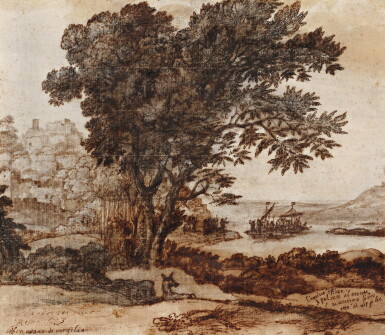
The arrival of Aeneas at Pallanteum, the site of Rome
signed, dated and inscribed in brown ink, recto: Claudio I.v fecit / Roma 1673 / libro ottavo di virgilio and l'arrivo d'Anea / a palante al monte / è a vantino libro / otto di virgilio
and inscribed, verso: Disigne facto per il principe Don Gasparo
pen and brown ink and brown and gray wash, over black chalk and traces of pencil, within brown ink framing lines
9 ⅜ by 10 ¾ in.
238 by 274 mm
Henry Brooks Adams (1838-1918), Boston, Massachusetts, (according to Collection of Pictures of the Late Henry Adams, unpublished, 1918, 'Claude Lorraine Landscape, #27, Lot #2, Value $400');
Thence by inheritance to his brother, Brooks Adams (1848-1927), Quincy, Massachusetts;
Thence by inheritance to his niece, Abigail Adams Homans (1879-1974), Boston, Massachusetts;
Thence by descent to her son and daughter-in-law, Professor and Mrs. George C. Homans, Cambridge, Massachusetts;
Anonymous sale, New York, Christie's, 27 January 2010, lot 137;
Where acquired by the present collector.
Washington, D.C., National Gallery of Art, and Paris, Grand Palais, Claude Lorrain: A tercentenary exhibition, 17 October 1982 - 2 January 1983, no. 67, and Paris, Grand Palais, 15 February - 16 May 1983;
Fogg Art Museum, Cambridge (TL 66.1975), on loan from 1975-2009
M. Roethlisberger, 'Additional works by Goffredo Wals and Claude Lorrain', The Burlington Magazine, CXXI, January, 1979, pp. 20-28, fig. 38;
L. Giles, A late composition drawing by Claude Lorrain, reconsidered, unpublished qualifying paper, Harvard University, 1981
This elegant, serene and highly finished drawing, dated 1673, is one of no fewer than thirteen – all except two of them in major museum collections – related to a painting of the same subject in the Fairhaven Collection at Anglesey Abbey, Cambridge (fig. 1). The canvas and its pendant, also at Anglesey Abbey, are among the most important and beautiful of Claude's late works, and are known as ‘the Altieri Claudes;’ The Arrival of Aeneas at Pallanteum, the Site of Rome was commissioned by Don Gasparo Altieri (1646-1720), an important Roman patron who married into one of the oldest families in Rome and whose identity was closely linked to the story of Aeneas, the mythological founder of the Eternal City.
After leaving the Altieri collection in 1799 the paintings were acquired by the great English writer, collector and politician, William Beckford (1760-1844), creator of the short-lived Gothick architectural masterpiece, Fonthill Abbey. In 1808 Richard Hart Davis, M.P. (1766-1842) acquired the paintings for 12,000 gns., at the time the highest price ever paid for paintings on canvas. They were later in the collection of Prince George, Duke of Kent (1902-1942) whose widow, Princess Marina, Duchess of Kent (1906-1968) sold them at auction in 1947.
The unusually large number of surviving drawings by Claude that relate to this quintessential composition attests to the significance of the commission, as does their variety of type and function: the thirteen sheets include figure studies, compositional sketches, both cursory and elaborately worked up, and ricordi. The painting was completed in 1675 as a pendant to Landscape with the Father of Psyche Sacrificing to Apollo, which had been executed in 1662 for Gasparo's father, Angelo Paluzzi degli Albertoni, marquess of Rosina (1623-1698). In 1667 Gasparo married the niece of Cardinal Emilio Altieri (1590-1676) who became Pope Clement X in 1670. As a result, Gasparo and his father both assumed the Altieri name and emphasized the family's connection to the myth of Aeneas, traditionally considered the founder of Rome. It seems that the early 1670s saw a period of exaltation of the Altieri family: in addition to Gasparo's commission of Claude's painting, the 1671 beatification of Ludovica Albertoni was commemorated in a tomb by Gian Lorenzo Bernini, completed in 1674-75.
Gasparo seems to have been deeply involved in the development of the painting, which is believed to have been commissioned from Claude as early as 1670. Altieri might even have suggested the subject, as the inscription on the verso of the present drawing suggests. Claude was clearly familiar with Virgil’s Aeneid, written in the first century B.C., and depicted scenes from the celebrated epic in no fewer than six paintings from the last decade of his career. For this image of the arrival of Aeneas at the site of Rome he clearly drew on a popular Italian translation by Annibale Caro, in which the subject of the painting and drawing is described in Book VIII, verses 88-126.1 There we read of the Mediterranean voyage of the Trojan Aeneas along the Tiber river. Upon his arrival at Latium he is initially greeted warmly by the Latins, but then they turn on Aeneas and his fleet, who seek refuge upstream at Pallanteum. Arriving there, Aeneas holds out an olive branch as a sign of peace to King Evander and his son, Pallas, with whom he then forms an alliance. In John Dryden’s 1697 translation we read:
But when they saw the ships that stemmed the flood,
And glittered through the covert of the wood,
They rose with fear and left the unfinished feast,
Till dauntless Pallas reassured the rest
To pay the rites. Himself without delay
A javelin seized, and singly took his way;
Then gained a rising ground, and called from far:
'Resolve me, strangers, whence and what you are;
Your business here; and bring you peace or war?'
High on the stern Aeneas took his stand,
And held a branch of olive in his hand.
The sheer number of drawings that Claude made in connection with this magnificent painting is more or less unparalleled within his oeuvre.2 The twelve others are of a wide range of types, varying from quick, loose preliminary sketches and studies of small figure groups to fully developed compositional studies and drawings made after the painting, including the one contained in the Liber Veritatis, the famous volumes of drawings after his own paintings that Claude compiled as a type of catalogue raisonné of his autograph paintings. Despite bearing a date of 1675, a loosely drawn study of the shoreline, now at the Courtauld Institute, London3, is considered an early study related to the painting, as is a quick pen and ink sketch in the Teyler Museum, Haarlem).4 Two drawings at the British Museum, one a more cursory composition than the other, depict the moment when Aeneas and his troops meet Evander, Pallas and their retinue.5 A drawing dated 1673, which Roethlisberger believes is a view, made from life, of the Aventine, seems to have been the real life basis for the idealized landscape in the finished composition.6
At the other end of the scale of completeness, there are, in addition to the present drawing, no fewer than seven fully developed compositional drawings – four made preceding the painting and three made after it. The ones made before the painting show just how fully realized the composition was at that stage, and yet Claude was still working out details such as the exact angle of the boat as it approaches the coastline, the architecture of the palace in the hills in the left background, and the density of the leaves of the trees in the foreground. A drawing in the Nationalmuseum, Stockholm and another at the Morgan Library (both dated 1672-73) significantly crop the foreground, thereby placing greater emphasis on Aeneas's arrival, his waving of the olive branch and the two boats that carry him and his troops.7 Two other drawings datable to 1673, also in Stockholm (one a replica of the other and in poor condition), extend the foreground landscape and animate it with a shepherd and his flock, reducing the size of the boats, which are moved further into the background.8
Three further drawings were made as ricordi, after the completion of the painting. The first, which is the very last drawing in the Liber Veritatis, is signed and dated 25 March 1675 (fig. 2).9 Another, a 1675 drawing in the Uffizi, is in fact closest in composition to the painting, while a third drawing dated 1677, at Windsor, was perhaps based on the Uffizi drawing rather than the painting.10
The present work was not known to Roethlisberger when he published his two-volume catalogue raisonné of Claude's drawings in 1968. He first published the drawing in The Burlington Magazine in 1979 (see Literature), where he hypothesized that it was made after the painting, perhaps upon the request of another patron. Laura Giles, however, in her unpublished qualifying paper, proposed that the drawing was in fact preparatory, and could even have been the modello submitted to Altieri for his approval.11 Giles’s hypothesis is very plausible, providing as it does an explanation for the important differences between this drawing and the painting. Though highly finished like the Liber Veritatis, Uffizi and Windsor drawings, it differs significantly both in its composition and in exactly how the subject is represented and interpreted. In the present drawing, unlike the painting, the landscape dominates, and the main narrative element - Aeneas's arrival – is relegated to the background. It is not hard to imagine that Altieri might have requested a change of emphasis, and a shift of focus onto the defining moment of the narrative: the founding of Rome, and by extension the importance of his own family. But whatever his reasons for doing so, what is clear is that Claude did significantly revise his composition, reducing the size of the monumental tree and increasing the size and prominence of the boat by moving it into the foreground.12
Like the two related drawings in Stockholm, this exceptional sheet is consistent with the artist's working method of creating, well before his painting was executed, a highly finished drawing, either as a presentation modello or as a working drawing for his own reference. Yet the drawing is also a supremely beautiful and successful work in its own right, a definitive example of Claude’s elegiac mastery both of the landscape genre and of narrative and atmosphere. As a landscape, the contrast between the superbly imposing tree that occupies much of the centre of the composition and the harmonious meanderings of the more delicately rendered river and forested hills behind is especially satisfying. These elements are offset, in turn, by the calm riverbank in the foreground, on which rests a solitary deer, a hint of unspoiled landscape that powerfully evokes the sense of discovery of Aeneas's journey. Compared with the final painting, the narrative in the drawing is subtler, yet also more captivating; here Claude uses, with singular genius, the poetry of landscape to tell the fundamental origin story of Roman civilization.
This drawing is first recorded in the collection of Henry Brooks Adams (1838-1918), a writer and historian whose great-grandfather and grandfather, John Adams (1735-1826) and John Quincy Adams (1767-1848), were, respectively, the second and the sixth Presidents of the United States of America. It is not known where Adams acquired the drawing or if his ancestors acquired it before him, but it is very possible that this was the first drawing by Claude to enter an American collection. Henry Adams travelled extensively in Europe, beginning in 1858, and from 1861 he was in London, where he served for seven years as private secretary to his father, Charles Francis Adams, Sr., who was U.S. Ambassador to Great Britain. His niece, Abigail Adams Homans (1879-1974), who later inherited the drawing, wrote about Henry and his brother Brooks Adams (1848-1927) in her memoir, Education by Uncles (1966): describing Henry's house in Washington, D.C. as filled with bookcases '....and above were some of his collection of pictures, which were scattered everywhere all over the house. In his study were many drawings...’
1 M. Kitson, 'The 'Altieri Claudes' and Virgil,' The Burlington Magazine, 102, no. 688, July 1960, p. 312
2 M. Roethlisberger, Claude Lorrain: The drawings, Berkeley 1968, nos. 1062r, 1075, 1077-86
3 inv. D.1978.PG.215; Roethlisberger, op. cit., no. 1079
4 Ibid., no. 1062r
5 Ibid., nos. 1075, 1078
6 Ibid., no. 1082
7 Ibid., nos. 1078, 1077
8 Ibid., nos.1080, 1081
9 Ibid., no. 1084
10 Ibid., no. 1086
11 Giles, op. cit., p. 23
12 Ibid., pp. 21-24
You May Also Like