Jean-Baptiste-Camille Corot
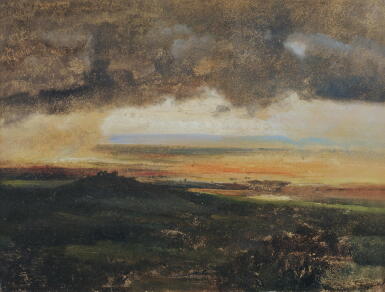
Vue d'un orage sur Rocca di Papa
Estimate
80,000 - 120,000 USD
Lot Details
Description
Jean-Baptiste-Camille Corot
Paris 1796 - Ville d'Avray 1875
Vue d'un orage sur Rocca di Papa
oil on paper, laid on canvas
8 ¾ by 11 ½ in.
22.2 by 29.2 cm
Executed circa 1828.
We would like to thank Martin Dieterle and Claire Lebeau for kindly confirming the authenticity of this lot which will be included in their forthcoming sixth supplement to the catalogue raisonné by Alfred Robaut.
French private collection;
With Galerie Sanct Lucas, Vienna;
Where acquired by a private collector in 2016;
By whom sold, Sotheby’s, New York, 26 January 2023, lot 140;
Where acquired by the present collector.
When Corot arrived in Rome in December 1825, he encountered the same landscape that had drawn generations of artists before him. From lodgings near the Piazza di Spagna, he painted the city’s rooftops and monuments, explored its ancient ruins from countless vantage points, and ventured into the surrounding Campagna, where the light and expansive landscape offered a striking contrast to the forests and fields of northern France. It was in Italy that Corot first embraced painting directly from nature, laying the foundations for the plein-air practice that would define his early career.
Painted during his first Italian sojourn, probably around 1828, the present work depicts Rocca di Papa in the Alban Hills, southeast of Rome. Monte Cavo, crowned by the medieval monastery of Santa Maria di Monte Cavo, provides a recognizable point of reference. Executed with the fluid, economical brushwork that Martin Dieterle has aptly described as “drawing in oil,” the present work is a consummate example of Corot’s earliest plein -air studies. Thrashes of blue, orange, and charcoal gray sweep across the horizon, while backlit clouds hover ominously above the dark silhouette of the rolling hills in the foreground.
Rather than documenting a specific view, Corot sought to record the shifting effects of light and weather across the Roman landscape, and form is established less through descriptive detail than through carefully calibrated tonal relationships. The passing storm becomes the true subject of the composition, transforming a familiar panorama into a study of atmosphere and tone. It is precisely this freshness of execution, together with its remarkable sensitivity to light and atmosphere, that makes Corot’s Italian studies feel so strikingly modern. In isolating the essential visual relationships of color, tone, and structure, they anticipate concerns that would occupy landscape painters for decades to come.
We are grateful to Martin Dieterle and Claire Lebeau for confirming the authenticity of this work.
You May Also Like