
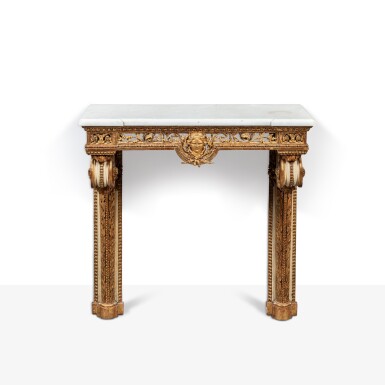
A Louis XVI lacquer and giltwood console d'applique, circa 1780-1785, in the manner of the Rousseau brothers and Richard Mique
Lot closes
June 25, 09:25 AM GMT
Estimate
7,000 - 10,000 EUR
Starting Bid
6,000 EUR
We may charge or debit your saved payment method subject to the terms set out in our Conditions of Business for Buyers.
Read more.Lot Details
Description
in the Neoclassical style, finely carved, the frieze with an open work of acanthus leaves frieze, pearls frieze and a mascaron with scrolling foliages and roses, the mounts with scrolling motifs with rows of pearls and acanthus leaves, with a white marble top
Haut. 84 cm, larg. 83,5 cm, prof. 33 cm ; Height 33 in, width 32 ¾ in, depth 13 in
Related literature :
P. Arizzoli-Clémentel, Le Mobilier de Versailles, XVIIe et XVIIIe siècles, Dijon, 2002, part. II, no 84, p. 239.
J.-B. Corne, « L’appartement de Madame Adélaïde de 1769 à 1789. Histoire d’un appartement princier », Versalia, no 18, 2015, pp. 79-102.
By its architectural character, the quality of its carving, and the singularity of its decoration, this console may have been conceived for one of the royal residences, as part of works carried out under the administration of the Bâtiments du Roi. Its ornamental vocabulary closely links it to the décors created by Richard Mique and the brothers Jules‑Hugues and Jean‑Siméon Rousseau for the apartments of the royal family during the final years of the reign of Louis XVI.
The shallow depth of the piece, its strictly frontal composition, and the structure of its supports indicate that it was intended to be fixed to the wall and probably integrated into a set of paneling. Its decoration combines small naturalistic leaves, fully opened roses, beaded friezes, tied laurel branches, and a female figure in the antique manner. This encounter between Antiquity and nature is one of the defining features of the décors developed by Mique and the Rousseau brothers from the late 1770s onward.
These ornaments can be found in the Cabinet de la Méridienne of Marie‑Antoinette at Versailles, fitted out in 1781 under the direction of Richard Mique. The Rousseau brothers carved rose stems, garlands, small leaves, and symbolic motifs whose design was echoed in the bronzes by Pierre Gouthière and in the furniture. The Cabinet doré, remodeled in 1784 by Mique and the Rousseau brothers, bears witness to the same taste for an antique repertoire softened by particularly delicate floral carving.
The most significant comparison is provided by the console executed around 1780 for the chambre des bains of Madame Adélaïde at Versailles. Stamped by Georges Jacob, it was made after a drawing by the Rousseau brothers, now preserved at the Château de Versailles under number MV 8066. The room itself had been redesigned by Mique. This console displays, like ours, a highly architectural structure and a decoration combining flower garlands, acanthus leaves, an openwork rosette, and a beaded frieze. It attests to the collaboration of Mique, the Rousseau brothers, and Georges Jacob in the creation of a décor intended for a royal apartment.
The present console may also be compared to the pair preserved at the Metropolitan Museum of Art in New York, dated around 1775–1780 (inv. 07.225.184 a and b, gift of J. Pierpont Morgan, 1906). Of comparable proportions, these consoles were likewise designed to be applied against a wall. The Metropolitan Museum classifies them among the works of menuisiers en bâtiments, craftsmen responsible for the fixed elements of an interior, notably paneling, mirror frames, and consoles.
This distinction is important for understanding the possible absence of the present console from the royal inventories. Movable furniture—such as commodes, seats, or screens—was delivered and inventoried by the Garde‑Meuble de la Couronne. Consoles designed in harmony with the paneling, however, could fall directly under the administration of the Bâtiments du Roi. They therefore received neither a Garde‑Meuble number nor necessarily a residence mark.
The case of Madame Adélaïde’s console is particularly enlightening in this respect. Although executed for Versailles by Georges Jacob after a drawing by the Rousseau brothers, it bears no royal number. Its provenance was re‑established thanks to its correspondence with drawing MV 8066 and with the décor of the chambre des bains. The disappearance or transformation of many royal apartments explains why other consoles of this type have lost their original context and are now difficult to identify.
No document currently allows the present console to be linked to a specific apartment. However, its architectural nature, the quality of its execution, and the concordance of its decoration with the works of Richard Mique and the Rousseau brothers strongly support the hypothesis of a commission for one of the royal residences, issued not by the Garde‑Meuble de la Couronne but by the administration of the Bâtiments du Roi.
Related works :
- Georges Jacob and the Rousseau brothers, Console for the chambre des bains of Madame Adélaïde at Versailles, c. 1780, Château de Versailles, inv. V 5264.
- Rousseau brothers’ workshop, Design for a table for the chambre des bains of Madame Adélaïde, Château de Versailles, inv. MV 8066.
- Richard Mique and the Rousseau brothers, Paneling of the Cabinet de la Méridienne of Marie‑Antoinette, Versailles, 1781.
- Pair of wall consoles
You May Also Like


