
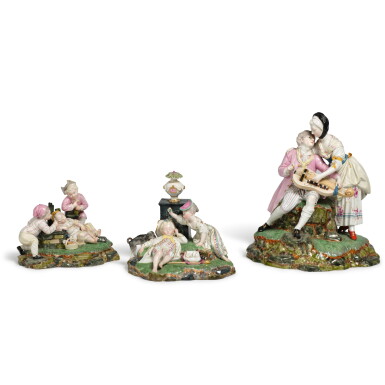
Two Höchst porcelain figure groups of children, ‘Der gestörte Schlummer’ and the ‘Der bekränzte Schläfer’, and a large Höchst porcelain figure group of musicians, circa 1770
Estimate
3,000 - 5,000 EUR
We may charge or debit your saved payment method subject to the terms set out in our Conditions of Business for Buyers.
Read more.Lot Details
Description
modelled by J. P. Melchior, ‘The Disturbed Slumber’, with a sleeping girl with her toys in basket before her, being awoken by a boy kneeling beside her, looked on by another boy leaning on a gate, ‘The Wreathed Sleeper’, with a sleeping boy lying before a plinth surmounted by a vase and accompanied by a dog, his companion leaning to place a garland on his head, the musician group modelled with a couple, he seated on rockwork holding a hurdy-gurdy, she standing to his side, her arm around his shoulders, all on grassy rockwork bases, wheel mark in underglaze-blue to all three, the first incised MS N48 M66, the second incised MC, the third with purple enamel mark
(3)
Height of first group 15.5 cm; 6 ⅛ in
Height of second group 17.5 cm; 6 ⅞ in
Height of third group 28.5 cm; 11 ¼ in
Frankfurt am Main, Jahrhunderhalle Hoechst, Höchster Porzellan des 18. Jahrhunderts aus Privatbesitz, 9 December 1984 - 9 January 1985 (the musician group, exhibition label applied to base).
Horst Reber, Höchster Porzellan des 18. Jahrhunderts aus Privatbesitz, exh. cat., Frankfurt am Main, 1984-85, p. 118 (the musician group).
An example of the group known as ‘Der gestӧrte Schlummer’ or ‘The Disturbed Slumber’ is illustrated by Patricia Stahl, Höchster Porzellan 1746-1796, Katalog zur Ausstellung Höchster Porzellan, Heidelberg, 1994, p. 260, cat. No. 6.9.6, where the author notes that the subject is based on a painting by François Boucher, widely known through various engravings. Here the theme is adapted by Melchior with children replacing the shepherd and shepherdess and the composition rendered in reverse. The group is first mentioned in the factory records around 1770 and is also recorded in the inventory list of the sales magazine in 1773.
You May Also Like


