
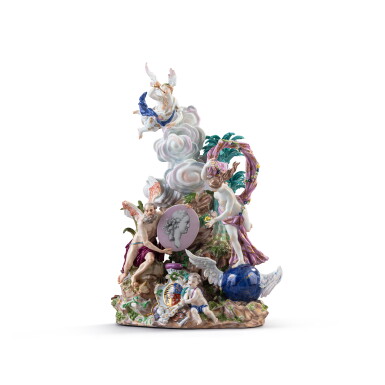
A Meissen porcelain large figural centerpiece group, 'The Glorification of The Electorate of Saxony', circa 1766
Estimate
4,000 - 6,000 EUR
We may charge or debit your saved payment method subject to the terms set out in our Conditions of Business for Buyers.
Read more.Lot Details
Description
formed of four sections, modelled by J.J. Kändler, with figural allegories of Time, Fortune and Fame, Chronos holding a pink-ground oval medallion painted en grisaille with the portrait Maria Josepha of Austria, Fortune to one side, standing on a winged globe, holding a flower in her left hand, winged Fame above, blowing a trumpet and supported on a column of clouds, the centre of the rocky base applied with the crowned Electoral Saxon coat of arms with electoral cap, a putto to one side, and attributes of the fine arts and astronomy below, crossed swords and dot mark in underglaze-blue
Height 35.3 cm; 14 ⅞ in
Dorotheum, Vienna, 26 April 2018, lot 900;
Acquired at the above sale.
This complex figure group, titled the ‘Glorification of the Electorate of Saxony’ was created by Johann Joachim Kändler between December 1765 and February 1766 and unlike other known examples which depict August III, Elector of Saxony, research suggests it presents a portrait of his wife, Maria Josepha of Austria (1699–1757), Queen of Poland, Grand Duchess of Lithuania, and Electress of Saxony. Maria Josepha Benedikta Antonia Theresia Xaveria Philippine of Austria, heiress presumptive to the Habsburg monarchy from 1711 to 1717, was Archduchess of Austria, the eldest child and eldest daughter of Joseph I, Holy Roman Emperor and his wife, Princess Wilhelmina Amalia of Brunswick-Lüneburg. Through her marriage to Frederick Augustus II (later III), she became Electress of Saxony and Queen of Poland in 1733.
The coat of arms displays a variation of the Electorate of Saxony's coat of arms as it was used from the early 17th century onwards. The coat of arms: Main shield, quartered: Field 1: Duchy of Saxony; divided nine times by black and gold, above a green bend sinister wreath. Field 2: Landgraviate of Thuringia; in blue, a lion rampant crowned and armed gold, divided seven times by silver and red. Field 3: Duchy of Jülich; in gold, a lion rampant black, armed silver. Field 4: Duchy of Cleves: in red, with a silver escutcheon, a gold wheel of glebe. Inescutcheon: in a field divided black and silver, two swords in saltire red, the electoral swords symbol of the office of Archmarshal (Archimareschallus), which was granted to the Elector of Saxony in 1356 by the Golden Bull. Above the shield, the electoral cap of the Holy Roman Empire.
You May Also Like


