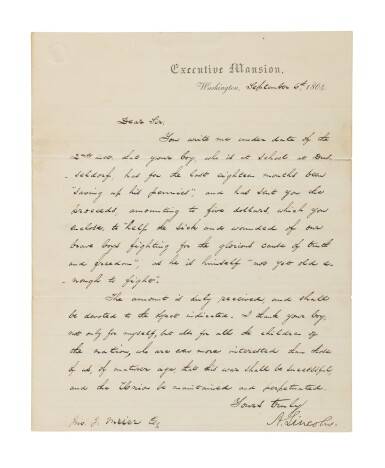
View full screen - View  of Lincoln, Abraham | The President thanks a schoolboy on behalf of "all the children of the nation for his efforts to ensure "that this war shall be successful, and the Union be maintained and perpetuated.".

Property from the Collection of Elsie and Philip Sang

Lincoln, Abraham | The President thanks a schoolboy on behalf of "all the children of the nation for his efforts to ensure "that this war shall be successful, and the Union be maintained and perpetuated."

Estimate

200,000 - 300,000 USD

Lot Details

Description

Lincoln, Abraham

Manuscript letter signed ("A. Lincoln") as sixteenth President, one page (250 x 200 mm) on a bifolium of blue-ruled Executive Mansion letterhead, Washington, D.C., 6 September 1864, to John J. Muir of Brooklyn, thanking Muir's son for his contribution to the Union cause, body of the letter in the hand of presidential secretary Edward D. Neill, docketed on the verso, "To Mothers brother."


Despite being a wartime president, Abraham Lincoln was remarkably accessible, and more than most nineteenth-century presidents, he was inundated by letters, requests, and petitions from his constituents. Most of this incoming correspondence— averaging between 250 and 500 letters a day— was dealt with summarily by his small office staff (principally John G. Nicolay and John Hay) or sent on to an appropriate federal agency or department for response. In the introduction to Dear Mr. Lincoln: Letters to the President (Addison-Wesley, 1993), Harold Holzer described Lincoln’s mailbag as swollen “to nearly unmanageable proportions … with demands for favors, … a mind-numbing avalanche of requests for jobs, … pleas for pardons, requests for autographs, requests for passes through the lines, ideas on prosecuting the war, advice on political matters, pleas for private meetings, and letters accompanying gifts of all value and sizes, … compliments and criticism of the President, and of nearly all the cabinet and military officers he had appointed, … the inevitable ravings of seers, soothsayers, and mystics, and threats both violent and profane” (pp. 5, 32–33).


Nicolay later recalled that Lincoln probably saw only one out of every one hundred letters sent to him, although Hay remembered the ratio as closer to one out of every fifty. But occasionally a letter would elicit a personal response from the overtaxed President. Most often these were requests for a contribution of an autograph or relic for sale in support of the Sanitary Commission.


But in the midst of Lincoln’s 1864 reelection campaign against George B. McClellan, the former commander of the Union Army, a letter from an immigrant in Brooklyn, dated September 2, reached Nicolay’s desk and then was brought to the attention of the President. The author of the letter, John J. Muir, proudly explained that three generations of his family supported Lincoln in his determination to end slavery and preserve the Union. Muir also made reference to the Reverend Henry Ward Beecher’s fiercely antislavery Plymouth Church, which served as a station on the Underground Railroad and where Lincoln himself twice worshipped.


"I take the liberty to enclose to your care Five dollars, being the proceeds of some German currency, sent to me by my only child, James B Muir, for the last eighteen months at school in Düsseldorf.


"He writes me that he has been 'saving up his pennies' in order that he might 'help the sick and wounded of our brave boys, fighting for the glorious cause of truth and freedom' as he is 'not yet old enough to fight.'


"Will you respected Sir accept my 'Boys offering' even tho’ small, and may I ask of you the great favour of one word of acknowledgement, in his behalf, it will tend to encourage our true hearted Girls & Boys in our Sunday Schools, and especially of the Plymouth Church SS (Mr Beechers) of which my Boy was a member, we need in these times of fearful trial, to use every legitimate means to inculcate and energize the doctrine of a true 'God fearing patriotism' and especially among our rising youth throughout the land.


"Permit me to add one word. My Father died here at the age of 86 praying for the blessing of Heaven upon yourself and our beloved adopted Country, he was one of the earliest signers of the first petition that was presented to the British Parliament praying for the abolition of the Slave trade.


"We are Scotch and have lived in this blessed land over 30 years and our 'Clan' of relatives will muster our 50 votes, loyal and true for your honoured name, the coming election, as they did on the previous one, and some of them have sealed their title to the 'good cause' in many a hard fought field during the last three years.


"And now may the God of Abraham Isaac & Jacob be your support & comfort and everlasting succor. And may an eventual 'peace' be the 'work of righteousness,' in 'quietness and assurance forever.'"


Muir signed his letter as Lincoln’s “prayerful wellwisher and obt. Servant.” Before passing the letter onto Lincoln, Nicolay summarized its contents in a note on the back of the second page: “Jno. J. Meier, Brooklyn, N.Y. Sep 2, 64, Sends $5, the savings of his son, at school in Dusseldorf to be used [sic] for the soldiers. Wants the President to send his son a little note.”


Lincoln was famously indulgent of all children (including his own), and this letter from James Muir’s father must have especially appealed to him as it shared his own view that in the prosecution of the War, the preservation of the Union and the elimination of slavery were two sides of a single coin. With Nicolay’s assistance, Lincoln drafted a reply, which extensively quoted the boy’s original letter to his father. Another of the President’s personal secretaries, Edward D. Neill, then neatly copied the text onto a sheet of engraved Executive Mansion letterhead for Lincoln’s signature, and the reply was sent to Muir, senior, on September 6:


"You write me under date of the 2nd inst. that your boy, who is at school at Dusseldorf, has for the last eighteen months been 'saving up his pennies,' and has sent you the proceeds, amounting to five dollars, which you enclose, to 'help the sick and wounded of our brave boys fighting for the glorious cause of truth and freedom,' as he is himself 'not yet old enough to fight.'


"The amount is duly received, and shall be devoted to the object indicated. I thank your boy, not only for myself, but also for all the children of the nation, who are even more interested than those of us, of maturer age, that this war shall be successful, and the Union be maintained and perpetuated."


Since James Muir already had several older relatives in the Union Army, his father must have been particularly grateful to receive Lincoln’s letter of thanks with its clear implication that he hoped the War would be successfully concluded before James and others of the nation’s youth would have to take up arms.


Lincoln’s letter reached John Muir at 51 Columbia Street in Brooklyn, as demonstrated by a later familial pencil note on the back: “To Mothers brother.” But the Muir family evidently guarded the letter so carefully that it completely vanished from sight. It might otherwise be as famous as Lincoln’s celebrated reply to Mrs. Horace Mann regarding the “Little Peoples’ Petition,” which was distributed throughout the North in facsimile reproductions earlier in 1864.


Muir’s letter to Lincoln survives among the Abraham Lincoln Papers at the Library of Congress, and it was even included (with a number of errors in transcription) in Dear Mr. Lincoln: Letters to the President, compiled and edited by Harold Holzer, pp. 219–220. Holzer perpetuated Nicolay's misreading of Muir's name as Meier, perhaps influenced by the ostensibly Scot James Muir being at school in Düsseldorf. James's mother, however, was the former Caroline von Benckendorff, who was was born in Russia into a prominent German diplomatic family.


The text of Lincoln’s reply has been known because the draft is also a part of the Papers at the Library of Congress, but while The Collected Works of Abraham Lincoln edited by Roy Basler (vol. 7: 538-39) assumed that Lincoln had signed and sent a final version of the letter, that had not previously been confirmed.