
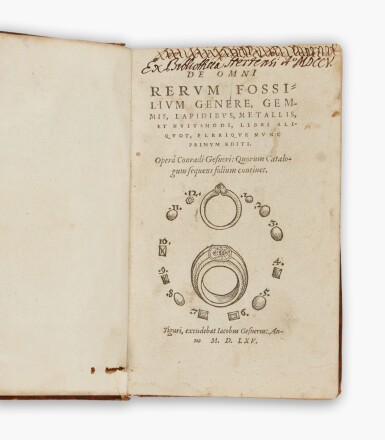
Gesner, Conrad | The first significantly illustrated work on fossils
No reserve
Lot closes
December 12, 08:25 PM GMT
Estimate
2,000 - 3,000 USD
Current Bid
1,000 USD
8 Bids
No reserve
We may charge or debit your saved payment method subject to the terms set out in our Conditions of Business for Buyers.
Read more.Lot Details
Description
Gesner, Conrad
De omni rerum fossilium genere, gemmis, lapidibus, metallis, et huiusmodi, libri aliquot [Io. Kentmani, Georgji Fabricj, Severini, Goebelij, Valerij Cordi, S. Epiphanij Episcopi Cypri, Francisci Ruei] plerique nunc primum editi. Zurich: J. Gesner, 1565
8 parts in one volume, 8vo (154 x 95 mm). Each part with separate title, with the blank leaf I8 without blank M8). Woodcut vignette on title, and several woodcuts in text of fossils, minerals, gems, and assaying apparatus; tear crossing text on a3, generally a clean and fresh copy. Contemporary calf; some wear to extremities.
First edition of the first significantly illustrated work on fossils. Gesner, a Swiss polymath whose interests in natural history were more focused on botany and zoology, also studied mineralogy. This work was the last to be published in his lifetime. This book of multiple parts is also distinguished by the first appearance of a catalogue of a mineral collection, that of Johannes Kentmann, "stated to have been the first man in Europe to make a collection of minerals." His catalogue contains entries for sixteen hundred specimens, making it a "conspectus of most of the minerals known at that time, with the localities from which they were derived as well as an exact equivalent in German of the various names by which they were known in Latin" (Adams, Birth).
Its eight separate treatises are the work of seven authors, all edited and with a general introduction and commentary by Gesner. His own De rerum fossilium, the final work, is the earliest scientific attempt to classify the members of the mineral kingdom, based on the forms of the fossils. It is illustrated by numerous woodcuts after Gesner’s own drawings, many of which are still preserved in the Basel University Library. According to Adams, this contains the earliest illustration of a lead pencil. There is also an illustration of the Mariner’s Compass made from magnetic iron ore.
REFERENCES
Adams, Birth and Development of the Geological Sciences, p. 176-83; Milestones of Science, p. 10; Hoover 347
PROVENANCE
Duke of Arenberg (Nordkirchen bookplate)
You May Also Like

![[Catalog — Natural History] | Catalogue d’un Très Beau Cabinet d’Histoire Naturelle](https://dam.sothebys.com/dam/image/lot/d7a8d868-2bc3-4198-adfb-a3277912d841/primary/extra_small)


