
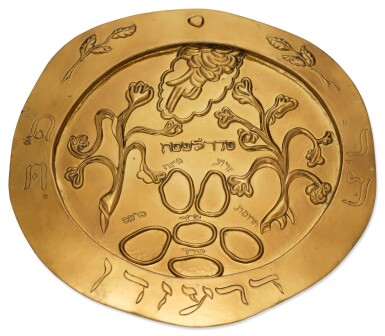
A German Brass Modernist Seder Plate, designed by Rahel Ruth Sinasohn, made by Max Otto Leopold Mache, Hellerau (Dresden), 1922-23
Estimate
6,000 - 8,000 USD
Lot Details
Description
circular, the rim with stalks of wheat and Hebrew inscription "Dresden 1922-23", the center with stylized plant motifs and the Hand of God, labeled Passover Seder above irregular compartments for the elements of the Seder, marked underneath rim with engraved monogram and stamped MM J 15
Diameter 12 7/8
32.7 cm
Hannah-Lea Wasserfuhr, "Craft or Art? A New York Seder Plate and the rediscovery of Rahel Ruth Sinasohn," Mimeo: Blog of the doctoral students at the Dubnow Institute, April 22, 2004, https://mimeo.dubnow.de/handwerk-oder-kunst/ .
Rahel Ruth Sinasohn, (née Cohn, 1891-1969) was a German avant-garde designer who specialized in ritual objects made of textile, glass, porcelain, and metal. She participated in various exhibitions, including one titled "Artistic Creation of Jewish Women." The brass pieces to her design were fabricated by a metalsmith outside of Dresden.
Married to Max Mordechai Sinasohn, a neo-Orthodox rabbi, in 1924, she commissioned the architect Harry Rosenthal to create an exhibition and sales space in the family apartment in Berlin.
Hannah-Lea Wasserfurh quotes a critic at the 1924 exhibition: "The young artist shows us new paths, excluding everything tasteless, everything inauthentic, everything spurious material from our Jewish ritual and ornamental objects," and notes, "Sinasohn belonged to a larger group of artists and craftspeople who, following Martin Buber's proclamation of a 'Jewish Renaissance' in 1901, consciously turned to the genre of ritual objects in order to liberate them from the mass-produced goods rejected at that time as inferior and "inauthentic," and to offer the Jewish bourgeoisie during the Weimar Republic an artistically designed alternative."
Sinasohn fled with her husband and one of her daughters to Belgium in 1942 and went into hiding. In 1947, the family emigrated to what would become Israel the following year.
Works by her were included in the exhibition Defiance: Jewish Women and Design in the Modern Era at the Jewish Museum Berlin, (11 July to 23 November 2025), including a Seder plate of this design from the museum's permanent collection.
You May Also Like


