
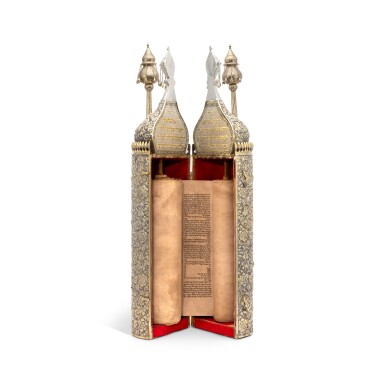
A Chinese Parcel-Gilt Silver Torah Scroll Case, Dated 1892
Estimate
40,000 - 80,000 USD
Lot Details
Description
cylindrical , the surface chased with white silver peonies and foliage within gilt borders, line of gilt buds at the top below dome chased with gilt peonies highlighted with engraving, against darkened ground, central finial with chased bands and hung with pendants, the interior with chased plaques with Hebrew inscriptions within blue enamel ground floral borders, lined in red velvet paper with older printed textile lining visible beneath at edges, with two chased Torah Finials with chased foliage scrolls, marked on front gilt borders with Chinese characters; fitted with a Torah Scroll
height overall 37 3/8 in.
95 cm
The inscription records that this tik and the sefer Torah were dedicated by Aaron Abraham Hardoon in memory of his son Saul, 5652 [1892].
The names listed were likely the father and younger brother of Silas Aaron Hardoon (1851-1931), who died the richest foreigner in Shanghai. He was born into a poor Baghdadi Jewish family that moved to Bombay, where Silas was educated at a school funded by David Sassoon. He moved to Shanghai in 1868 to work for D. Sassoon & Co., set up on his own in 1882, but left that to become branch manager for Elias Sassoon & Co. in 1885. He made a fortune in real estate, even being considered at one time the richest person in Asia. His father, Aharon Abraham Hardoon, was observant enough that Silas built the Beth Aharon Synagogue in Shanghai in his memory in 1927.
A private family website notes Saul Shaul Aaron Hardoon was born in 1854, three years after Silas Aaron. In 1885, a “Certificate of Naturalization” was issued to “Saul Hardoon, an alien, now residing at 8 Jasmine Grover, Anerley [South London]… a subject of His Majesty the Sultan of Turkey – of the age of thirty-one years – a clerk with Mess. Sassoon & Co. of 12 Leadenhall Street E.C. – unmarried.” Saul Aaron Hardoon died 7 February 1891 in London.
Adrien von Ferscht notes that Hone Wo was a retail silversmith on Tai Ping Shan [Victoria Peak], Hong Kong, active between c. 1845 and 1925.
You May Also Like


