
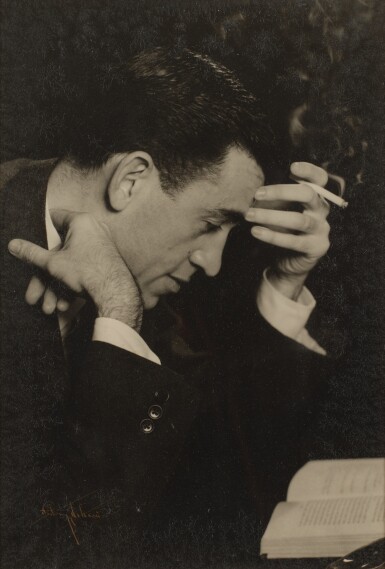
Salinger, J.D. | The Graham Family archive, including autographed letters, an inscribed Catcher, a rare studio photograph of the author, and more
Lot closes
December 16, 04:05 PM GMT
Estimate
120,000 - 180,000 USD
Starting Bid
100,000 USD
We may charge or debit your saved payment method subject to the terms set out in our Conditions of Business for Buyers.
Read more.Lot Details
Description
Salinger, J.D.
The Graham Family archive, 1951-1989
4 letters (1 ALS and 3 TLS), all signed (“Jerry”), addressed to Mrs. Esther Graham or to Mr. J. Graham, with original mailing envelopes, 1953-1989; a signed and inscribed first edition of The Catcher in the Rye, 1951; a partial The Catcher in the Rye dust jacket, signed by the illustrator E. Michael Mitchell on the same date as the aforementioned first edition, 1951; a rare portrait photograph of Salinger, signed by the photographer Antony di Gesu and presented by Bett Graham to her niece, Pamela, 1952; all items either given or sent to members of the Graham family, documenting their longstanding and, until now, little known friendship with Salinger.
In 1949, Salinger met a Canadian couple, Beth (“Bett”) Graham and Michael Mitchell, in Westport, CT, where he was living while finishing his groundbreaking novel, The Catcher in the Rye. The Mitchells had a house nearby and, though it is unclear how exactly they were introduced, they soon became close friends. Salinger would write in their guest house and then read recently written passages from Catcher to the married couple. Michael, a successful magazine illustrator, was asked to design the book’s dust jacket. His striking image of a red carousel horse remains one of the most iconic dust jackets ever created. Even Salinger, notorious for despising his books’ cover art, loved the design.
After moving to Cornish, NH, Salinger continued to correspond with the Mitchells, and he occasionally visited them in New York or London. In one of Salinger’s letters to Michael, now at the Morgan Library, he informed the couple that he has “never had two dearer friends,” and refers to their “tri-cornered” friendship (Cowan, Alison Leigh. “Unsealed Letters Offer Glimpse of Salinger. New York Times. February 11, 2010). Bett Graham and Michael Mitchell divorced sometime in the 1960s. From then on, Salinger stayed in touch with them both separately.
It is abundantly clear from this archive that the author had a special appreciation for his friendship with the Graham family, especially for Bett and her mother Esther, who he affectionately refers to as “Mother Graham.” Through these unexpectedly warm and revealing letters, spanning nearly forty years, Salinger shows his humor, introspection, and humanity — aspects of his personality which he oftentimes kept hidden.
The archive contains:
1) Autograph letter signed “Jerry” to “Dear Mrs. Graham.” Windsor, VT: November 15, 1953
One-page letter (196 x 156 mm), in black ink; old horizontal fold. With postmarked autograph envelope.
A short but sympathetic letter where Salinger sends his condolences to Esther soon after the passing of her husband, William. Salinger calls him “the gentlest and best kind of human being.”
2) Typed letter signed “Jerry” to “Dear Mrs. Graham.” Windsor, VT: June 16, 1959
Two-page letter typewritten on one side of a single folded sheet (210 x 271 mm), signed in black ink; old folds, very faint toning along the top edge at center. With postmarked typed envelope.
An affable, funny letter from Salinger to Esther Graham, where he discusses Bett and Michael’s recent move to London. He expresses his sadness at not seeing his friends more often, and his desire to go visit them so that they can “all go see the Queen together.” Salinger mentions his grueling work schedule and laments his lonely automat lunches. He goes on to thank Esther for the clipping she sent him and says that the thought of her brother reading his fiction in Glasgow cheers him up. Near the end of the letter, Salinger mentions his 4-year-old daughter, Peggy. He wishes that she could meet Esther and bemoans the fact that his daughter never gets to see Bett and Mike.
3) Typed letter signed “Jerry” to “Dear Mother Graham.” Windsor, VT: March 3, 1971
One-page letter (270 x 210 mm), typed, signed in black ink; old folds. With postmarked typed envelope.
Salinger recounts his recent trip to London where he saw Bett, who is now divorced from Michael. He mentions some of their amusing adventures together, including “the police-station stuff and the mixup at Battersea Park,” and praises Bett’s new apartment, her tiny car, and her friends. He goes on to discuss Michael and how, a little while back, he didn’t see him due to a bout of hypoglycemia. Salinger explains that he has been feeling much better recently, “like the gifted sportsman and Oujia player you knew in Westport.” He then updates Esther on his children, who he feels are happy and doing well.
4) Typed letter signed “Jerry” to “Dear J.” Cornish, NH: November 19, 1989
One page letter (270 x 210 mm) to James Graham, typed, signed in black ink; old folds. With postmarked typed envelope.
In this heartfelt, yet somber letter, Salinger responds to news of the death of his friend Bett Graham. He writes back to her brother, James, and begins by saying that his memory isn’t what it used to be, before recounting a series of detailed memories. First, he remembers exactly who James is, despite having never met him. He goes on to eulogize Bett, praising her kindness, intelligence, and wit. With his characteristic acerbity, Salinger expresses disdain for the word “compassion,” which he finds overly sentimental. However, he admits that, when referring to Bett, he can make an exception for the word. After a brief digression to discuss Mike, who had already phoned him with the news, he responds to a remark that he thought was disparaging to Bett — a reference to her supposedly turbulent life. He vigorously defends her against this characterization, recalling her selflessness, and imagining her at a kitchen sink washing other people’s dirty dishes — “gloomy thoughts,” he adds. Salinger ends the letter by thanking James for being there with Bett during her last days, and he sends his love to the rest of the Graham family. He signs the letter “Jerry,” before adding “(Salinger)” in typescript.
5) J.D. Salinger. The Catcher in The Rye. Boston: Little, Brown and Company, 1951
8vo (195 x 127 mm). First edition, third printing, inscribed “To Esther and Willie Graham, / with love, / Jerry” and dated September 5, 1951, in blue ink on the front free endpaper; old smudge to the word “Willie” in the inscription. Publisher’s cloth; lacking dust jacket, a few minor spots of rubbing and wear to the extremities, spine title a bit dulled, a slight lean, front hinge cracked.
6) A partial The Catcher in the Rye dust jacket, signed and inscribed by the illustrator E. Michael Mitchell, “To Mother / and Father Graham / with love” and dated September 5, 1951 on the rear flap in light blue ink, the jacket from a Book-of-the-Month Club edition; front cover missing, front flap detached, some creasing, staining, and fraying along edges.
7) Antony Di Gesu. Portrait Photograph of J.D. Salinger reading The Catcher in the Rye. November 20, 1952
Silver gelatin print (216 x 317 mm), double matted and framed. Signed and dated by Di Gesu in gold ink in lower left corner, additionally inscribed in pencil on the frame’s verso, “To: Pamela from Aunt Beth / a portrait of an old friend Nov. 1989.”
A studio portrait photograph of Salinger reading from The Catcher in the Rye while smoking a cigarette. This is from one of only two known studio sessions that the author sat for. This print was presumably gifted by Salinger to Bett Graham, who then gave it to her niece shortly before her death in 1989.
Anthony di Gesu, the photographer, is known for his celebrity portraits, including Norman Mailer, Truman Capote, Irving Berlin, Margaret Mead, and Jonas Salk. He wrote about Salinger’s visit in his unpublished memoir:
“On the 20th of November, 1952, J.D. Salinger (author of Catcher in the Rye) came to the studio and said he wanted a portrait of himself for his mother and his fiancée. Since I didn’t [know] as much then as I do now, I set up the camera and light and sat him right down. His expression was so rigid and self-conscious [that] I was at my wits end. Nothing happened. I decided on something I had never done before with an adult. I excused myself, went up to my apartment and came down with ‘Catcher in the Rye.’ I brought him a table and ashtray, set down the book (why the hell didn’t I ask him to autograph it?) and suggested he do anything he pleased. Read to himself. Read aloud or just smoke.
“If I’d thought he was going to be so damned famous, I’d have written down everything we talked about to get the expression we did. I took 48 5 x 7 negatives. Serious, thoughtful, smiling, laughing, howling with laughter. White shirt, white background. Black suit, black background. But I don’t remember a thing.
“He was pleased with the results, but asked me not to show the portraits publicly. When I asked why, he said when people recognized him, they usually behaved peculiarly because they thought he would write about them. I promised I wouldn’t and I kept that promise for thirty years.”
(Anthony di Gesu. From his unpublished memoir. https://sandiegohistory.org/collection/photographs/digesu2/)
For a book inscribed by Salinger to Bett Graham, The Complete Novels of Jane Austen, see following lot.
You May Also Like


![Complete Cycle of Haftarot (Prophetic Readings), [Spain, 14th century]](https://dam.sothebys.com/dam/image/lot/21c5a5f1-1a12-40c9-a8f1-ff1c55cb81fa/primary/extra_small)


