
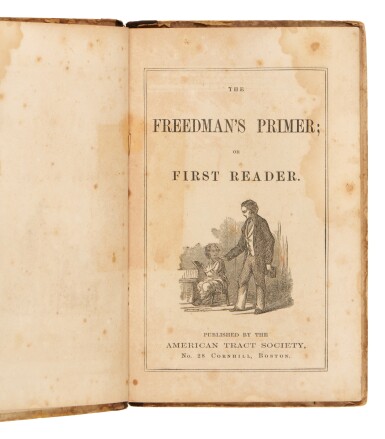
"The Freedman's Primer" | The unique surviving copy of an 1864 primer specifically designed for the use of formerly enslaved persons
Lot closes
December 16, 03:17 PM GMT
Estimate
25,000 - 50,000 USD
Starting Bid
18,000 USD
We may charge or debit your saved payment method subject to the terms set out in our Conditions of Business for Buyers.
Read more.Lot Details
Description
The Freedman’s Primer; or First Reader. Boston: Published by the American Tract Society, (1864)
8vo (160 x 105 mm). 45 wood-engraved illustrations, decorative initials, and vignettes; some light browning and staining throughout. Publisher’s cloth-backed printed boards; rubbed and stained, cloth spine very worn.
Evidently the only surviving copy of an 1864 primer specifically designed for the use of formerly enslaved persons, published in the year between the issuing of the Emancipation Proclamation and the ratification of the Thirteenth Amendment.
This is the sole surviving copy of the first edition of The Freedman’s Primer—a testament to its popularity and utility. Typical of similar pedagogic publications of its day, the Primer provides several alphabets, as well as lessons in phonics, arithmetic, and cursive writing. The poems and stories included stress moral and spiritual development, and the texts include the Ten Commandments and the Lord’s Prayer.
But the Primer is atypical of similar nineteenth-century publications in its illustrations, which prominently, but not exclusively, feature black children. Of the 45 wood-engravings in the book, seven include black children and in two of these, the black children are depicted in the company of white children.
The sincere tenor of the publication, which from a contemporary perspective might seem paternalistic, is conveyed in the caption to a nearly full-page illustration on the verso of the title-page, which depicts a man speaking to a group of white girls as he sits with his arm around a black girl: “‘You say Patsy is black; but she can not help that; and it is only the color of the skin, after all. Has she not a soul, just as you have? Can she not learn to read and sing like you? Did not Jesus die for her, and does he not love her as well as you?’” More interesting, perhaps, is a little story on pages 42–43, which is illustrated by an image of two boys looking at a store sign. Although one boy is white and the other is black, the text does not differentiate them by their color; rather, they are identified to the reader by their headwear: one has a cap and the other has a hat.
This primer remained in print throughout much of Reconstruction, but by 1866 it had been renamed The Lincoln Primer.
You May Also Like


