
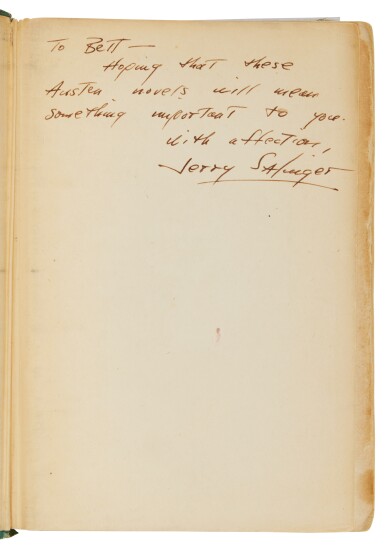
(Salinger, J.D.) — Jane Austen | Inscribed copy of Austen’s Complete Novels, given to his close friend Bett Graham
Lot closes
December 16, 04:06 PM GMT
Estimate
25,000 - 35,000 USD
Starting Bid
20,000 USD
We may charge or debit your saved payment method subject to the terms set out in our Conditions of Business for Buyers.
Read more.Lot Details
Description
(Salinger, J.D.) — Jane Austen
The Complete Novels of Jane Austen. New York: The Modern Library, [1940]
8vo (195 x 130 mm). Second Modern Library edition. Signed and inscribed by Salinger in ink on the front free endpaper, “To Bett / hoping that these Austen novels will mean something important to you. / With affection, / Jerry Salinger;” the contents with occasional light toning and soiling, a small loss to the lower corner of the title page, the front free endpaper and half title are separated from the text block but still attached to the upper board. Publisher’s green cloth boards, with Modern Library logo; wear to boards, the spine missing, the front hinge cracked, the upper board holding to the linen cloth “cords,” a well-read copy. Housed in a custom clamshell case.
A presentation copy of The Complete Novels of Jane Austen, one of J.D. Salinger’s favorite reads, gifted to his longtime friend Bett Graham. Though the inscription is undated, he may have given it to Bett soon after her separation from Michael Mitchell to provide some much-needed entertainment, consolation, or inspiration from one of Austen’s strong-willed heroines.
Salinger was a voracious reader throughout his life – he had a rotating bookcase next to his bed where he kept his favorite books within arm’s reach morning and night (the bookcase and its contents were exhibited at the New York Public Library in 2019). One of his favorite authors was undoubtedly Jane Austen. It is interesting to note that, though their lives were separated by over a century, Austen and Salinger both wrote coming of age novels whose protagonists search for a way to live authentically in conventional adult society, a society that they perceive as inherently hypocritical. Both authors regularly use satire to criticize this hypocrisy or, as Holden would call it, “phoniness.”
In addition to this connection, Salinger mentions Jane Austen at least three times in his short stories – first in “Uncle Wiggily in Connecticut” (The New Yorker, March 20, 1948, and then twice in “Hapworth 16, 1924,” (The New Yorker, June 19, 1965). In “Uncle Wiggily,” his unhappily married protagonist, Eloise, is asked by an old friend why she married her husband. Eloise replies, "He told me he loved Jane Austen. He told me her books meant a great deal to him. That's exactly what he said. I found out after we were married that he hadn't even read one of her books."
Hapworth, takes the form of a long letter sent from summer camp by seven-year-old, Seymour Glass, to his parents. At one point, the precocious child describes Miss Overman, an old-fashioned librarian,– “In her heart of hearts, she would zestfully live out her remaining years as a charming, intimate neighbor of Elizabeth and Jane Bennett, continually being approached by those equally delicious heroines of Pride and Predjudice for sensible and worldly advice.” Later on, while listing books that he would like Ms. Overman to send him, along with Cervantes, Tolstoy, Dickens, and De Balzac, is a plea for, “Jane Austen, in entirety or in any shape or form, discounting Pride and Prejudice, which is already in possession. I will not disturb this incomparable girl’s genius with dubious remarks; I have already hurt [the librarian] Miss Overman’s feelings inexcusably by refusing to discuss this girl, but I lack even the slight decency to regret it very much. Quite in a pinch, I would be willing to meet someone at Rosings, but I cannot enter into a discussion of a womanly genius this humourous, magnificent, and personal to me; I have made some feeble, human attempts, but nothing at all meritorious.”
While inscribed copies of Salinger’s own books come up with some regularity, this is the first time that another author’s novel with an inscription by Salinger has been offered at auction. It provides a revealing glimpse into Salinger’s personal relationships and literary tastes, calling attention to certain oftentimes overlooked aspect in his biography – his friendships with women and his longstanding appreciation of Jane Austen. For an archive of letters, a rare studio photograph, and more, all given to Bett and members of her family, see previous lot.
RFERENCES
Sanford, Jaclyn M. "The Bildungsroman and the Theme of Authenticity in Jane Austen’s Emma and J.D. Salinger’s The Catcher in the Rye." Master's thesis, Harvard University, 2019
You May Also Like


![Darwin and Wallace | On the Tendency of Species to form Varieties... , [contained in:] Journal of the Proceedings of the Linnean Society, Vol. III, No. 9., 1858, Darwin announces the theory of natural selection](https://dam.sothebys.com/dam/image/lot/30891576-117d-4943-b2fa-a8ad164ee5f7/primary/extra_small)

![[Austen, Jane] | A handsome first edition of Sense and Sensibility, the author's first novel](https://dam.sothebys.com/dam/image/lot/46156b5d-366c-4a91-9f4c-de385091375e/primary/extra_small)


