
Property of the Southborough Historical Society
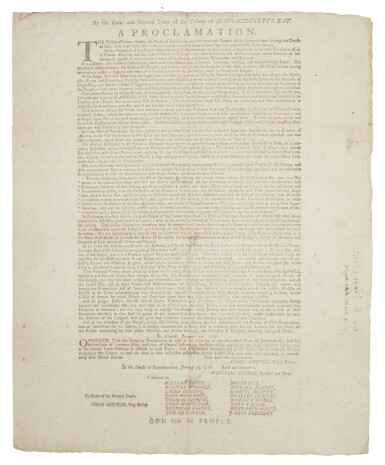
Massachusetts General Court | A powerful precursor to the Declaration of Independence: "every Act of Government … without the Consent of the People, is … Tyranny "
Lot closes
December 16, 03:34 PM GMT
Estimate
40,000 - 60,000 USD
Starting Bid
28,000 USD
We may charge or debit your saved payment method subject to the terms set out in our Conditions of Business for Buyers.
Read more.Lot Details
Description
Massachusetts General Court
By the Great and General Court of the Colony of Massachusett’s-Bay. A Proclamation. The Frailty of human Nature, the Wants of Individuals, and the numerous Dangers which surround them, through the Course of Life, have in all Ages, and in every Country, impell’d them to form Societies, and establish Governments. As the Happiness of the People is the sole end of Government, so the Consent of the People is the only Foundation of it, in Reason, Morality, and the Natural Fitness of Things: And therefore every Act of Government, every exercise of Sovreignty, against, or without the Consent of the People, is Injustice, Usurpation and Tyranny … God Save the People. [Watertown: Printed by Benjamin Edes, 1776]
Letterpress broadside (434 x 352 mm) on a sheet of laid paper preserving deckle on three margins, contemporary endorsement on verso, “For the Town Clerk In Southborough”; some separation at central vertical fold neatly reinforced on verso and just touching a few letters.
The spark that lit the fuse of independence — an extraordinary 1776 broadside proclamation by John Adams, which would lay the philosophical groundwork for the preamble of the Declaration of Independence.
"The Administration of Great Britain, despising equally the Justice, Humanity, and Magnanimity of their Ancestors; and the Rights, Liberties and Courage of AMERICANS, have, for a Course of Years, laboured to establish a Sovereignty inAmerica, not founded in the Consent of the People ... " A significant and early proclamation issued by Massachusetts, that vanguard of rebellion against the British Crown.
The document contains all the axiomatic concepts of government then circulating among the colonies by way of polemical pamphlets and books such as Rousseau's Social Contract, Paine's Common Sense, and Jefferson's Summary View of the Rights of British America. The proclamation declares that sovereign power resided with the people; that officials of government existed for the common good and security of the people; and that when any government had violated its trust, the majority of the community had the right to resist and rebel against it.
Much of the language would later find its clarion voice within the Declaration of Independence, which heralded the American Revolution: "As the Happiness of the People is the sole End of Government, so the Consent of the People is the only Foundation of it … And therefore every Act of Government, every Exercise of Sovereignty, against, or without, the Consent of the People, is Injustice, Usurpation, and Tyranny. … When Kings, Ministers, Governors, or Legislators therefore, instead of exercising the Powers intrusted with them … prostitute those Powers … to destroy … the Lives, Liberties, and Properties of the People;—they are no longer to be deemed Magistrates vested with a sacred Character but become public Enemies, and ought to be resisted."
The proclamation not only lists grievances, but also sets forth a philosophical statement deeply rooted within the precepts of its colonial Charter. When Thomas Gage presided as military governor of Massachusetts between 1774 and 1775, he forced members of the colonial council to resign or take refuge with him in Boston. He cancelled the autumn elections to the General Court, and the towns claiming this to be illegal, elected representatives to a Provincial Congress, which became the revolutionary government of the colony. The January 1776 proclamation reiterates the call for an independently elected government that does not recognize the sovereignty of Parliament or officials appointed by the Crown and Parliament until the terms and spirit of its Charter are respected and restored: "That no Obedience being due to the Act of Parliament for altering the Charter of the Colony of Massachusetts-Bay, nor to a Governor or Lieutenant Governor, who will not observe the Directions of, but endeavour to subvert that Charter … and Inconveniences arising from the Suspension of the Powers of Government, are intolerable, especially at a Time when General Gage hath actually levied War, and is carrying on Hostilities against his Majesty's peaceable and loyal Subjects … that, in order to conform as near as may be to the Spirit and Substance of the Charter, it be recommended to the Provincial Convention, to Letters to the Inhabitants of the several Places … intitled to Representation in Assembly, requesting them to chuse such Representatives; and that the Assembly when chosen, do elect Counsellors; and that such Assembly and Council, exercise the Powers of Government, until a Governor of his Majesty's Appointment will consent to govern the Colony, according to it's Charter." The proclamation boldly concludes with "God save the People" rather than "God Save the King."
This proclamation was adopted by the Council of the Massachusetts General Court on 19 January 1776, less than six months before the Continental Congress passed the Declaration of Independence, and it is signed in type by seventeen members of the General Court. The text proper is followed by a Resolution of the Massachusetts House of Representatives, 23 January, ordering “That the foregoing Proclamation be read at the opening of every Superiour Court of Judicature, &c., Inferiour Court of Common Pleas, and Court of General Sessions for the Peace within this Colony, by their respective Clerks; and at the annual town meetings in March, in each Town. And it is hereby recommended to the several Ministers of the Gospel, throughout this Colony, to read the same in their respective Assemblies on the Lord's Day next after their receiving it, immediately after Devine Service.” This resolution is signed in type by William Cooper, Speaker pro Tem. of the House.
REFERENCES
ESTC W36775; Evans 14839; Ford, Massachusetts Broadsides 1973; Lowance & Bumgardner, Massachusetts Broadsides of the American Revolution 27; cf. P. Maier, American Scripture: Making the Declaration of Independence (1997)
You May Also Like

![Complete Cycle of Haftarot (Prophetic Readings), [Spain, 14th century]](https://dam.sothebys.com/dam/image/lot/21c5a5f1-1a12-40c9-a8f1-ff1c55cb81fa/primary/extra_small)


![Grotesques, 20 etchings; Davent, landscape prints; Pencz, Triumphs of Petrarca, and others [16th century], vellum](https://dam.sothebys.com/dam/image/lot/8550040d-141d-40f4-9dfc-4ef4e0864844/primary/extra_small)


