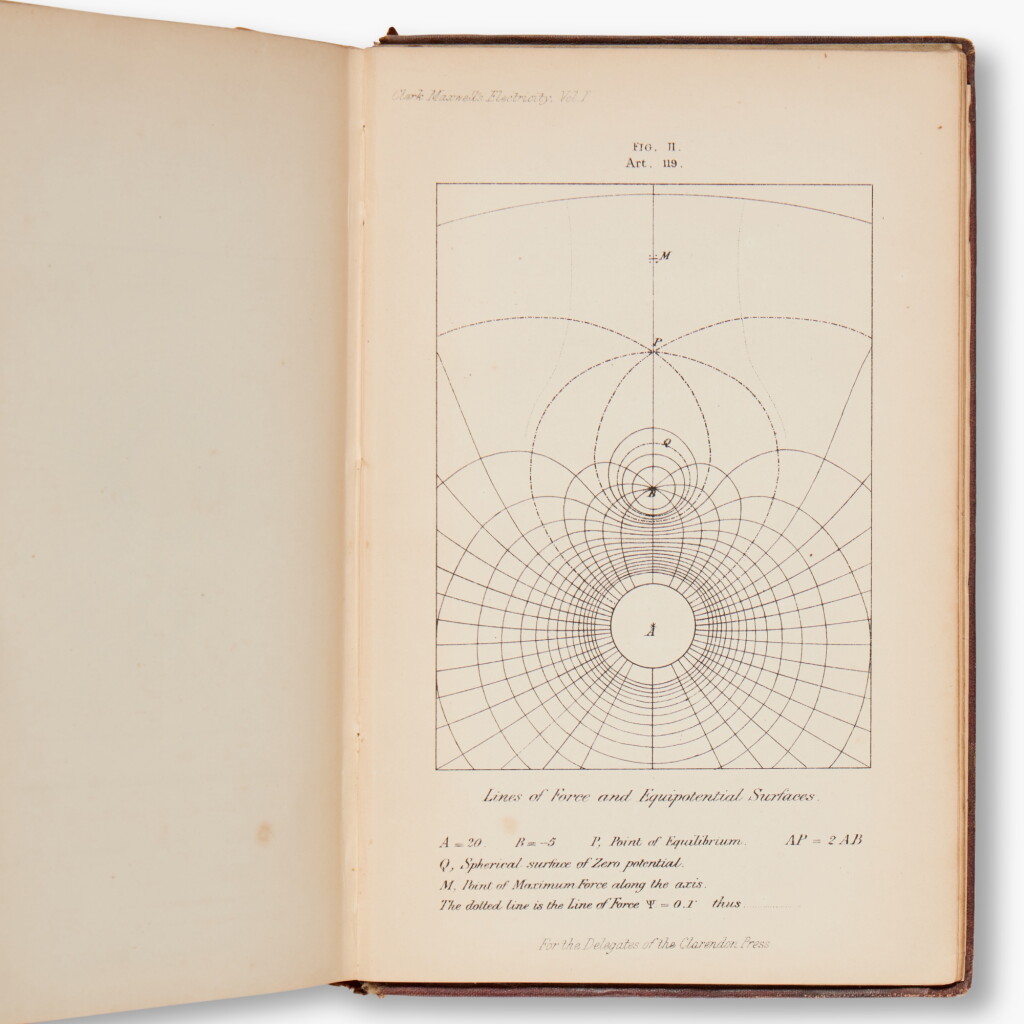
Maxwell, James Clerk | A Treatise on Electricity and Magnetism, Oxford, 1873, first edition, original cloth
Live auction begins on:
October 20, 02:00 PM GMT
Estimate
10,000 - 15,000 USD
Bid
9,000 USD
Lot Details
Description
Maxwell, James Clerk
A Treatise on Electricity and Magnetism. Oxford: The Clarendon Press, 1873
First edition of Maxwell's most important text, given as an academic prize to James Alfred Ewing.
Maxwell's Treatise put forth his foundational electromagnetic theory of light, which paved the way for countless future discoveries in the field of physics. It particularly influenced Einstein's theory of relativity—Einstein himself wrote in 1931 that Maxwell's "change in the conception of reality is the most profound and the most fruitful that physics has experienced since Newton" (Einstein).
Maxwell "began the investigation of moving frames of reference, which in Einstein's hands were to revolutionize physics; gave proofs of the existence of electromagnetic waves that paved the way for Hertz's discovery of radio waves; worked out connections between the electrical and optical qualities of bodies that would lead to modern solid-state physics; and applied Tait's quaternion formulae to the field equations, out of which Heaviside and Gibbs would develop vector analysis" (Norman).
A fine association copy, awarded to James Alfred Ewing in the year of publication. Ewing was eighteen in 1873, an engineering student at Edinburgh under Fleeming Jenkin and Peter Guthrie Tait, two of the men in Britain who stood closest to Maxwell personally and intellectually, and the book was presented to him by Jenkin as first prize in the Class of Engineering for the winter session of 1872–73 (the printed presentation slip, accomplished and signed by Jenkin, is loosely inserted). Jenkin had worked alongside Maxwell on the British Association Committee on Electrical Standards since 1862 and was editing its collected Reports in this same year, so the Treatise was chosen for the prize by a man who had seen the work behind it. Ewing read it as a working text: pencil annotations in a single contemporary hand clarify Maxwell's sign conventions, verify the derivation of the electrostatic pressure, and at Art. 400, where Maxwell defines magnetic induction, cross-reference the equations of magnetization and sketch induction as lines through a section. Loosely inserted is a folded sheet (one side ruled), pencil and ink, of calculations apparently in the same hand as the marginalia, computing the electrodynamometer couple from Maxwell's series for coaxial coils; undated, after 1881 on the evidence of its units.
Maxwell's treatment of magnetization in Part III rests on the theory of the Göttingen physicist Wilhelm Weber (1804–1891), who held that a piece of iron consists of permanently magnetized molecules which an applied field turns into alignment, and on a largely static account of induction and residual magnetism built on that footing; the phenomenon that most conspicuously escaped this account was the lag of magnetization behind the applied field, which Ewing identified experimentally in Tokyo, named "hysteresis" in his 1881 paper to the Royal Society, and worked into a molecular theory of magnetism that consciously extended Weber's and Maxwell's premises to explain what they had left open. His Magnetic Induction in Iron and Other Metals (1891) became the standard treatise on the ground Maxwell had staked out but not fully surveyed, and on the very quantity he had paused to annotate here. The dated ownership signature places the book at the start of the one career that most directly carried Maxwell's magnetic theory forward, in the year of issue, before Maxwell's death in 1879 and before Ewing had published anything. Association copies of the Treatise with contemporary scientific provenance are rare in commerce; one awarded to the discoverer of hysteresis by Maxwell's own collaborator, while he was still a student of Maxwell's closest colleagues, is of great historical importance.
2 volumes, 8vo (223 x 142 mm). Numerous plates, textual diagrams, errata slip in vol.1. Original cloth; worn, vol. 1 chipped at head with partial loss of title, spines sunned.
REFERENCES
Einstein, "Maxwell's Influence on the Development of the Conception of Physical Reality," 1931; Norman 1466
PROVENANCE
James Alfred Ewing (1855–1935, Scottish physicist and engineer, best known for his work on the magnetic properties of metals and, in particular, for his discovery of, and coinage of the word, hysteresis; inserted award slip, ownership signatures dated 1873 on both half-titles, his occasional penciled marginalia, inserted leaf of calculations) — Robert S. Dunham (his 1970 acquisition inscription; Sotheby's New York, 11 December 1993, lot 665 [part, not mentioning the Ewing provenance])

![Darwin and Wallace | On the Tendency of Species to form Varieties ... [1858–1859], in: Journal of the Proceedings of the Linnean Society, Vol. III, No. 9., 1859, Darwin announces the theory of natural selection](https://sothebys-md.brightspotcdn.com/dims4/default/0ae5d5e/2147483647/strip/true/crop/2000x2000+0+0/resize/150x150!/quality/90/?url=http%3A%2F%2Fsothebys-brightspot.s3.amazonaws.com%2Fmedia-desk%2Fwebnative%2Fimages%2F18%2F98%2Fd0ba6d9f4fada55611b512c2635f%2Fn12451-bkh45-t1-01.jpg)

![Kepler, Johannes | Harmonices Mundi Libri V, Linz, 1619, first edition, [bound with:] Prodomus dissertationum cosmographicum …, Frankfurt, 1621–1622](https://sothebys-md.brightspotcdn.com/dims4/default/d54d010/2147483647/strip/true/crop/2000x2000+0+0/resize/150x150!/quality/90/?url=http%3A%2F%2Fsothebys-brightspot.s3.amazonaws.com%2Fmedia-desk%2Fwebnative%2Fimages%2F63%2F0b%2Fa27794664ee78085e15afe3c5535%2Fn12451-58tmv-t1-05.jpg)