
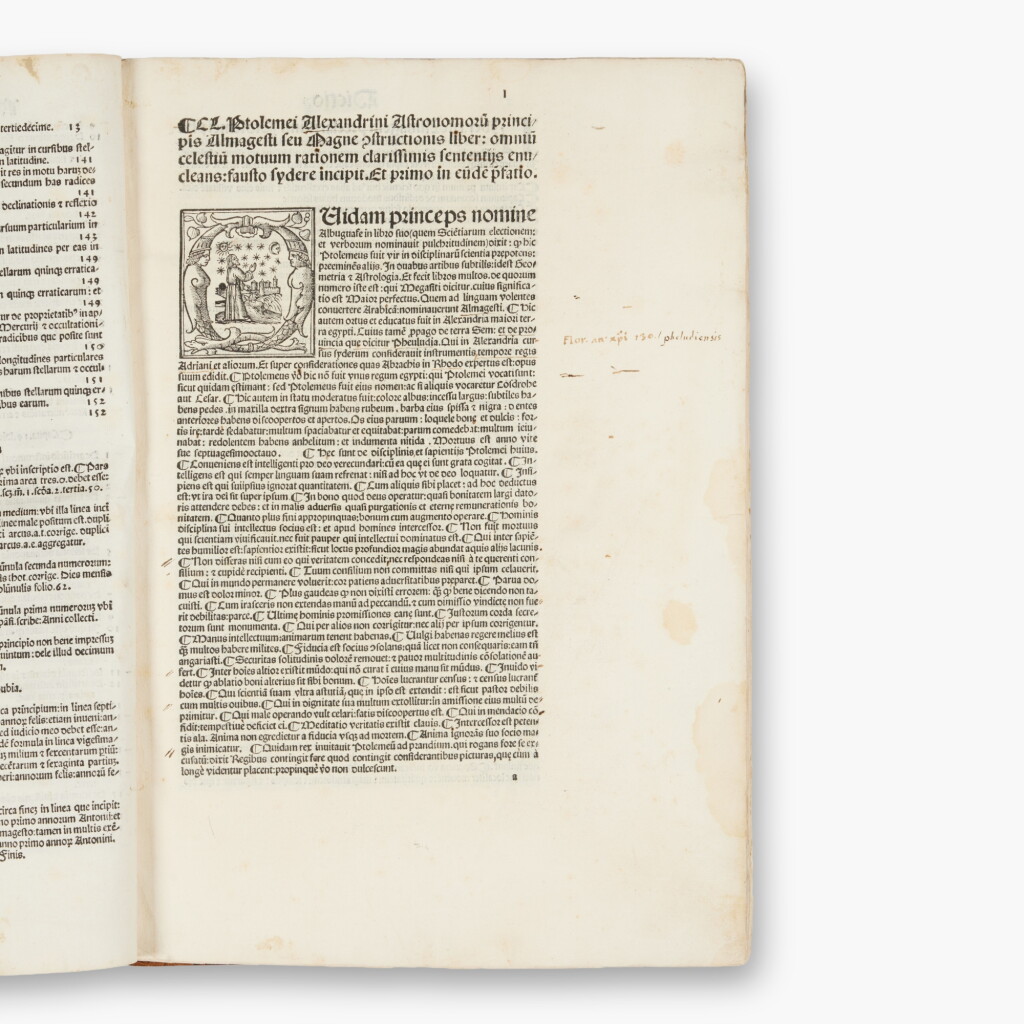
Ptolemaeus, Claudius | Almagestum, Venice, 1515, first complete edition
Live auction begins on:
October 20, 02:00 PM GMT
Estimate
40,000 - 60,000 USD
Bid
35,000 USD
Lot Details
Description
Ptolemaeus, Claudius
Almagestum. Venice: Petrus Liechtenstein, 1515
First complete printed edition of Ptolemy’s great synthesis of ancient mathematical astronomy, and the first appearance in print of his complete catalogue of the stars.
Composed at Alexandria in the second century, the Almagest brought the astronomical knowledge of antiquity into a single systematic and computational framework. Although Ptolemy drew extensively upon Hipparchus and other earlier astronomers, the work is not merely a compilation: its organization, mathematical demonstrations, and much of its planetary theory represent a substantial original achievement. Across thirteen books Ptolemy established the mathematical principles of spherical astronomy; treated the motions of the Sun and Moon, parallax, eclipses, and the dimensions and distances of the luminaries; described the fixed stars; and constructed geometrical models for the five known planets. By means of eccentrics, deferents, epicycles, and the equant, he created a system capable of calculating and predicting the apparent motions of the heavens with remarkable effectiveness.
Books VII and VIII contain Ptolemy’s celebrated catalogue of more than a thousand stars, arranged according to the forty-eight classical constellations and recorded by position and magnitude. The oldest comprehensive star catalogue to survive from antiquity, it had circulated for centuries in Greek, Arabic, and Latin manuscripts, but appears here in print for the first time. Its positional data remained the principal basis for European celestial cartography until the end of the sixteenth century. More broadly, the Almagest established astronomy as a rigorously mathematical discipline in which geometrical theory was measured against observation and used to predict future celestial phenomena. For more than a millennium it remained the indispensable advanced textbook of astronomy in the Byzantine, Islamic, and Latin worlds. G. J. Toomer in Dictionary of Scientific Biography describes it as “a masterpiece of clarity and method, superior to any ancient scientific textbook and with few peers from any period.”
The work’s familiar title records the history of its transmission: Ptolemy called it the Mathēmatikē Syntaxis, or “Mathematical Compilation”; it subsequently became known in Greek as the Megistē Syntaxis, the “Greatest Compilation.” The Arabic form, al-Majisṭī, passed into medieval Latin as Almagestum. Its preservation and eventual recovery in western Europe depended heavily upon the scientific culture of the Islamic world, where the text was translated, studied, criticized, and revised from the ninth century onward.
The present edition prints the twelfth-century Latin translation of Gerard of Cremona, made at Toledo from Arabic and certainly in existence by 1175. Stillwell, following the scholarship then available, described the text as a translation made in 1175 from the Arabic version prepared by al-Ḥajjāj about 829. More recent research has established that 1175 is the date recorded in a surviving manuscript copy, rather than necessarily the year in which Gerard completed his translation, and that Gerard drew upon both the Arabic version of al-Ḥajjāj and that of Isḥāq ibn Ḥunayn, as revised by Thābit ibn Qurra. The present printing preserves a text in which the two principal classes of Gerard’s Latin translation are themselves combined.
An important abridgement and critical reworking of the Almagest, begun by Georg Peurbach and completed by Johannes Regiomontanus, had appeared at Venice in 1496. That Epitoma became one of the most influential astronomical books of the Renaissance, but it did not reproduce Ptolemy’s complete text. Liechtenstein’s edition was the first to place all thirteen books of the Almagest before readers in print; the Greek editio princeps would not appear until the Basel edition of 1538. Published less than three decades before Copernicus’s De revolutionibus, the volume stands at the meeting point of the medieval Arabic-Latin astronomical tradition and the Renaissance reform of astronomy. Copernicus rejected the immobility of the Earth, but he continued to work within many of the mathematical methods and problems that Ptolemy had defined.
Folio (305 × 222 mm). 152 leaves. Collation: *² a–z⁶ A⁶ B⁸. Gothic types; numerous woodcut astronomical and geometrical diagrams and tables, many printed in the margins; woodcut initials; Liechtenstein’s armillary-sphere device printed in red and black on the verso of the final leaf; marginal soiling and staining, occasional light browning, leaves z3 and z4 misbound, fore-edge loss to z6 repaired, terminal leaf somewhat defective, stained and mended. Tree-calf-patterned paper over boards; front cover detached, wear.
REFERENCES
Adams P2213; EDIT16 CNCE 35583; Honeyman sale 6:2550; Houzeau & Lancaster 865; Stillwell, Science 97.
PROVENANCE
Robert S. Dunham (acquired from Heller in 1950; Sotheby's New York, 10 December 1993, lot 750)
You May Also Like





![Kepler, Johannes | Harmonices Mundi Libri V, Linz, 1619, first edition, [bound with:] Prodomus dissertationum cosmographicum …, Frankfurt, 1621–1622](https://sothebys-md.brightspotcdn.com/dims4/default/d54d010/2147483647/strip/true/crop/2000x2000+0+0/resize/150x150!/quality/90/?url=http%3A%2F%2Fsothebys-brightspot.s3.amazonaws.com%2Fmedia-desk%2Fwebnative%2Fimages%2F63%2F0b%2Fa27794664ee78085e15afe3c5535%2Fn12451-58tmv-t1-05.jpg)

