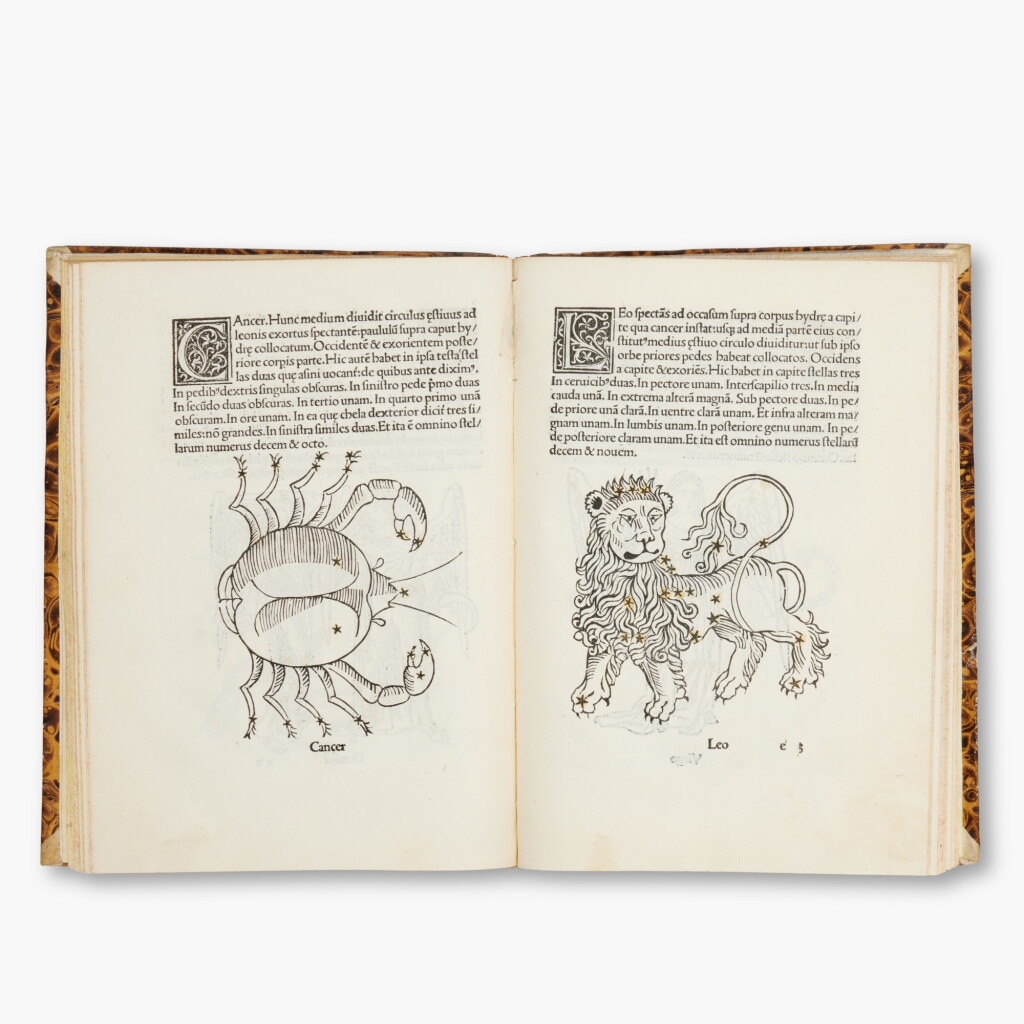
Hyginus, Gaius Julius | Poetica astronomica, Venice, 1485, ed. Sentinus and Santritter
Live auction begins on:
October 20, 02:00 PM GMT
Estimate
10,000 - 15,000 USD
Bid
9,000 USD
Lot Details
Description
Hyginus, Gaius Julius
Poetica astronomica (ed. Jacobus Sentinus and Johannes Lucilius Santritter). Venice: Erhard Ratdolt, 22 January 1485
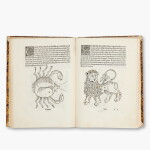
Third edition, the second illustrated, of this second-century handbook describing forty-seven Ptolemaic constellations and the Greek and Roman mythology surrounding them. The woodcuts are the first printed illustrations of the allegorical figures of the constellations and planets. They were used by Ratdolt in his first edition of the Poetica (Venice, 1482, Goff H560) and again in his 27 November 1488 Augsburg printing of Johannes Angeli, Astrolabium (Goff A711). The woodcut of Sphaera Mundi appears for the first time in this edition. A beautiful, crisp copy, with the stars in the constellation figures heightened in yellow.
A foundational illustrated book of astronomy. The Poeticon astronomicon combines elementary cosmology with the mythology, forms, and component stars of the classical constellations. Its four books proceed from the structure and circles of the celestial sphere to the stories attached to the constellations, the disposition of their stars, and the movements of the sun, moon, and planets. The identity of the author remains uncertain: the work was traditionally assigned to Gaius Julius Hyginus, librarian to Augustus, but the attribution is no longer regarded as secure.
The text first appeared at Ferrara in 1475 without printed illustrations, although spaces were left for their addition by hand. Ratdolt’s 1482 edition introduced the first printed cycle of the classical constellation and planetary figures. The stars are marked directly upon the bodies and attributes of the gods, heroes, animals, and objects represented, creating an immediate correspondence between Hyginus’s descriptions and their pictorial forms. These are constellation figures rather than a geometrically coherent chart of the sky; their larger importance lies in translating a variable manuscript tradition into a fixed and reproducible visual canon.
The designs have traditionally been associated with Johannes Lucilius Santritter, one of the edition’s two editors and possibly the adviser or artist responsible for the cycle. Recent scholarship has shown, however, that their unusual iconography owes more to the constellation imagery transmitted with Michael Scot’s Liber introductorius than to any surviving illustrated manuscript of Hyginus. The resulting figures are vigorous, occasionally eccentric hybrids of classical subject matter and late-medieval visual convention.
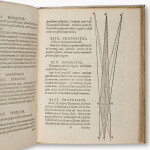
For the present edition Ratdolt reset the text in longer lines and reused the blocks of 1482 with several notable alterations: a diagram of the celestial sphere was added on a1v; a new image of the Milky Way was introduced after Book II; the block for Scorpius was replaced by a reversed version; and Saturn was turned through ninety degrees. Once established in print, the series was repeatedly copied, adapted, and reused by printers in Venice, Augsburg, and Paris, becoming the dominant model for astronomical book illustration for approximately the next forty years.
4to (203 × 153 mm). Full-page diagram of the celestial sphere on verso of first leaf, 47 woodcuts illustrations of constellations, zodiac signs and allegories of the planets, including the Milky Way, the stars heightened in yellow, numerous 3- to 11-line white-on-black floriated initials; constellation with early manuscript identification of the zodiacal signs and with small internal repaired wormhole, pale dampstaining in the upper margin of the final quire, small paper defects at the lower outer corners of quires f–g, not affecting text, red stains surrounding the cuts on c2v, d5v, and d7v, leaf e2 with small expert repair at inner head. Nineteenth-century German quarter calf, edges stained yellow and sprinkled red.
Contents and collation: a–g⁸, 56 leaves, the first four leaves of each quire signed; c3 mis-signed “d3”; unpaginated and unfoliated; 32 lines. a1r blank; a1v woodcut diagram of the sphere; a2r incipit: Clarissimi viri Hyginii Poeticon astronomicon opus utilissimum foeliciter incipit; a2r–g7v text, concluding with verses to the reader by Jacobus Sentinus; g8r colophon: Anno salutifere incarnationis millesimo quadringentesimo octogesimo quinto mensis Ianuarii die vigesima secunda. Impressum est presens opusculum per Erhardum Ratdolt de Augusta. Venetiis; g8v blank. The collation and characteristic mis-signing are recorded in institutional copies of the edition. Types: 8:91R, text; 3:91G, inscriptions to the cuts “Piscis” and “Sol”; 10:65G, caption to the diagram; 91 Greek, a few words.
REFERENCES
BMC V 289 (IA 20540); BSB-Ink H-460; CIBN H-335; Essling 286; Goff H561; GW n0375; Houzeau & Lancaster 1029; ISTC ih00561000; Klebs 527.3; Proctor 4398; Redgrave, Ratdolt 48; Sander 3473, pls. 155–56; Kristen Lippincott, “Hyginus, Michael Scot (?) and the Tyranny of Technology in the Early Renaissance,” in Certissima signa (2017), pp. 213–264.
PROVENANCE
Robert S. Dunham (acquired from Dawson's in 1959; Sotheby's New York, 11 December 1993, lot 708)
You May Also Like
![Pliny, the Elder | Historia naturalis [Italian], Venice, 12 September 1489](https://sothebys-md.brightspotcdn.com/dims4/default/9db2168/2147483647/strip/true/crop/2000x2000+0+0/resize/150x150!/quality/90/?url=http%3A%2F%2Fsothebys-brightspot.s3.amazonaws.com%2Fmedia-desk%2Fwebnative%2Fimages%2F7e%2F0c%2Fa8f2c8eb4fe384efbf7f5fb1128c%2Fn12451-b8s5d-t2-02.jpg)