Huygens, Christiaan | Horologium oscillatorium …, Paris, 1673, first edition, the Trotter of Mortonhall copy
Live auction begins on:
October 20, 02:00 PM GMT
Estimate
30,000 - 50,000 USD
Bid
25,000 USD
Lot Details
Description
Huygens, Christiaan
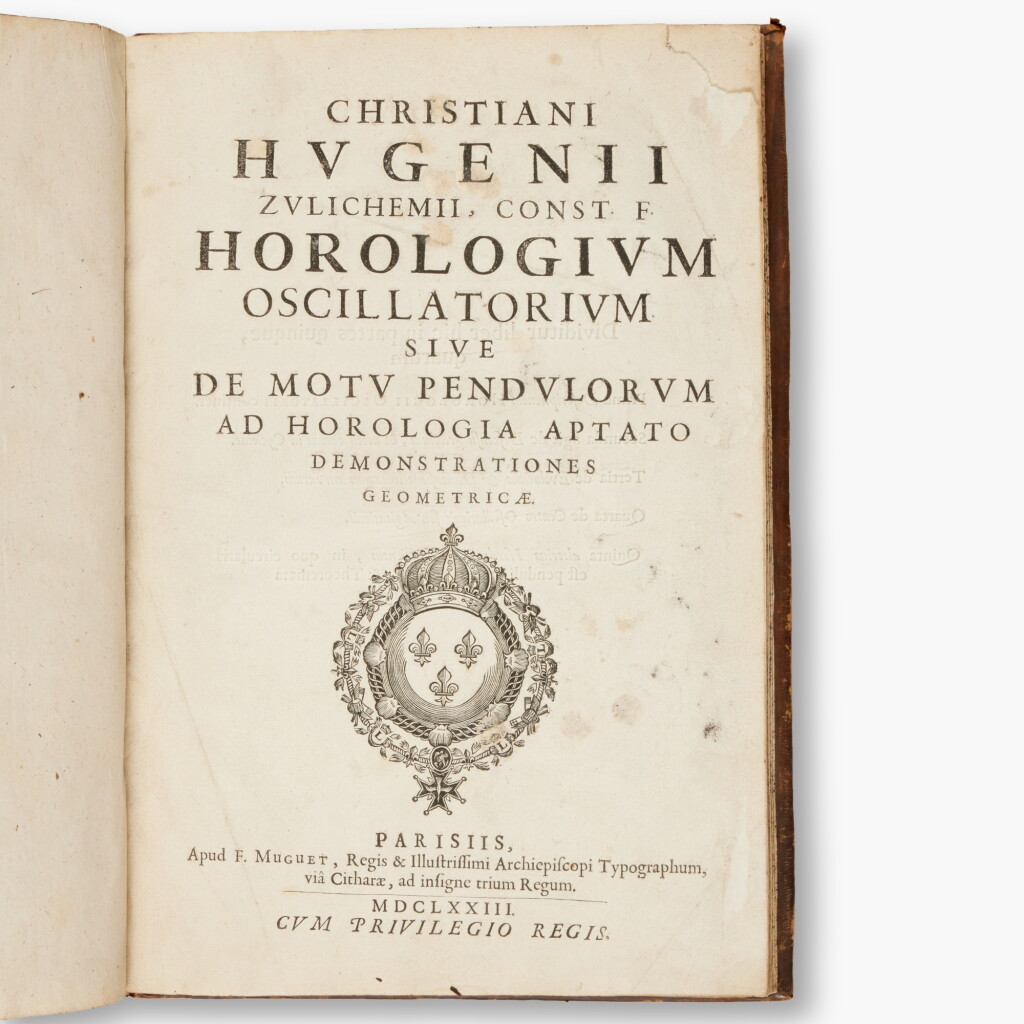
Horologium oscillatorium; sive, De motu pendulorum at horalogia optato demonstrationes geometricae. Paris: Francois Muguet, 1673
First edition of Huygens's most important work, "second in scientific importance perhaps only to [Newton's] Principia" (Singer).
This treatise contains the first mathematical analysis of the pendulum's motion, alongside a general treatise on the dynamics of moving bodies. In 1657 Huygens notably constructed the first pendulum clock, an idea suggested by Galileo. This technological innovation provided an excellent solution to the problem of timekeeping aboard ship. Huygens's invention, described in the present volume, was quickly adopted, and his study of centrifugal force was highly influential for Newton.
The armorial bookplate found in the present volume is that of John Trotter (1667–1718), a noted bibliophile and son of John Trotter of Mortonhall, a wealthy Edinburgh merchant. According to David Pearson, "John Trotter often made distinctive inscriptions in his books, noting the price alongside where and when they were purchased." On the front free endpaper of the present volume, Trotter meticulously records that it was "Bought at an Auction in Mr Simpsons house, the 8. Jan. 1696. cost 6. shil. ster." While the Trotter provenance had not yet been established when the present copy was offered in these rooms in December 1993 (the bookplate with the Latin motto was erroneously attributed to "Dunbar"), the cataloguer's tentative identification of the auctioneer as Andrew Symson of Edinburgh seems highly plausible given Trotter's connection to the city. The auction in which this book was sold on 8 January 1696, "in Mr Simpsons house," is not recorded by Munby and Coral, British Book Sale Catalogues, 1676–1800 (1977). The Trotter family library held over 1,000 titles, and other scientific works in their collection included a second edition of Tycho Brahe's Astronomia instauratae mechanica (Nuremberg, 1602; sold Christie's, 9 July 2019, lot 226).
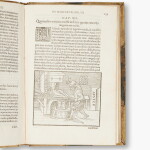
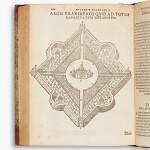
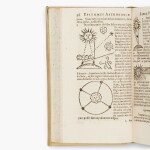
Folio (295 x 203 mm). Woodcut royal arms on title-page, full-page woodcut of the pendulum on A2v, numerous woodcut diagrams, woodcut initials, head- and tailpieces; title-page with slight loss at upper corner, some soiling to a2. Old mottled calf, sprinkled edges; spine and extremities rubbed.
REFERENCES
Babson/Macomber Newton 75.682; Buffalo/Sparrow 109; Dibner, Heralds 145; Grolier/Horblit 53; Honeyman sale 4:1729; Printing and the Mind of Man 154; Singer, A Short History of Science (1941), p. 258; USTC 6122584; David Pearson, "John Trotter 1667-1718", Book Owners Online, accessed 9 September 2026
PROVENANCE
John Trotter (1667–1718; purchased at auction on 8 January 1696 for "6 shi[llings] ster[ling" [see above], acquisition note to front free endpaper and engraved armorial bookplate) — Robert S. Dunham (acquired from F. Thomas Heller in June 1947, pencil acquisition note to front pastedown; Sotheby's New York, 11 December 1993, lot 705)
You May Also Like