Property from a Private European Collection
Andries van Baseroy the Younger
Faust's condemnation to Hell
Live auction begins on:
July 2, 10:00 AM GMT
Estimate
30,000 - 50,000 GBP
Bid
22,000 GBP
Lot Details
Description
Property from a Private European Collection
Andries van Baseroy the Younger
Antwerp 1617–after 1655
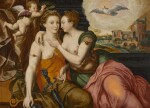
Faust's condemnation to Hell
signed with monogram and dated, lower left: AVB / 1639 [AVB in ligature]
signed and inscribed on an open manuscript, lower left: IN ME RTN / EE MEN ⋅ SC ⋅ [left page] / BASEROY / IONGEN ⋅ [right page]
inscribed at lower centre: OONENS ✳
oil on oak panel
unframed: 28.3 x 40.2 cm.; 11⅛ x 15⅞ in.
framed: 40 x 51.2 cm.; 15¾ x 20⅛ in.
Private collection, Ascot, by April 1993;
With Jonny Oppenheimer, Tönnersjö, by May 1993;
Anonymous sale, Amsterdam, Sotheby's, 17 November 1993, lot 66 (as Andries Baseroy the Younger, The temptation of Saint Anthony), for 49,450 Netherlandish guilders.
D. Maufort, 'De Antwerpse schildersfamilie Van Baesrode uit de zeventiende eeuw en de historie van Dokter Faust', in Gentse bijdragen tot de kunstgeschiedenis en oudheidkunde, vol. 31, 1996, pp. 217–20, reproduced fig. 3 (as Andries Baseroy the Elder, Dokter Faust en de duivels- en heksenkunsten).
Dr Fred G. Meijer has pointed out that this painting may have been started by Andries Baseroy the Elder (1574–1641), but finished after his death by his son, Andries Baseroy the Younger. Baseroy the Younger has clearly signed his name on the manuscript at lower left, BASEROY / IONGEN [BASEROY THE YOUNGER], but the potential participation of the Elder would account for the second signature in monogram, alongside the date of 1639. As there is very little comparative material on either of these elusive artists, this notion is impossible to prove properly.
When this panel sold at Sotheby's Amsterdam in 1993, the subject was identified as The temptation of Saint Anthony. However, as pointed out by Danielle Maufort in 1996 (see Literature), a pig nor a bell – the saint's usual attributes – are found beside the man seated at left. As such, Maufort has argued that this composition instead depicts a scene from the story of Doctor Faust. Embittered by the limits of science, the humanities and theology, Faust called upon the Devil for magical powers. The Devil's representative, Mephistopheles, appeared, resulting in Faust trading his soul and knowingly condemning himself to Hell for a single year of the demon's unquestioned servitude. During the term of the bargain, Mephistopheles helps Faust to seduce a beautiful and innocent young woman named Gretchen, whose life is ultimately destroyed when she gives birth to Faust's illegitimate son. It is possible to suggest that the nude woman at lower centre, looking directly towards Faust, represents Gretchen. The first known printed source of the legend of Faust is a small chapbook bearing the title Historia von D. Johann Fausten, published in 1587. Several texts recounting Faust's legend had already appeared in Dutch prior to 1639, when this work was painted.1
1 Maufort 1996, p. 220.
You May Also Like