The Property of a Private Collector
Pietro Longhi
An elegant lady at her morning ritual
Live auction begins on:
July 2, 10:00 AM GMT
Estimate
15,000 - 20,000 GBP
Bid
11,000 GBP
Lot Details
Description
The Property of a Private Collector
Pietro Longhi
Venice 1702–1785
An elegant lady at her morning ritual
oil on canvas
unframed: 43.6 x 34.5 cm.; 17¼ x 13⅝ in.
framed: 58.2 x 49 cm.; 23 x 19¼ in.
Possibly Maximilien de Beauharnais, 3rd Duke of Leuchtenberg (1817–1852), Saint Petersburg;
His wife, Grand Duchess Maria Nikolajevna Romanova (1819–1876);
Possibly by inheritance to her second husband Count Grigori Aleksandrovich Stroganov (1824–1879);
Possibly by inheritance to Anatoly Nikolaievich Demidov, 1st Prince of San Donato (1813–1870), Florence;
His wife, Princess Mathilde Bonaparte, formerly Princess Demidoff (1820–1904);
Château de St. Gratien, Enghien;
Philippe de La Rochefoucauld (1922–1993), Château de Beaumont, near Marne;
His sale, New York, Parke-Bernet Galleries, 17 May 1952, lot 276;
J. Hope, New York, before 1972;
Ferrari Trecate collection, Trezzano sul Naviglio, 1970s.
T. Pignatti, 'Aggiunte a Pietro Longhi', in Arte Illustrata, vol. V, Janaury 1972, pp. 3–4 and 30–31, reproduced fig. 8;
T. Pignatti, L'opera completa di Pietro Longhi, Milan 1974, p. 87, no. 31, reproduced.
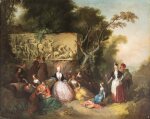
In the 1952 Parke-Bernet Galleries sale this painting was sold as a companion to lot 277, a canvas of the same dimensions depicting A lady fainting (now untraced). The composition was engraved (with some minor differences) by Charles Joseph Flipart (1721–1797) after 1748,1 providing a terminus ante quem for this painting. In Pignatti's 1974 catalogue, he erroneously mentions a second version in the Ferrari Trecate collection, which is in fact this same picture. A preparatory drawing for the seated male figure exists, today in the Museo Correr, Venice.2
Note on Provenance
The present work came to Philippe de La Rochefoucauld’s family as either sold or gifted by Princess Mathilde Demidova, née Bonaparte (1820–1904). Mathilde was the daughter of Napoleon’s younger brother Jérôme (1784–1860) and of Princess Katharina of Württemberg (1783–1835). She married Anatoly Nikolaievich Demidov, 1st Prince of San Donato (1813–70), from whom she split in 1847.
It is not certain how the painting passed to Princess Mathilde from the collection of the Duke of Leuchtenberg, whose name appears in the provenance listed in the 1952 Parke-Bernet sale catalogue. The connection between Mathilde and Leuchtenberg could have been the Grand Duchess Maria Nikolajevna Romanova (1819–76), daughter of Tsar Nicholas I of Russia (1796–1855), who married the 3rd Duke of Leuchtenberg, Maximilien de Beauharnais (1817–52), in 1839.
After the death of her husband, Duchess Romanova sold his Bavarian properties and moved to St. Petersburg in 1854. She lived there until 1862, when she moved to Florence and bought from Princess Mathilde (who had inherited it from her father) Villa di Quarto, a 15th century villa in the Florentine hills. It is known that Duchess Romanov also brought there from St. Petersburg a part of her husband’s art collection, possibly including the present painting.
The work, however, was never inherited by their children: their properties were taken during the revolution and exhibited in 1917 in Stockholm,3 where the present work is not listed. It is possible that the painting somehow passed to the family of the Duchess' second morganatic husband, Count Grigori Aleksandrovich Stroganov (1824–1879), who was vaguely related to Mathilde Bonaparte’s husband Anatoly Demidoff. If Demidoff received the painting from Stroganoff and his family, he must have then passed it to Mathilde after their separation.
Another possibility is that the painting was bought directly in Italy by Duchess Romanova while she was avidly collecting Italian paintings to add to her residence under the guidance of the art historians and connoisseurs Baron Karl-Eduard von Liphart (1808–1891) and Prince Grigory Gagarin (1810–1893). It then must have been sold or gifted to Mathilde, perhaps on the occasion of the purchase of Villa di Quarto.
1 https://www.britishmuseum.org/collection/object/P_1951-0714-141
2 Inv. no. 563; charcoal and white chalk, 26.7 x 38.4 cm.
3 R. de Liphart-Rathsoff, Leuchtenbergska tavelsamlingen, Stockholm 1917.
You May Also Like