
Property from an Italian Private Collection
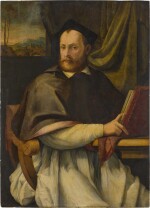
Carlo Portelli
Portrait of Giovanni della Casa (1503–1556)
Live auction begins on:
July 2, 10:00 AM GMT
Estimate
40,000 - 60,000 GBP
Bid
28,000 GBP
Lot Details
Description
Property from an Italian Private Collection
Carlo Portelli
Loro Ciuffenna before 1510(?)–1574 Florence
Portrait of Giovanni della Casa (1503–1556)
inscribed on the reverse of the panel: 24 Gio: Della Casa.Op:a di Raff. / 1561
oil on poplar panel, unframed
112.9 x 81.4 cm.; 44½ x 32 in.
Acquired by the grandfather of the preset owner in Florence, in 1940;
Thence by descent.
This superb portrait of the Italian poet, humanist, diplomat, and political theorist Giovanni della Casa (1503–1556) constitutes a rare and significant addition to the little-known œuvre of Carlo Portelli (before 1510(?)–1574). Trained in the workshop of Ridolfo Ghirlandaio (1483–1561), Portelli enjoyed an active career in Florence, developing a style that combined his master's conservative High Renaissance idiom with the more extravagant inventions of his contemporaries such as Pontormo (1494–1556/7), Bronzino (1503–1572) and Francesco Salviati (1510–1563). Most evident in this portrait however, is the influence of Pier Francesco Foschi (1502–1567), whose depictions of Florentine intellectual and aristocratic society find close parallels with this work.
Giovanni della Casa was among the most distinguished literary and ecclesiastical figures of 16th century Italy. Educated in Bologna and Florence, he pursued a successful career in the service of the papacy, culminating in his appointment as Archbishop of Benevento and Apostolic Nuncio to Venice. He is best remembered today as the author of the immensely influential Galateo overo de' costumi (1558), a treatise on manners and social conduct that became one of the defining texts of Renaissance civility. Written in elegant vernacular Italian and cast in the form of advice from an elderly mentor to a young gentleman, the work codified standards of behaviour for polite society and explored subjects such as dress, table manners, and conversation. The work was widely translated and reprinted throughout Europe, exercising a profound influence on the development of courtly behaviour from the 16th century onwards.
We are grateful to Philippe Costamagna for suggesting the attribution to Carlo Portelli on the basis of digital images. He praises the high quality of the work and dates it to circa 1535–40.
You May Also Like


