
Property of The Bass, Miami Beach to Benefit the John and Johanna Bass Art Acquisition Fund, Sold Without Reserve
16th-Century Follower of Albrecht Dürer
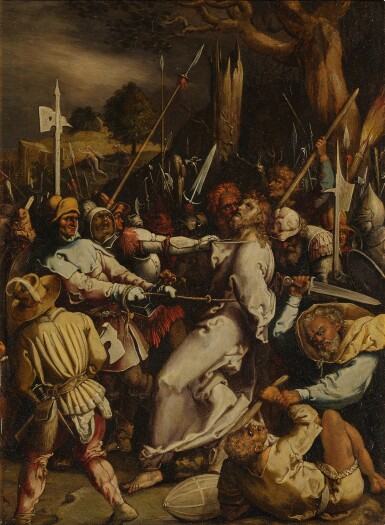
Kiss of Judas
No reserve
Live auction begins on:
February 6, 03:00 PM GMT
Estimate
6,000 - 8,000 USD
Bid
11,000 USD
Lot Details
Description
Property of The Bass, Miami Beach to Benefit the John and Johanna Bass Art Acquisition Fund, Sold Without Reserve
16th-Century Follower of Albrecht Dürer
Kiss of Judas
oil on copper
copper: 14 ½ by 10 ¾ in.; 36.8 by 27.3 cm
framed: 18 ½ by 14 ½ in.; 47.0 by 36.8 cm
John and Johanna Bass, New York;
By whom donated to the Bass Museum of Art, Miami Beach, 1963 (inv. no. 63.30).
The John and Johanna Bass Collection at Miami Beach, Florida, Miami 1973, n.p., cat. no. 30 (as Attributed to the Master of Messkirch);
M. Russell, in Paintings and Textiles of the Bass Museum of Art: Selections from the Collection, M. Russell (ed.), Miami 1990, p. 36, reproduced (as German School, circa 1600).
This scene depicts one of the central episodes of the Passion: the Betrayal of Christ, in which Judas identifies Jesus to the Israelite soldiers with a kiss, leading to Christ’s arrest and subsequent delivery to the High Priest for judgment. The composition closely follows Albrecht Dürer’s 1510 woodcut of the subject from the Grand Passion series, a print of which is affixed to the verso of the present panel.1 Attached with rabbit-hair glue, the print appears to have been in place for a considerable period, possibly adhered shortly after the painting’s completion.
Formerly attributed to the Master of Messkirch (active circa 1500–1543), the painting was reassessed in private correspondence with the Bass Museum in 1986, when Thomas DaCosta Kaufmann proposed a slightly later date, circa 1600. While the work resists secure attribution to a specific hand, it was clearly conceived in the spirit of profound admiration for Dürer, whose inventions were disseminated and reinterpreted through copies and free adaptations produced during the "Dürer revival" in northern Europe around the turn of the sixteenth century.
1 For another example of Dürer's woodcut, see: The Clark Art Institute, Williamstown, M.A., inv. no. 1968.123.
You May Also Like


