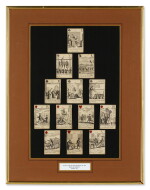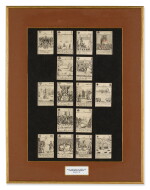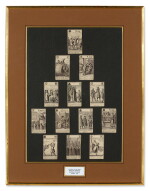
(Playing cards) — Stock-jobbing cards or the humours of Change Alley
(London: Thomas Bowles, 1720)
Estimate
30,000 - 50,000 USD
Lot Details
Description
(Playing cards) — Stock-jobbing cards or the humours of Change Alley
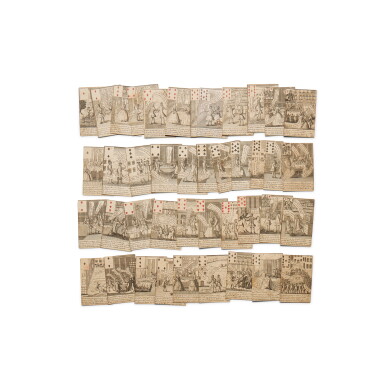
52 engraved playing cards. Laid paper, backed with stiff card, red hand-colored hearts and diamonds, a red tax stamp on the ace of spades, plain versos; light even toning, a few pale stains, the versos with small areas of soiling and abrasion, the result of having been, at one point, pasted down. 10 cards mounted in a frame, the rest in in archival sleeves, housed in a folder attached to the back of the frame.
3 ½ by 2 ⅓ in. (each card); 26 by 20 in. (frame)
9 x 6 cm; 66 by 51 cm
Jaime Ortiz-Patiño (Sotheby's, London, 10 December 2013, English literature, history, children's books and illustrations,
lot 233);
Acquired at the above sale by the present collector
Jaime Ortiz-Patiño Collection of Early Playing Cards, #78;
Hargrave, Catherine Perry, A History of Playing Cards and a Bibliography of Cards and Gaming, Boston 1930, pp. 197-199
A second Thomas Bowles South Sea Bubble deck — complete with all fifty-two cards.
While the previous lot mocked a wide array of stock market "bubble" companies, this deck of cards focuses largely on the South Sea Bubble crash. The South Sea Company, established in 1711, was a public-private partnership formed to reduce the national debt by converting it into private company stock. To create income, the company was granted a monopoly on the English slave trade with South America. However, it could never realize significant profits because the Spanish, who had recently been at war with England, controlled most of the continent and restricted English trade in the region. Nonetheless, the Company became the focus of massive speculative stock frenzy, pushing the value of shares from around £100 in January of 1720 to £1,000 in June, before it came crashing back down later that year.
The cards' illustrations depict various Londoners conversing in speech bubbles as though in a comic book. They are often shown in their homes, in businesses, or in Change Alley, the location of several coffee-shops that were the predecessors of London's stock exchange. These scenes provide a glimpse into contemporary social, commercial, and domestic life. The characters discuss and react to the delusional optimism and foolish gullibility of South Sea Bubble investors. The characters are drawn from all parts of London society, including doctors, lawyers, tradesmen, servants, stock-jobbers, foreigners, and Jews. Women feature prominently, and the cards often dwell on the ill affects of wealth on marriage — "Here Ancient Maids, that ne'er Defil'd the Smock, / Boast of their great success in South Sea Stock; / says one, when Poor, tho' young, no Man would [pur]sue me / But now I'm Rich, six Irish Captains Woo me." The four lines of humorous, occasionally coarse, rhyming verse at the bottom of each card give the scenes their context, as well as provide the punch-line and the moral.
It is, perhaps, tongue-in-cheek that these decks of cards, made for gambling, lampoon the stock market — a far more socially respectable form of financial speculation.
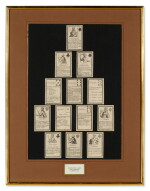
You May Also Like