A Pair of Empire Gilt-Bronze Mounted Jasper and Porphyry Candlesticks, Attributed to Lucien-François Feuchère, Circa 1805
Estimate
20,000 - 30,000 USD
Lot Details
Description
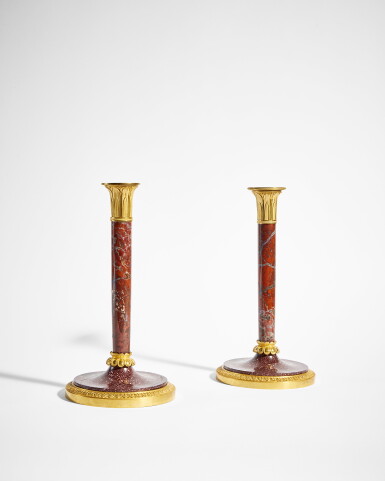
A Pair of Empire Gilt-Bronze Mounted Jasper and Porphyry Candlesticks, Attributed to Lucien-François Feuchère, Circa 1805
with lotus-leaf capitals and leaf tip bases and bobeches
height 11 ½ in.; diameter 5 7/8 in.
29.5 cm; 15 cm
Probably Maréchal Étienne Jacques-Joseph-Alexandre Macdonald, 1st duc de Tarente (1765-1840);
Probably by descent to his daughter Anne-Charlotte 'Nancy' Macdonald (1792–1870), wife of Nicolas François Sylvestre Régnier, 2nd duc de Massa (1783-1851);
By descent to André Philippe Alfred Régnier, 3rd duc de Massa (1837-1913), Hôtel de Massa, Paris;
By descent to his cousin Jean Louis Napoléon Eugène Régnier, 4th duc de Massa (1875-1946);
Thence by descent;
Galerie Kugel, Paris;
From whom acquired by the present collector, 24 July 2024.
These candlesticks were in the collection of the Ducs de Massa and were likely acquired at the time of their manufacture by the Maréchal Macdonald, Duc de Tarente, whose daughter Anne-Charlotte married the 2nd Duc de Massa in 1810 and would later become lady-in-waiting to Queen Marie-Amélie, consort of King Louis Philippe. Her grandson André Philippe Alfred Régnier became the 3rd Duc de Massa and in 1857 acquired the Hôtel de Massa, a neoclassical mansion originally built in 1777-1778 for the financier Thiraux de Montsauge at what is now the junction of the Rue La Boétie and Avenue des Champs-Elysées in the 8th arrondissement of Paris. After the Revolution the hôtel passed through several owners including the general, collector and politician Comte Flahaut de la Billarderie (d.1870), illegitimate son of Talleyrand and lover of Hortense de Beauharnais, who sold the property in 1853 to the Swiss banker Roger du Nord, father-in-law of the 3rd Duc de Massa. It remained in the Massa family until 1927 and thereafter was sold, dismantled and reconstructed in 1929 at 38 Rue du Faubourg-Saint-Jacques in the 14th arrondissement and now houses the writers' association La Société des gens de lettres de France. A pre-World War I photograph of the house's 2e Salon shows the pair of candelabra visible at the left placed on a grand piano.
The lotus-leaf capital and leaf-tip base of these candlesticks are very similar to those appearing on a pair delivered on 7 November 1809 to the chambre à coucher de l’Impératrice at the Château de Compiègne by the bronzier Feuchère, now in the Mobilier National (GML 4126/1-2; illustrated in Marie-France Dupuy-Baylet, De bronze et de cristal: Objets d'ameublement XVIIIe-XIXe siècles du Mobilier national, Dijon 2020, p.401-402, n°233). Lucien-François Feuchère (1766-1841) ran one of the largest Parisian firns producing objects in gilt bronze, including wall lights, candelabra, andirons and clock cases for both private clients and the Imperial and Royal residences during the Empire, Restoration and July Monarchy, receiving a silver medal at the Exposition de l'Industrie in 1819 at one point employing nearly 150 artisans at his workshop in Rue Notre-Dame de Nazareth; his output and influence on the Empire style was comparable to that of his colleagues and competitors Thomire and Galle.
Although an expensive material reserved for more important commissions, red porphyry was not unusual in French luxury goods production at the time, but the use of Sicilian jasper was far more rare. A pair of gilt bronze vases using an identical jasper with the same family provenance are recorded in a private collection, and it is possible the same block was imported from Italy and used for both the vases and the candlesticks.
You May Also Like