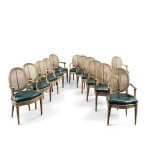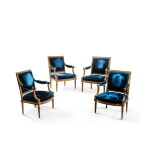
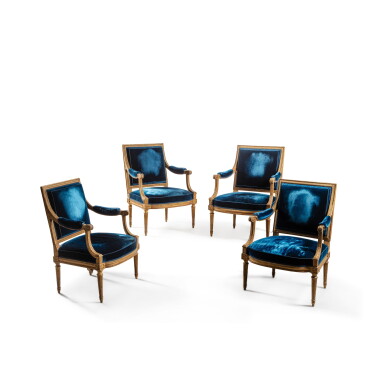
A set of four Louis XVI giltwood armchairs, circa 1782, stamped by Georges Jacob
Estimate
15,000 - 25,000 EUR
We may charge or debit your saved payment method subject to the terms set out in our Conditions of Business for Buyers.
Read more.Lot Details
Description
the rectangular back carved with a frieze of water leaves lined with a beaded frieze, the recessed cuffed armrests and their supports adorned with a frieze of piastres applied with an acanthus leaf, the connecting blocks decorated with foliate rosettes, the rounded arched seat rail carved with a frieze of water leaves and beading, on tapering, fluted and reeded legs with reed-and-tie motifs, upholstered in midnight blue silk velvet; one stamped G. IACOB, all four with a manuscript delivery label reading Salon on the back rail
(4)
Height 36 5/8 in., width 26 3/8 in., depth 26 in. ; Haut. 93 cm, larg. 67 cm, prof. 66 cm
RELATED LITERATURE:
B. Langer, Die Möbel der Residenz Munchen I. Die französischen Möbel des 18.Jahrhunderts, Munich/New York, 1995, p 209, 277-278
P. Michel, « Un collectionneur très actif » dans « Christian IV, duc des Deux-Ponts (1722-1775) », Bulletin du Centre de recherche du château de Versailles, [Online], 2026
Georges Jacob, menuisier, received master 4 September 1765.
Our set of four armchairs is identical to the model delivered by Georges Jacob to Charles II August, Duke of Zweibrücken, for his château of Carlsberg on 5 March 1782. The marchand-mercier Jacques Bourjot, entrusted with this delivery to the château, supplied on that day "ten fauteuils à la reine, a canapé, a bergère and a screen", all stamped G. IACOB and bearing a delivery label reading Cabinet n° 14, 1er étage (B. Langer, Die Möbel der Residenz München I. Die französischen Möbel des 18. Jahrhunderts, Munich/New York, 1995, p. 209, 277-278). This set matches our armchairs in both dimensions and carving: a frieze of water leaves and beading to the back, a piastre motif applied with an acanthus leaf to the arm supports, connecting blocks carved with foliate rosettes, and tapering legs with simple reed-and-tie fluting.
In 1793, as revolutionary troops approached, the furnishings of the Château de Carlsberg were removed to safety before the building was burnt down. Part of this set subsequently entered the Residenz in Munich, where it remains today (inv. Res. Mü. M 86).
You May Also Like