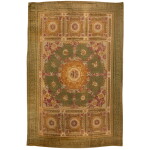
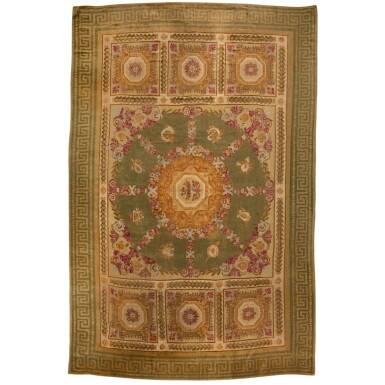
An Empire carpet au point de savonnerie, circa 1810, attributed to the Aubusson manufactory or the Piat Lefebvre manufactory in Tournai, after a design attributed to Jacques-Louis de la Hamayde de Saint-Ange
Estimate
40,000 - 60,000 EUR
We may charge or debit your saved payment method subject to the terms set out in our Conditions of Business for Buyers.
Read more.Lot Details
Description
the border with Greek key motifs, decorated with flowered rosettes within square medallions bordered by laurel, centred by a flowered vase surrounded by a garland; (restorations)
619 x 385 cm ; 243 3/4 x 151 1/2 in.
Galerie Chevalier, Paris
Tapis d'Empire, maquettes de la Collection Marmottan, Bibliothèque Marmottan, Boulogne, 23 October 2003 – 31 January 2004.
Tapis d'Empire, maquettes de la collection Marmottan, exhibition catalogue, Boulogne, bibliothèque Marmottan, 2003, p. 84
It is under Napoleon's impetus that textile production, and particularly the carpet industry, saw a revival in the early 19th century, notably following the decree of 28 Floréal, Year XII (1803). His desire to redecorate the royal palaces was realized through the influence of Percier and Fontaine, but above all through Jacques-Louis de la Hamayde de Saint-Ange, who was appointed designer for the Mobilier impérial in 1810 and placed in charge of carpet and tapestry designs, supplying his designs to the workshops of the Savonnerie, Aubusson, and the Piat Lefebvre manufactory in Tournai.
Our carpet is distinguished by its ornamental repertoire of flowered rosettes within square medallions bordered by laurel, framed by a border of Greek key motifs, and a central medallion featuring a flowered vase surrounded by a garland.
It was exhibited at Tapis d'Empire, maquettes de la Collection Marmottan (Bibliothèque Marmottan, Boulogne, 23 October 2003 – 31 January 2004) and illustrated on page 84 of the exhibition catalogue.
You May Also Like