Collection of the Rochechouart de Mortemart Family
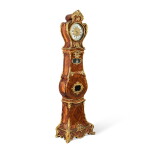
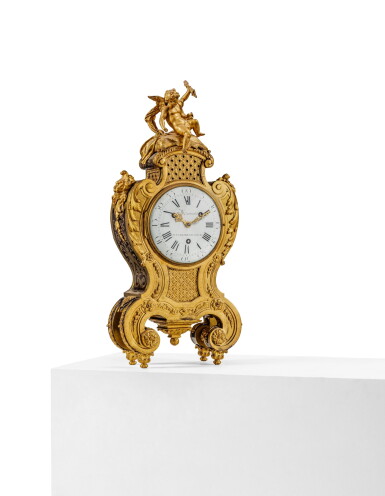
A Régence gilt-bronze and gilt-brass, tinted pearwood and tortoiseshell marquetry quarter striking mantel clock, attributed to Charles Cressent, the mechanism by Claude Martinot, Paris, dated 1726
Lot closes
September 29, 01:02 PM GMT
Estimate
15,000 - 25,000 EUR
Current Bid
8,000 EUR
2 Bids
Reserve not met
We may charge or debit your saved payment method subject to the terms set out in our Conditions of Business for Buyers.
Read more.Lot Details
Description
the later enamel dial surmounted by a child seated on a cushion holding a thunderbolt, the case of viol-shaped form, decorated with acanthus leaves, partially openwork lattice motifs and scrolls, the sides adorned with lion masks and arabesques on a tortoiseshell ground, raised on four scrolling feet decorated with flowers, the white enamel dial signed MARTINOT / AUX GALLERIES DU LOUVRE, the three train movement quarter striking on two bells and striking the hours on a further bell, with later alterations, signed on the backplate C. Martinot / aux galleries du Louvre / 1726
Height 30 in., width 13 ¾ in. ; Haut. 76 cm, larg. 35 cm
Collection of the Rochechouart de Mortemart Family.
RELATED LITERATURE
Tardy, La pendule française, Vol. 1, Paris 1974, p. 141, Ill. 2
H. Ottomeyer and P. Proschel, Vergoldete, Bronzen, Munich, 1986, vol. I., p. 78, fig. 1.12.4.
The model for this cartel clock is a relatively early work, dating to the 1710s and attributed to André-Charles Boulle and illustrated by H. Ottomeyer and P. Proschel Vergoldete Bronzen, Munich, 1986, Vol. I, p. 78, fig. 1.12.4. It is distinguished by the unique figure of a childn seated on a cushion and hurling thunderboltd, as well as by the tortoiseshell and brass marquetry adorning its sides. H. Ottomeyer and P. Proschel note the existence of an example complete with its matching cul-de-lampe at Schloss Fasanerie, near Fulda.
This type of cartel clock likely inspired Charles Cressent’s own designs in the 1730s—specifically his clock featuring a female mask cartel, first model because of its general shape, the crowning figure of the child, and the use of brass and tortoiseshell marquetry on the sides.
You May Also Like