

Carey, Matthew | Carey's General Atlas, with the rare Lewis "Map of the United States," 1796
Lot closes
June 25, 06:55 PM GMT
Estimate
15,000 - 20,000 USD
Starting Bid
13,000 USD
We may charge or debit your saved payment method subject to the terms set out in our Conditions of Business for Buyers.
Read more.Lot Details
Description
Carey, Matthew
Carey's General Atlas. Philadelphia: Matthew Carey, 1796
Folio (358 x 235 mm). Front free endpaper with early ownership inscriptions, typographic title with table of contents, and 44 engraved maps, 17 of which are folding, 20 are double-page, and 3 are single page, the maps variously signed by Harding Harris, Samuel Lewis, General D. Smith, Elihu Barker, and engraved by W. Barker, J.T. Scott, Thakara & Vallance, Smither, A. Doolittle, Matthew Carey, B. Tanner, C. Tiebout, and S. Hill; loss of the lower two-thirds of the inscribed front free endpaper, small loss at fore-edge of the title, the contents with foxing, toning, offsetting, and occasional staining, some creasing at map edges and folds, splitting along a few of the map's folds, notably to the "Chart of the World" where the split extends into the map, the map of Switzerland trimmed inside the neatline, the large two-sheet folding map of the United States reinforced along folds, with creasing, a strip of toning, and a few stains, the map of Cook's discoveries in the Pacific is loose and supplied from another copy. Calf backed contemporary marbled paper boards; rebacked, boards worn, losses to marbled surface, a repaired crack in the rear board.
The first stand-alone atlas of the world to be published in the United States, containing 19 maps of American interest, including Samuel Lewis's large-scale Map of the United States, which is often lacking.
Matthew Carey emigrated from Dublin to America in 1784, setting up his print shop in Philadelphia. It would go on to become one of largest and most important publishing houses in nineteenth-century America. In the early days he was primarily a publisher of newspapers, journals, and serials, including the Pennsylvania Evening Herald. During the 1790s, however, he became one of the first American publishers to issue atlases. His first was A General Atlas for the Present War, dated 1794, using maps based on those in William Guthrie’s Atlas to Guthrie’s System of Geography, a popular text book that had first appeared in London in 1770. He followed this with his Atlas for the First Volume of Carey’s Edition of Guthrie's Geography Improved of 1794 (only one copy known, see lot 353) and his General Atlas for Carey’s Edition of Guthrie’s Geography Improved of 1795. The American maps that he had engraved for these atlases were, in 1795, compiled with five additional maps to create his American Atlas, the first atlas of America to be published in America.
The following year, 1796, he issued this General Atlas, his most ambitious atlas to date. In it, he combined most of his maps of America with various maps of the rest of the world. Carey's General Atlas is sometimes designated as a second edition of The General Atlas for Carey’s Edition of Guthrie’s Geography Improved, seeing as they largely contain the same maps, but with a new title and the addition of Samuel Lewis's impressive "Map of the United States." However, the two works differ substantially because this 1796 atlas was issued as a stand-alone work, not as a supplement to another text. This would account for Carey's General Atlas's continuing success—it was repeatedly reissued up to 1818.
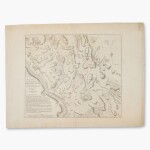
Samuel Lewis's large scale "A Map of the United States, compiled chiefly from the State Maps and other authentic information," shows the settled parts of the United States of America in great detail. It shows the eastern seaboard from Florida to The Gulf of Saint Lawrence, and extends west to the Mississippi River. The entirety of the Florida peninsula is included in the inset at the lower right. Most of the map's detail is centered on the settled portion of the United States, and it includes place names, borders, and topographic features such as rivers and mountains. Canada and Florida include some geographic details, but no place names, and the still unexplored areas West of the Mississippi and North of the Great Lakes are left almost entirely blank.
Rare—the last copy of this atlas with Lewis's map to sell at auction was at Freeman's in 2012 (with the map "torn and defective but largely present") and before that at Sotheby's in 1976 (Rare Book Hub). We also note a copy that was offered in the trade in 2015.
REFERENCES
ESTC W30216; Phillips Atlases 683; Sabin 10858
PROVENANCE
Thomas Jenks (early ownership inscription dated 28 August 1804) — John L. Pauney (inscription stating that he purchased the book from Jenks on 21 March 1828)
You May Also Like



![[Privy Council Hearing — Benjamin Franklin] | A rare Boston printing of the proceedings of the Privy Council Hearings](https://sothebys-md.brightspotcdn.com/dims4/default/5bd4b39/2147483647/strip/true/crop/2000x2000+0+0/resize/150x150!/quality/90/?url=http%3A%2F%2Fsothebys-brightspot.s3.amazonaws.com%2Fmedia-desk%2Fwebnative%2Fimages%2Fff%2Ff4%2Fadab67b445b1b086407e406e296c%2Fn12185-dgbf3-t2-01.jpg)
