

Jean Lattré | The first French map of the newly formed United States of America, dedicated to Benjamin Franklin
Live auction begins on:
June 24, 06:00 PM GMT
Estimate
20,000 - 30,000 USD
Bid
16,000 USD
Lot Details
Description
Jean Lattré
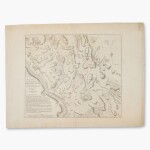
Carte des Etats-Unis de L’Amerique Suivant le Traité de Paix de 1783. Dédiée et Présentée A.S. Excellence Mr. Benjamin Franklin Ministre Plénipotentarie des Etats-Unis de l’Amérique pres la Cour de France, ancien Président de la Pensilvanie et de la Societé Philosophique de Philadelphie, &c, &c. Paris: Delamarche, 1784
Engraved map on a full sheet, hand-colored, flanked on both sides by panels of engraved text (sheets in total: 580 x 1070 mm; neatline: 545 x 765 mm); old folds, a few minor marginal chips, splits, and tears, mostly closed, professionally backed with Japanese tissue.
The first French map of the United States, and the first map of the newly formed nation to be published after the ratification of the Treaty of Paris, celebrating the Franco-American alliance, and dedicated to Benjamin Franklin.
The first issue, first state, of the map, exceedingly rare with the flanking text panels.
Jean Lattré's map of the United States covers the area from Canada to Florida, and from the East Coast to the Mississippi River. The geography draws heavily on earlier maps of North America, primarily John Mitchell's landmark 1755 A Map of the British and French Dominions in North America, a suitable source given that map's role in the boundary negotiations during the Treaty of Paris. It is notable that the United States' borders on Lattré's map do not exactly follow the boundaries that were agreed upon in the treaty, despite being printed a month after the treaty's ratification in May 1784. Instead, the map's primary purpose was journalistic, being an account of the chronology and geography of recent events in the Revolutionary War, rather than a detailed representation of the United State's new post-treaty borders. Lattré was likely influenced by his contemporaries in London, mapmakers like Jeffreys, Faden, and Sayer and Bennett, who often included text in their maps that summarized recent events, or provided other types of information. .
The engraved text on the side panels, titled the "Principaux Evenemens Militaires entre les Americains et les Anglois," is organized both chronologically and by state, beginning in April 1775 with Massachusetts and the Battles of Lexington and Concord, and ending in October 1781 in Virginia with The Battle of York. Nearly all of the place names mentioned in the text, even small battles such as Lynch's Creek in South Carolina, are marked on the map. Particular attention is paid to the French forces that took part in the War, highlighting the close alliance between the two nations. Lafayette is mentioned specifically four times, including an amusing anecdote about General Howe promising the ladies of Philadelphia that he would capture the young French officer and bring him to them for dinner.
Lattré dedicated his map to Benjamin Franklin, the minister plenipotentiary for the United States, who had been in France since 1776 encouraging French participation in the War. Franklin was incredibly popular in Paris, welcomed everywhere from salon society to the the Académie des Sciences. The map's cartouche, depicting a ship's stern, includes Franklin's own self-conceived, pseudo-aristocratic seal, shown being hung by a sailor on the yardarm. Franklin's seal is accompanied by two others—the recently designed Federal Seal of the United States, and the seal of the Society of the Cincinnati. This is the earliest known depiction of the Society's seal in print.
This map is the first issue, first state, with Lattré's imprint, before the addition of the table listing the thirteen states, and before the addition of Washington, D.C., in the map and Vermont in the table. This separately published map is exceptionally rare when found with the flanking text panels. Only four complete copies have been identified: at the Library of Congress, the Library of the Society of the Cincinnati, an example of the second state that appeared recently in the trade, and the present example. Additionally, an example that was owned by a New York dealer appeared on the market in the 1980s with only one panel, while an example at Colonial Williamsburg has incomplete text.
REFERENCES
Pritchard and Taliaferro, Degrees of Latitude 70; Mary Sponberg Pedley, "A Map for Benjamin Franklin" (Ann Arbor: 2010); https://www.americanrevolutioninstitute.org/masterpieces-in-detail/first-french-map-of-the-united-states/
You May Also Like
![[Political Cartoon] | A rare political cartoon featuring Franklin and satirizing the 1776 Pennsylvania Constitution, Banks, and more](https://sothebys-md.brightspotcdn.com/dims4/default/b0a98d2/2147483647/strip/true/crop/2000x1629+0+0/resize/150x122!/quality/90/?url=http%3A%2F%2Fsothebys-brightspot.s3.amazonaws.com%2Fmedia-desk%2Fwebnative%2Fimages%2F74%2F65%2F985a573c4d3590bb8b1824ac805e%2Fn12185-d5wqr-t3-02.jpg)



![Christian Zervos I Pablo Picasso. Œuvres de 1895 à [1972], 1949-1978, 33 volumes in 34, a fine set of the Picasso catalogue raisonné](https://sothebys-md.brightspotcdn.com/dims4/default/06933b3/2147483647/strip/true/crop/5248x6618+0+0/resize/150x189!/quality/90/?url=http%3A%2F%2Fsothebys-brightspot.s3.amazonaws.com%2Fmedia-desk%2F3f%2Fde%2F6099508648ca893ef15bb2391c55%2Fl26402-dlds8-t2-03.jpg)


