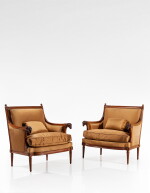
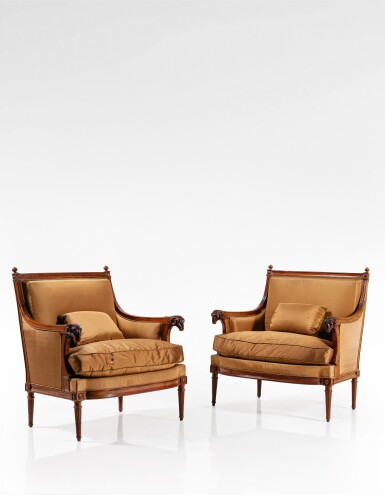
View full screen - View 1 of Lot 12. A pair of mahogany marquise chairs, attributed to Georges Jacob, late 18th century.

A pair of mahogany marquise chairs, attributed to Georges Jacob, late 18th century

Estimate

8,000 - 12,000 EUR

Lot Details

Lire en français
Lire en français

Description

The armrests terminated with ram's heads, resting on fluted feet with rosettes, with a brown silk upholstery


(2)


Haut. 97 cm, larg. 95 cm, prof. 64 cm; Height 38 1/8 in, width 37 /12 in, depth 25 ¼

FR : L’importation de ces lots aux U.S. peut être interdite ou peut nécessiter des licences et des certificats délivrés par les organismes compétents (U.S. Fish & Wildlife Service) pour être exportés et des licences et certificats supplémentaires pour être importés. Le U.S. Fish & Wildlife Service se reserve le droit de bloquer l’exportation sur le territoire des U.S. L'impossibilité pour un acheteur d'exporter ou d'importer ces lots, ou une saisie par un organisme gouvernemental, ne peut justifier un retard de paiement ou l'annulation d'une vente. EN : Importation of these lots into the U.S. may be prohibited or may require licenses and certificates issued by the appropriate agencies (U.S. Fish & Wildlife Service) to be exported and additional licenses and certificates to be imported. U.S. Fish & Wildlife Service reserves the right to block export into the US. Fish and Wild Life reserves the right to block export to the U.S. The inability of a buyer to export or import these lots, or a confiscation by a government agency, cannot justify a delay in payment or the cancellation of a sale.

Hélène Rochas collection, Paris.

The unusual feature of this pair of marquises is the presence of ram’s heads positioned on the armrests. This motif, more original than the traditional lion’s heads, was employed by Georges Jacob at an early stage. It appears notably on the veilleuse à la turque dating from the 1780s, likely commissioned by Paul I of Russia and sold at Sotheby’s Paris on 30 June 2021, lot 391 (sold for €460,200). This model is becoming recurring during the Empire period, especially on desk armchair , some attributed to Jacob Frères.