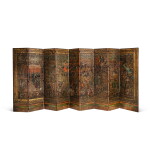

A Mexican (New Spain) nine-leaf screen called Biombo, late 17th-18th century
Estimate
8,000 - 12,000 EUR
We may charge or debit your saved payment method subject to the terms set out in our Conditions of Business for Buyers.
Read more.Lot Details
Description
on canvas, depicting various scenes of royal life including the marriage of Louise-Marie de Gonzague to King Ladislas IV of Poland, after a work by Abraham Bosse, framed by a gilt border decorated with floral motifs and stylized bands, set against a faux-marble background
Height 94 1/2 in., width of one leaf 24 in. (the 9th leaf measuring 31 7/8 in.) ; Haut. 240 cm, larg. d'une feuille 61 cm (la 9e feuille de 81 cm de large)
Bought in 1976 on the French market
This folding screen is a remarkable example of the cultural exchange between Mexico and Europe during the 17th century. Heavily inspired by Japanese byōbu, Mexican biombos—crafted in painted wood or on canvas—are documented in New Spain from 1630 onwards, featuring a broader range of iconographic subjects, particularly mythological and historical scenes.
Adopted by the elites of New Spain, they quickly became prestige objects that blended local techniques, Oriental influences, and European iconographic models. Artisans in New Spain drew inspiration from European engravings to compose historical, religious, or urban scenes, while incorporating materials, pigments, and motifs native to Mexico.
Our screen features a gilt border decorated with stylized floral motifs and geometric bands, recalling the ornamentation of Japanese screens—such as the hana-bishi (floral diamond) motif—also found on the biombo sold at Sotheby's, Paris, 15 November 2023, lot 136 (sold for €60,960).
Rich Iconography
Our folding screen is particularly notable for the richness of its depicted iconography. Among the illustrated scenes is one on the left showing the marriage of Louise-Marie de Gonzague to King Ladislas IV of Poland, after a work by Abraham Bosse, circa 1645, attended by Queen Anne of Austria, with the young King Louis XIV, then seven years old, standing to her right.
Also visible in the lower central section of the screen is a ceremonial scene depicting Louis XIII in coronation robes, wearing the royal regalia: the crown, the ermine mantle, and the collar of the Grand Master of the Order of the Holy Spirit. A striking detail is the colour of the mantle—red rather than the blue traditionally associated with French kings. This anomaly is explained by the fact that Mexican biombos were often created using uncoloured European engravings, leaving the artisans free to interpret the colours as they saw fit.
Furthermore, numerous anecdotal scenes are drawn from the Recueil des plus illustres proverbes, edited by Jacques Lagniet and published in Paris in 1657, including depictions of the proverbs "strike while the iron is hot" and "washing a donkey's head is a waste of soap." Also present is a horn-player in antique dress, appearing on the right as a male figure of Fame, on a scale far larger than that of the surrounding scenes.
The richness and diversity of the scenes making up our folding screen stand as testimony to colonial influence on artistic production and to the eclectic nature of such work.
You May Also Like