
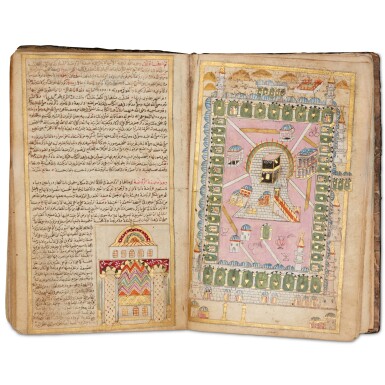
An illustrated and illuminated prayer book, copied by Darwish Yusuf ibn Sinan and Marami al-Anqarawi, Turkey, Ottoman, dated 1186 AH/1772-73 AD
Estimate
30,000 - 50,000 GBP
Lot Details
Description
Arabic manuscript on paper, 85 leaves, plus 2 fly leaves, 13 lines to the page written in naskh in black ink, within gold and black rules, verses separated by gold rosettes, headings in white on gold and polychrome illuminated panels, f.1b with illuminated headpiece surmounting text, 2 further illuminated headpieces within the text, f.8b to f.10a with illustrations including full page illustrations of Mecca and Medina, in contemporaneous gilt and tooled brown leather binding, marbled paper doublures
text panel: 11.8 by 5.8cm.
leaf: 17 by 10.7cm.
This prayer book is composed in two parts, the first comprising Dala’il al-khayrat, signed by Darwish Yusuf ibn Sinan, the second, consists of a work invoking the names of the Companions of the Battle of Badr (asma’ ashab badr) and it is signed by Marami al-Anqarawi (Merami Ankaravi) and dated 1186 AH/1772-73 AD.
Neither scribe appears to be recorded yet Darwish Yusuf ibn Sinan is known by a closely comparable prayer book sold at Christie’s, London, 25 October 2025, lot 59. The unusual illustrative scheme is identical in both manuscripts comprised of the following illustrations: al-masjid al-haram in Mecca, the entrance to the rawda al-jinna in Medina, four alternative arrangements of the graves of the Prophet Muhammad, Abu Bakr and ‘Umar, and the rawda al-jinna in Medina.
Each illustration is generally executed in a schematic style, though a few elements such as the Ka’ba and minbars are rendered in 3-dimension. This linear style of drawing and vibrant colouration is rarely found in Ottoman prayer books in the eighteenth century which are more commonly illustrated with perspective by this date. The style appears related to diagrams present in pilgrimage guides such as the Futuh al-haramayn, which was widely copied by the Ottomans in the sixteenth and seventeenth centuries (see MET Museum, acc. no.32.131, Khalili Collection, inv. no.MSS 1308). Much like those manuscripts the iterations of al-masjid al-haram and al-rawda al-jinna include many architectural elements that surround both locations. An early nineteenth century manuscript in the Sadberk Hanim Museum shows comparably rendered double-page illustration of Mecca and Medina (Tanindi 2019, pp.64 and 65, no.25).
The illustrations of the entrance to the rawda al-jinna in Medina and the four illustrations of the graves of the Prophet Muhammad, Abu Bakr and ‘Umar, find relatively few parallels in Dala’ail al-khayrat manuscripts of this date, especially included together as part of this elaborate illustrative scheme. A manuscript in the Islamic Arts Museum, Malaysia, shows a full-page illustration of the rawda al-jinna entrance (Rusli 2016, no.8, p.46), and a similarly arranged double page with this scene besides a depiction of Mecca is present in a prayer book in the Sadberk Hanim (Tanindi, op.cit., p.61, no.23). A manuscript in the Qatar National Library, Doha (inv. no.30003, Witkam 2021, p.400) is illustrated with a comparable diagram showing three possible arrangements of the graves, though it is less elaborate than that of the present manuscript. It has been suggested that the Qatar manuscript originates from India but the calligraphy of the page illustrated by Witkam could also indicate an Ottoman attribution. Witkam suggests that the illustration could derive from al-Fasi's commentary on Dala'il al-khayrat, entitled Mataliʿ al-Masarrat (Witkam, op.cit., p.399).
You May Also Like


