
Property from a Dutch Private Collection
Myles Birket Foster, R.W.S.
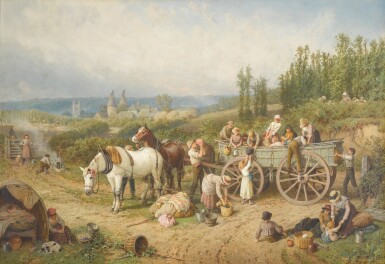
Arrival of Hoppickers, Farnham
Estimate
10,000 - 20,000 GBP
Lot Details
Description
Property from a Dutch Private Collection
Myles Birket Foster, R.W.S.
British
1825 - 1899
Arrival of Hop-pickers, Farnham
signed with initials lower left and signed and inscribed No 1 / "Arrival of Hop-pickers / Farnham" / Birket Foster / The Hill Witley Surrey on a label on the reverse
watercolour heightened with white on paper
unframed: 72 by 104.5cm., 28¼ by 41in.
framed: 87 by 120cm., 34¼ by 47¼in.
Frost & Reed, London, by 1973
Richard Green, London, by 1983
Purchased from the above by a private collector and thence by descent
London, Royal Society of Painters and Watercolours, Summer Exhibition, 1890, no. 63 (sold at the private view for £500)
Herbert Minton Cundall, Birket Foster, London, 1960, p. 202
Frank Lewis, Myles Birket Foster 1825-1899, Leigh-on-Sea, 1973, p. 38, pl. 22 (illustrated)
Jan Reynolds, Birket Foster, London, 1984, no. 103, p. 172
Myles Birket Foster moved to Surrey in 1863, when he purchased the Tudor-style country-house 'The Hill' in the village of Witley near Godalming, where he commissioned his friends Edward Burne-Jones and William Morris to decorate the interior. Living in the beautiful Surrey countryside provided him with endless subjects of rural life to paint. The present picture depicts a scene he would have witnessed every year when working-class families from London travelled to the Home Counties to help with the annual harvest of hops for the brewing industry. As an acute observer of human life Birket-Foster constructed a superb composition of several families who have arrived at the hop-fields near Farnham and are unloading their provisions and preparing to set-up camp with bundles of clothing and bedding – including a patchwork quilt. The older children are helping unload the wagonette, priority given to a blackened kettle so that tea can be made. Mothers nursing babies wait patiently and in the lower-left corner a young girl, her terrier and a baby, are snoozing in the shade – she has been picking plums and the basket for the hops and her sharp cutting-blade have been put aside for the day. In the background, beyond the hop-fields, are the oast-houses used for drying the harvested hops and the tower of the church of St Andrew’s which at that time would have been the highest structure in Farnham.
You May Also Like


