
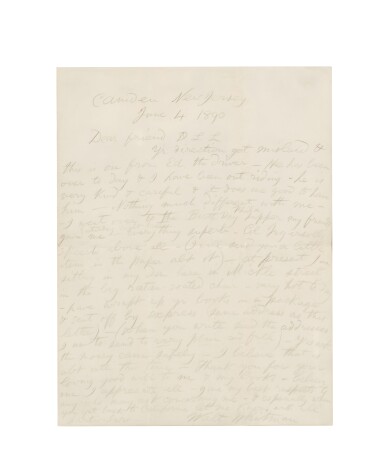
Whitman, Walt | Autograph letter signed (“Walt Whitman”) to David L. Lezinsky, 4 June 1890
Lot closes
December 16, 04:09 PM GMT
Estimate
3,000 - 5,000 USD
Current Bid
2,500 USD
1 Bid
Reserve met
We may charge or debit your saved payment method subject to the terms set out in our Conditions of Business for Buyers.
Read more.Lot Details
Description
Whitman, Walt
Autograph letter signed (“Walt Whitman”), to David L. Lezinsky
One page (280 x 215 mm). Written in pencil from Camden, New Jersey, dated 4 June 1890, together with accompanying envelope addressed in Whitman's hand in brown ink with his printed address at lower corner (85 x 155 mm); letter with folds in sixths, pencil lightly faded, envelope lightly toned with a few stains and smudges. Mounted and framed; not examined out of frame.
One of Whitman’s “lost letters,” revealing his friendship with an admirer, David Lezinsky, who apparently provided financial support in the later years of the author’s life.
David Lezinsky, a young Jewish poet based in San Francisco and an admirer of Whitman’s works, became a fast friend of Whitman’s while the author was suffering from strokes in his later life—here, he is addressed as “Dear friend D L L.” Lezinsky’s first visit to Whitman’s residence in Camden was on 13 May 1890, during which he insisted the pair ride in his carriage and raised “a series of surprising stipulations,” according to Horace Traubel’s With Walt Whitman in Camden, the biography Traubel wrote of his daily visits with Whitman in this period.
“‘He went on at such a rate about Leaves of Grass, I thought he was turned—he was wrong here,’” Whitman told Traubel, tapping his forehead. “‘But when I put the question to Mary, she said, "He is sane as you or I." The tone of the man—his startling propositions, all confound me. As I understand, he comes from California, must have money, has become possessed of ideas about Walt Whitman… Why, Horace, you have no idea of the exuberance of the man: he talks of buying all my books, of buying a share in the copyrights, paying me several thousand dollars, having me write no more but by consultation with him’” (Traubel, 13 May 1890).
Whitman was amenable to Lezinsky’s proposition, reportedly saying, “I am quite willing to sell him my books: that is what they are here for” (13 May 1890). But the next day, he clarified his stance on the copyright question: “I told him I could not see that the copyright was of any value to anybody—though it might, after a long while, in many, many years, come to something. That I would not care to sell it anyhow. I am willing to sell books and books—but my freedom?” (Traubel, 14 May 1890).
It seems that Lezinsky and Whitman developed a routine of carriage rides, which continued even after Lezinsky returned west: “W. expected the coach to stop but it continues” (Traubel, 20 May 1890).
In the present letter to Lezinsky, dated 4 June 1890, Whitman again mentions the carriage: “He [the driver, Ed] has been over to-day & I have been out riding—he is very kind & careful & it does me good to have him.” He describes other recent activities, like celebrating at his “Birth Day supper” and sending Lezinsky a package with books. He thanks Lezinsky for an earlier letter including money: “Yr’s with the money came safely—I believe that is ab’t all this time—Thank you for your loving good will to me & my books—believe me I appreciate all.”
The present letter is listed as one of Whitman’s “lost letters” in Edwin Haviland Miller’s 1969 collection, Walt Whitman, The Correspondence, Volume V: 1890-1892 (p. 331). It is also mentioned in the 4 June 1890 entry of Traubel’s With Walt Whitman in Camden. Traubel writes: “W. reading. Had ‘had an outing today’—‘Lezinsky's carriage appears on the scene again!’ Had written Lezinsky at Butte City, Montana—sending him also a copy of the Post” (Traubel).
Nearly a year later, Traubel notes that Whitman called Lezinsky “our unknown,” and describes how “he had always felt there was an unsolved mystery about Lezinsky” (19 March 1891). In the time since, historians have remained puzzled by the pair’s friendship and, evidently, financial relationship.
The present letter—apparently lost for nearly 135 years—helps to clarify some of the mystery of the Whitman-Lezinsky partnership, while offering a glimpse into the author's later years.
REFERENCES
Miller, Walt Whitman, The Correspondence, Volume V: 1890-1892; Traubel, With Walt Whitman in Camden, vols. 6 and 8; The Walt Whitman Archive
You May Also Like


