
Albert Einstein | Autograph letter signed, to Alfred Bucherer, 12 September 1908
Lot closes
December 11, 03:18 PM GMT
Estimate
20,000 - 30,000 GBP
Starting Bid
20,000 GBP
We may charge or debit your saved payment method subject to the terms set out in our Conditions of Business for Buyers.
Read more.Lot Details
Description
Albert Einstein
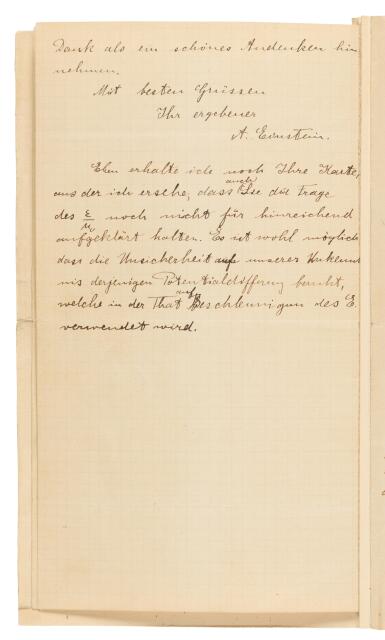
Autograph letter signed, to Alfred Bucherer, ON HIS CONFIRMATION OF EINSTEIN'S THEORY OF SPECIAL RELATIVITY, congratulating him on the results of an experiment measuring the path of electrons, which provided vital evidence in support of Einstein, in German, on graph paper, 4 pages, 8vo (210 x 122mm), Bern, 12 September 1908, former folds and slight creasing, remains of mount
“…glaube ich wirklich zu erkennen, dass Sie der Mann sind, der die Entscheidung in dieser Frage herbeigeführt hat..."
[…I truly believe I recognize that you are the man who brought about the decisive answer to this question…]
AN UNPUBLISHED LETTER PRESERVING AN EXCEPTIONAL MOMENT OF SCIENTIFIC PROGRESS.
Alfred Bucherer (1863-1927) was a German experimental physicist who provided vital early evidence in support of Einstein’s theory of Special Relativity, by shedding light on the disconcertingly strange behaviour of sub-atomic particles. The discovery of the electron in 1897 had revealed a new category of object for observation and study, putting to the test traditional ideas of the “ether” and revealing the limits of Newtonian physics. A pioneer in these experiments was Walter Kaufmann, who was the first to show, by measuring the deflection of beta rays within a magnetic field, that an electron’s momentum (or mass) increases with velocity. A number of competing theories soon emerged about the shape of the electron, and the way its mass would change as it approached the speed of light. Einstein’s Special Relativity was one of these theories. Bucherer was one of a number of scientists who became engaged in conducting experiments to establish the mass-to-charge ratio of electrons in order to test these competing theories about the shape of the universe.
In 1905 Kaufmann announced that his latest experiments on how transverse electromagnetic mass changed with velocity disproved Einstein’s theory of Special Relativity. His conclusions were soon contested by Max Planck, and In 1908 Bucherer set up a new experiment that measured the deflection of beta rays moving at a known velocity that were emitted by radium placed in the centre of a circular condenser, by recording the deflections on a photographic plate. This experiment allowed for results to be gathered with greater precision and on 7 September 1908 Bucherer wrote to Einstein to announce that “I have proved the validity of the relativity principle beyond any doubt by means of careful experiments” (vol. 5 no. 117). Bucherer’s delight at his clear results is palpable in the letter, even though they disproved Bucherer’s own earlier theories about the electron. Einstein wrote back immediately, and on 9 September Bucherer followed up with a second letter detailing his experiment, explaining that his results were more precise than Kaufmann’s, and enclosing a photograph of one of his experiments.
This letter by Einstein, which responds to Bucherer’s second more detailed letter, thrills with his excitement at having his theory confirmed by strong evidential support, as he congratulates Bucherer for his progress over Kaufmann’s experiment. He goes on to answer a question on the concept of force, and provides the formula for calculating the force acting on an electron in a uniform magnetic field (“…Setzt man das Relativitätesprinzip sowie die Maxwellschen Gleichungen für den leeren Raum als gültig voraus…” […if one assumes the principle or relativity to be valid, as well as Maxwell’s equations in vacuum…]).
Autograph letter signed, to Alfred Bucherer, ON HIS CONFIRMATION OF EINSTEIN'S THEORY OF SPECIAL RELATIVITY, congratulating him on the results of an experiment measuring the path of electrons, which provided vital evidence in support of Einstein, in German, on graph paper, 4 pages, 8vo (210 x 122mm), Bern, 12 September 1908, former folds and slight creasing, remains of mount
“…glaube ich wirklich zu erkennen, dass Sie der Mann sind, der die Entscheidung in dieser Frage herbeigeführt hat..."
[…I truly believe I recognize that you are the man who brought about the decisive answer to this question…]
AN UNPUBLISHED LETTER PRESERVING AN EXCEPTIONAL MOMENT OF SCIENTIFIC PROGRESS.
Alfred Bucherer (1863-1927) was a German experimental physicist who provided vital early evidence in support of Einstein’s theory of Special Relativity, by shedding light on the disconcertingly strange behaviour of sub-atomic particles. The discovery of the electron in 1897 had revealed a new category of object for observation and study, putting to the test traditional ideas of the “ether” and revealing the limits of Newtonian physics. A pioneer in these experiments was Walter Kaufmann, who was the first to show, by measuring the deflection of beta rays within a magnetic field, that an electron’s momentum (or mass) increases with velocity. A number of competing theories soon emerged about the shape of the electron, and the way its mass would change as it approached the speed of light. Einstein’s Special Relativity was one of these theories. Bucherer was one of a number of scientists who became engaged in conducting experiments to establish the mass-to-charge ratio of electrons in order to test these competing theories about the shape of the universe.
In 1905 Kaufmann announced that his latest experiments on how transverse electromagnetic mass changed with velocity disproved Einstein’s theory of Special Relativity. His conclusions were soon contested by Max Planck, and In 1908 Bucherer set up a new experiment that measured the deflection of beta rays moving at a known velocity that were emitted by radium placed in the centre of a circular condenser, by recording the deflections on a photographic plate. This experiment allowed for results to be gathered with greater precision and on 7 September 1908 Bucherer wrote to Einstein to announce that “I have proved the validity of the relativity principle beyond any doubt by means of careful experiments” (vol. 5 no. 117). Bucherer’s delight at his clear results is palpable in the letter, even though they disproved Bucherer’s own earlier theories about the electron. Einstein wrote back immediately, and on 9 September Bucherer followed up with a second letter detailing his experiment, explaining that his results were more precise than Kaufmann’s, and enclosing a photograph of one of his experiments.
This letter by Einstein, which responds to Bucherer’s second more detailed letter, thrills with his excitement at having his theory confirmed by strong evidential support, as he congratulates Bucherer for his progress over Kaufmann’s experiment. He goes on to answer a question on the concept of force, and provides the formula for calculating the force acting on an electron in a uniform magnetic field (“…Setzt man das Relativitätesprinzip sowie die Maxwellschen Gleichungen für den leeren Raum als gültig voraus…” […if one assumes the principle or relativity to be valid, as well as Maxwell’s equations in vacuum…]).
You May Also Like


