
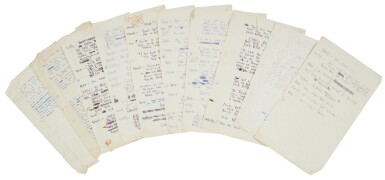
O'Brien, Richard | The Rocky Horror Show, original draft manuscripts
Lot closes
December 16, 04:24 PM GMT
Estimate
18,000 - 24,000 USD
Starting Bid
13,000 USD
We may charge or debit your saved payment method subject to the terms set out in our Conditions of Business for Buyers.
Read more.Lot Details
Description
O'Brien, Richard
Working manuscript pages for The Rocky Horror Show, comprising early and variant dialogue, lyrics and narrative material, [London, ca. January 1st, 1973 and June 19th, 1973]
16 pages of autograph manuscript on 10 leaves of lined paper (approximately 296 x 208 mm), written in blue and black ballpoint and orange felt tip, some with pencil page numbers, with marginal illustrations, heavily revised throughout with deletions, overwriting, inserted phrases, stage directions, character assignments; edges worn with short marginal tears, occasionally encroaching upon text, some creasing and yellowing.
The birth of the camp cult classic.
A rare and substantial group of Richard O'Brien's working manuscript for The Rocky Horror Show, comprising discarded dialogue, alternate lyrics, transitional scenes and narrative passages, together revealing the embryonic stages of one of the most influential musicals of the twentieth century.
Conceived in 1973 by the actor-writer as a tongue-in-cheek homage to mid-century science-fiction and horror cinema, The Rocky Horror Show premiered at the Royal Court Theatre’s tiny Theatre Upstairs before quickly transferring to the King’s Road Theatre and, by the following year, to the West End. Its anarchic blend of glam-rock, camp pastiche, and knowing cinematic parody attracted an immediate and devoted following, leading to the 1975 film adaptation, The Rocky Horror Picture Show, directed by Jim Sharman and retaining much of the original cast. Initially modest in its reception, the film evolved, through midnight screenings, audience participation, and its embrace by queer and countercultural communities, into one of the most enduring cult classics of twentieth-century cinema, with an uninterrupted exhibition tradition and a global fan culture that has transformed it into a cultural phenomenon.
The present leaves preserve O’Brien’s evolving dramaturgy in remarkable detail, incorporating early dialogue for Brad, Janet, Frank, Riff Raff, Dr Scott and others; abandoned worldbuilding (including the extraterrestrial planet “Tran-Zell”); and substantial lyrical development, such as multiple working versions of "You’d better wise up, Janet Weiss," later incorporated into the number "Planet, Schmanet, Janet" and the “hot dog / Frank-furter” chorus, later incorporated into "Planet Hot Dog." Other sections offer extended comic monologues on 1950s B-movies, including reflections on The Creature from the Black Lagoon, encapsulating the aesthetic pastiche that underpinned O’Brien’s concept. He starts: "In the 50s, low budget films were in a class of their own. Just how many were made is inestimable. Some were dreadful, some were excellent — but most of them had one thing in common — the style of their acting." Throughout, O’Brien experiments restlessly with tone, character, and staging: lines such as “He’s in the Zen Room,” and a story about a "Standard Fish Tail Exhaust Pipe" catch the eye alongside extensive overwriting, deletions, annotations, and marginal sketches.
The rich mixture of material demonstrates O'Brien's early process: riffing, cutting, and constantly reshaping the absurdist sci-fi tone that would define both the stage musical (1973) and the film (1975), echoing the Frankenstein-like central character of Rocky himself. As it celebrates fifty years on screen in 2025, these leaves provide a unique and rare insight revealing the earliest forms of now globally-recognized lines and lyrics, as well as substantial unpublished material.
"...Although The Rocky Horror Show is never less than terrific in any of its manifestations, it has never been better than during the first three weeks at the Royal Court. Many of my productions I have admired objectively, abstractly. I loved every minute of Rocky Horror ... It is the only show I have ever done that I can watch time and time again - I must have seen it a hundred times. ... Every three minutes you are being socked with another song or event. Everything about it works. The Rocky Horror Show is critic-proof..." (Michael White, Empty Seats, 1984, p.155)
You May Also Like


