
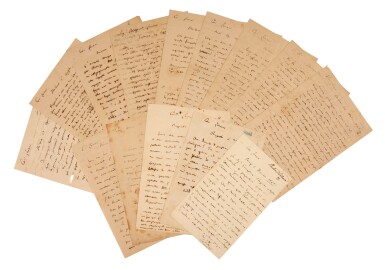
Giuseppe Verdi | Fourteen autograph letters signed to Alessandro Lanari, 1846-1850, largely unpublished
Lot closes
December 11, 04:35 PM GMT
Estimate
20,000 - 30,000 GBP
Starting Bid
16,000 GBP
We may charge or debit your saved payment method subject to the terms set out in our Conditions of Business for Buyers.
Read more.Lot Details
Description
Giuseppe Verdi
Fourteen autograph letters signed to Alessandro Lanari, the “Napoleon of Impresarios”, LARGELY UNPUBLISHED
about Attila, Macbeth, I masnadieri and other works, all sent from Milan unless otherwise indicated, all signed (“GVerdi”), all large 8vo and with integral autograph address-leaves or panels, postmarked and endorsed
1) discussing Attila and a new operatic project for Florence [Macbeth], which requires a lively tenor, a good bass and a very good seconda donna, who is required to be a ghost, 27 April 1846, 2 pages, 8vo, seal tear
2) discussing the projected opera for Florence, giving further information about the singers required, mentioning possible singers, 1 July 1846, 1 page, seal tear
3) Verdi rails against the strictures of Moriani, who wants a role like Nabucco, mentions Donizetti, affirms his artistic principles in the choice of subjects for librettos and hints at the title for the opera, either L’avola or I masnadieri, 6 August 1846, 1 page, marked confidential
4) Verdi aggressively makes his case for Varesi to be hired for the opera in Florence, now revealed to be Macbeth, firmly dismissing the idea of Fermi for the role, even if he be the best singer in the world, discussing his role in the hiring of singers, 13 August 1846, 2 pages, seal tear
5) complaining that he has received no answer from Lanari to his previous letter, reinforcing the necessity for Varesi not Ferri as a performer, describing the characteristics of both men, making further specifications for the chorus and other singers and offering to help with the arrangements for Varesi [published Copialettere, no. 29], 19 August 1846, 3 pages, 19 August 1846, 3 pages
6) discussing the efforts to engage Varesi for the role in the opera, discussing Varesi’s raised salary and contract, 2 September 1846, 1 page, red seal, seal tear
7) emphasizing the urgency to engage Varesi now and not wait for Fraschini to return, ruminating on the fate of a composer in Italy today and stating that he wants to start work on Macbeth now, 19 September 1846, 2 pages, marked in red ink “Verdi no.1”
8) providing a detailed account of Verdi’s progress on Macbeth, describing his efforts to provide some dance music in the third act, which Lanari has prescribed, his progress with the score, his intention of handing the parts to Varesi and Loewe soon, his intention of contacting Piave and describing the manner of his composition, orchestrating being the final process, giving an account of some of the minor characters and his ideas on performance, 24 October 1846, 3 pages
9) dealing with the withdrawal of the singer Loewe from the production of Macbeth, rejecting the idea of scrapping the subject altogether and recommencing with a new scenario, complaining about the loss of the singer and the advantages she had in terms of acting over her rival Barbieri, who, though she sings beautifully, lacks stage presence, and emphasizing his own forceful intervention in establishing the shape and content of the opera, 29 October 1846, 2 pages
10) discussing the copying of Macbeth, the role of Ricordi as owner of the full score and mentioning that Lanari would not have any expenses to pay; he offers him the opportunity to have copies of the parts, but would need a letter of authorization to achieve this, 2 November 1846, 2 pages, a few small holes
11) discussing his operatic projects in Naples and London and his collaboration with Lumley and the difficulties in undertaking both commissions, 12 November 1846, 1 page, seal tear, traces of red seal, some spotting
12) a letter of introduction to Lanari for the singer Ernestina Schapier, who was a singer at the Thėâtre des Italiens, Paris, until its recent closure and who wishes to pursue her career in Italy (“…Io te la raccomando caldissimamente…”), 1 December 1848, Paris, 1 page, small 8vo, integral blank, no address-panel
13) recommending the choreographer Borsi and asking his assistance in obtaining some “Siropo Pagliani”, a purgative developed in Florence by Prof Girolamo Pagliani, 10 May 1850, Busseto, 1 page, red seal, seal tear
14) testily declining to attend Macbeth and Luisa Miller in Bologna, 4 August 1850, Busseto, 1 page, traces of red seal, seal tear
…Per donna và bene la Barbieri, ma avrei bisogno d’un tenore animatissimo che fosse buon attore, un buon basso e una seconda donna buonissima che fosse della statura della prima…dovrebbe essere uno spettro che avessa la perfetta somiglianza della prima…m’abbisognerebbe una buona prima donna che sapesse cantare bene, un tenore che sapesse cantare ed agire…un basso baritone buono che dovrebbe far da vecchio: non so se Ferri ci servirebbe bene…Per Dio quanti voglio!!! Alla buon ora! Di fatti io sono l’uomo di buona pasta da scrivere come vogliono gli altri, e di sottomettere il libretto all’ altrui approvazione! …Per Dio la sarebbe bella e nuova!...Questa volta Moriani si è sbagliato all’ingrosso. Io sono solito a scegliere i sogetti che piacciano a me, distribuirli e trattarli a modo mio, a far musica come sento io…Ferri, te lo concedo, sarà il migliore cantante del mondo, ma per fare la parte di Macbet non c’è altro che Varese. Tutto gli artisti hanno il loro Genere, nè io farei mai con Ferri quell’opera. Vedo che non c’intendiamo e mi piange l’anima di dover rinunciare a quel sogetto…Varesi è il solo artista attuale in Italia che possa fare la parte e che medito, e per il suo genere di canto, e per il suo sentire, ed anche per la stessa sua figura. Tutti gli altri artisti, anche i migliori di lui non potrebbero farmi quella parte come io vorrei…capisco che i Maestri di musica sono destinati ad essere sempre almeno in Italia spiantati. Dio voglia che io possa incominciare il Macbet…Sono contento di quanto mi dici: solo mi dispiace non poter mettere un piccolo ballabile alla fine del terzo atto quando Macbet è svenuto. In quel punto è necessario, perche le streghe fanno venire delli spiriti aerei per ridonarli i sensi e questo mi giovava anche per fare in mezzo a quell’ lusso un pò di musica soave. La musica la faccio però egualmente, e se non potranno ballare, le faremo agire. Oh, oh tu mi domandi un po’ troppo presento la musica…La Barbieri ha magnifica voce, fa bene l’agilità, trilli, gruppetti, fioriture, canta bene l’adagio, ma tutto questo non può stare colla parte di Lady; e d’altronde la mia maniera di vedere e sentire è diversa. Con tutto ciò Ella avrá da figurare nella Cavatina, in un Brindisi, e nell’ultima scena del Sonnambulismo...Ma in questa scena avrebbe fatto stupendamente la Loewe: la posizione drammatica è tanto bella che per quanto sia nugitrice la musica. La Loewe ne avrebbe fatto un gran partito e per la sua alta e pallida figura, e per la sua maniera d’agire…Io scrivo come sò, e come sento, e non risparmio mai fatica ma una volta che io sia persuaso, non posso addattarmi alli voleri altrui…Come tu ben sai nella primavera ventura io devo scrivere un’opera a Napoli, e perciò mi sarebbe impossibile scrivere per Londra…Che Diavolo di pasticcio hanno fatto a Bologna! Tu mi proponeva di and per 5 giorni, ed ora un certo G. Puglioli mi parla di 20 giorni, e di mettere in scena Macbet, Miller, e io aspetto i momenti di scrivere un opera. Nò, nò…
A COLLECTION OF IMMENSE IMPORTANCE FOR OUR KNOWLEDGE OF VERDI'S OPERAS IN THE MID-1840S AND OF GREAT BIOGRAPHICAL SIGNIFICANCE.
Of these fourteen autograph letters only one is previously known (19 August 1846) from the transcript in the Copialettere, from which the translation in Rosen and Porter is taken. None of the other letters appears in Abbiati and other writers. It is a collection of immense importance for knowledge of Verdi's operas in the mid-1840s and of great biographical significance.
LITERATURE:
Abbiati, F., Giuseppe Verdi (Milan, Ricordi, 1959); A. Luzio, ed., I Copialettere di Giuseppe Verdi (Rome, 1935-1947); Rosen, D. and Porter, A., edd., Verdi’s Macbeth: a Sourcebook (Cambridge, 1984)
You May Also Like


