
Property from the Collection of Dr. Robert Small
Grant, Ulysses S. | The Union commander instructs General Isaac F. Quinby during the initial phase of the Vicksburg Campaign
Lot closes
December 16, 03:20 PM GMT
Estimate
12,000 - 18,000 USD
Starting Bid
9,000 USD
We may charge or debit your saved payment method subject to the terms set out in our Conditions of Business for Buyers.
Read more.Lot Details
Description
Grant, Ulysses S., Eighteenth President, as Major General, United States Army
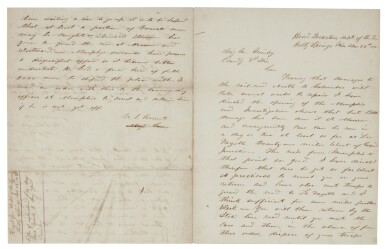
Autograph letter signed ("U. S. Grant | Maj. Gen."), 3 pages (244 x 193 mm) on a bifolium, Head Quarters, Dept. of the Tenn., Holly Springs, Mississippi, 28 December 1862, to Brigadier General Isaac F. Quinby, with a very lengthy autograph postscript signed ("U. S. Grant"), with file docket, "Letter of instruction from Maj. Genl. Grant, to Brig. Genl. Quinby"; some tiny pinholes at folds.
An up-to-the-moment report on the first stage of the Vicksburg Campaign, which had been disrupted by the destruction of Union stores at Holly Springs: "Forrest seems to have taken to the Tennessee river Sullivan in pursuit."
Grant began his letter intending that it would simply convey to General Quinby his instructions to repair and secure the railroad lines so vital to the proper administration of the Department of the Tennessee. Grant's supply depots at Holly Springs had been destroyed the previous week by Confederate General Earl Van Dorn, seriously interrupting Grant's planned movements against Vicksburg. "Fearing that damages to the rail-road North to Columbus will take several weeks to repair I have directed the opening of the Memphis road. Investigation shows that but little damage has been done it at Moscow and consequently cars can be run in a day or two at least as far as La Fayette, twenty-one miles West of Grand Junction. The roads from Memphis to that point are good. I have directed therefore that cars be got as far West as practicable to meet you on your return and have also sent troops to guard the road to La Fayette and I think sufficient for some miles further West.—You will then return by the State line road until you meet the cars and then, in the absence of further orders, dispose of your troops to guard the road Westward as the work progresses. We may find it necessary to send the wagons back to get a second load of supplies. This will depend however on the extent of damages to be repaired both on the road North and the Memphis road.
"I have no idea of keeping open the Memphis road except for temporary purposes.
"It may become necessary however to send more troops to Vicksburg. In that event the road will be very convenient."
But just before the letter was to be carried, Grant evidently received several dispatches, which he excitedly summarized for Quinby: "Our Cavalry that were sent in pursuit of Van Dorn has just returned. At every point except this, with much less garrison than this place had, he was repulsed. The Cavalry followed him on all his circuit and back to near Pontotoc but without getting a stand out of him. Captured quite a number of his men and forced him to abandon many of his led horses."
Not only was Van Dorn on the run, Grant continued, but so was Nathan Bedford Forrest, who had been disrupting Grant's lines of communication: "Forrest seems to have taken to the Tennessee river [Jeremiah Cutler] Sullivan in pursuit. As the river has risen two feet and our gun boats have only been waiting a rise to go up, it is to be hoped that at least a portion of Forrests men may be caught.—[James William] Denver's Division has gone to guard the road at Moscow and Westward."
Grant ends his appended remarks with a withering assessment of Colonel Robert C. Murphy of the 8th Wisconsin Volunteers, who had lost Holly Springs to Van Dorn. "Murphy's surrender here proves a disgraceful affair as it becomes better understood. He had a force here of full 2000 men to defend the place with. I send an order with this to the Commanding officer at Memphis to arrest and detain him if he is not yet off."
Murphy had in fact been taken prisoner, but Grant had him exchanged and then dismissed him from the service. Murphy eventually appealed his case to President Lincoln, claiming that his force was small and his orders confusing. Lincoln was not unsympathetic, but the question of revoking Murphy's dismissal eventually found its way back to Grant. On 24 June 1863 Grant—perhaps thinking that if Holly Springs had not been sacked he would already have been in Vicksburg—sent a report on the Murphy case to Secretary of War Stanton, commenting "The record of Col. Murphy at Holly Springs, Miss., and prior to that at Iuka, Miss., is so much against him that I cannot make any recommendation in his favor" (Papers 7:107 note).
REFERENCES
The Papers of Ulysses S. Grant, ed. Simon, 7:138 (text evidently from a retained copy, lacking the entire postscript and with many errors in incidentals)
You May Also Like


