
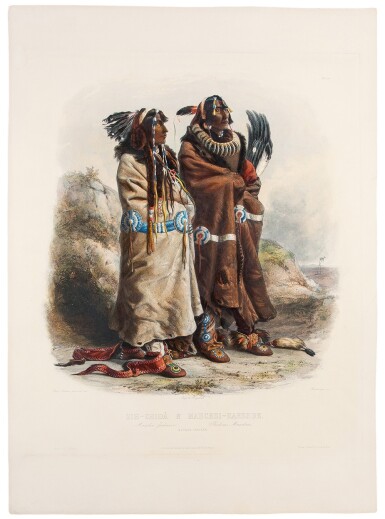
Bodmer, Karl | Sih-Chidä & Mahchsi-Karehde, a fine full-length double portrait
Lot closes
December 16, 03:08 PM GMT
Estimate
2,500 - 3,500 USD
Starting Bid
1,800 USD
We may charge or debit your saved payment method subject to the terms set out in our Conditions of Business for Buyers.
Read more.Lot Details
Description
Bodmer, Karl
Sih-Chidä & Mahchsi-Karehde. Mandan Indians. [Tab. 20]. Paris, Coblenz, and London: [1839-1842]
Hand-colored aquatint engraving by Hürlimann after Bodmer, blindstamp to bottom (plate size: 501 x 416 mm; sheet size: 625 x 454 mm). Matted, glazed, and framed; not examined out of frame.
A fine full-length double portrait by Bodmer depicting members of the Mandan tribe, composed from sketches made at Fort Clark, on the banks of the upper Missouri River, in the winter of 1833-1834.
Bodmer’s detailed images capture a previously little-understood (and soon to vanish) way of life. Swiss-born Bodmer was engaged by Prince Maximilian of Wied-Neuwied to provide a record of his expedition in North America, principally among the indigenous tribes of the Plains. The pair voyaged alongside David Dreidoppel, Prince Maximilian’s servant and hunting companion, throughout the territory from 1832 to 1834. Bodmer’s portraits, often depicting village life and culture, are particularly notable for their capturing of individual personalities.
The present portrait depicts two powerful figures of Mandan culture. On the left stands Sih-Chidä (“Yellow Feather”), a young warrior who was fascinated by the travelers’ work. Carried out over three days in early December 1833, Sih-Chidä’s portrait highlights his hair, embellished with long strings of dentalium shells and beads. In addition, the cluster of feathers at the back of his head may be an insignia of the Dog Society, a warrior group among the Plains tribes. Around his neck is draped a tippet of otter fur, the ends fringed with quill-wrapped leather. His heel-trailers are made of otter fur lined with red cloth, representing battle exploits.
On the right is Mahchsi-Karehde (“Flying War Eagle”), who at just over six feet was the tallest of the Mandan. He also showed an interest in Bodmer's work and was a frequent visitor throughout their winter at Fort Clark, often bringing friends to look at Bodmer's drawings. Mahchsi-Karehde was a member of a band of warriors that regulated the important affairs of the tribe. The wolf tail on his heels and painted eagle feather in his hair similarly denote battle coup.
Bodmer’s portraits represent the individuals and cultural traditions of the Mandan tribe—a history which would be largely lost in the years to follow.
REFERENCES:
Graff 4648; Howes M443a; Pilling 2521; Sabin 47014; Wagner-Camp 76:1
You May Also Like


![Arthur Szyk and Cecil Roth | The Haggadah, [1940], number 26 of 125 vellum copies signed by Szyk and Roth](https://dam.sothebys.com/dam/image/lot/b2feb911-cb05-4246-8e1a-488d8fc1bac6/primary/extra_small)

