
Benjamin Franklin | Wagons, horses, and teamsters for Braddock's Expedition
Live auction begins on:
June 24, 06:00 PM GMT
Estimate
40,000 - 60,000 USD
Bid
22,000 USD
Lot Details
Description
Benjamin Franklin
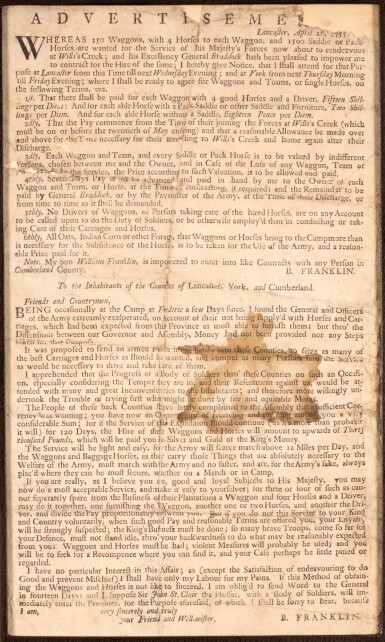
Advertisement[.] Lancaster, April 26, 1755. Whereas 150 Waggons, with 4 Horses to each Waggon, and 1500 Saddle or Pack-Horses are wanted for the Service of his Majesty’s Forces now about to rendezvous at Wills’s Creek; and his Excellency General Braddock hath been pleased to impower me to contract for the Hire of the same; I hereby give Notice, that I shall attend for that Purpose at Lancaster from this Time till next Wednesday Evening; and at York from next Thursday Morning ’till Friday Evening; where I shall be ready to agree for Waggons and Teams, or single Horses, on the following Terms viz. … Note. My Son William Franklin, is impowered to enter into like Contracts with any Person in Cumberland County. B. Franklin.
To the Inhabitants of the Counties of Lancaster, York, and Cumberland. Friends and Countrymen, Being occasionally at the Camp at Frederic a few Days since, I found the General and Officers of the Army extreamly exasperated, on Account of their not being supply’d with Horses and Carriages, which had been expected from this Province as most able to furnish them; but thro’ the Dissensions between our Governor and Assembly, Money had not been provided nor any Steps taken for that Purpose. … B. Franklin. [Lancaster: Printed by William Dunlap, 1755]
Letterpress broadside (338 x 206 mm, preserving deckle at fore- and lower edges and otherwise irregular) on a half-sheet of laid paper; chipped at top right corner with loss of one letter and portion of another, wear and repair at folds touching several letters, moderate sized stain at middle right. Hinged to a mat and mounted in a brown morocco portfolio gilt facing a portrait of Franklin.
“In January 1755 General Edward Braddock set sail for North America with two regiments of British infantry and a train of artillery. His objective: to capture Fort Duquesne, a French fortification in western Pennsylvania. The previous summer had been tumultuous. … General Braddock was sent to take military command of North America and reassert British authority over the frontier. … The governors of Virginia and Maryland had assured that sufficient wagons, pack horses, and forage would be available for the overland march. But these promises proved hollow: instead of two hundred fifty wagons, Braddock received twenty; instead of twenty-five hundred horses, he was furnished with two hundred. Braddock condemned the colonists as dishonest and dishonorable and threatened to seize what he had not been given. At this precarious juncture, Benjamin Franklin arrived at Braddock's headquarters, ostensibly on post office business. The Pennsylvania Provincial Assembly had, in fact, directed Franklin to allay the ‘violent Prejudices’ Braddock was said to harbor against the colony. On learning of Braddock's difficulties, Franklin opined that ‘it was a pity they had not been landed rather in Pennsylvania, as in that Country almost every Farmer had his Waggon’” (Houston, pp. 235–236).
Such was the genesis of this very scarce and significant French and Indian War broadside. Braddock contracted with Franklin—who had been with Braddock arranging postal communications for his army—to provide sufficient wagons and pack horses, even providing £800 for advance payments. Franklin proved far more successful at fulfilling his commission than Braddock did at his.
The broadside actually comprises two distinct communications from Franklin. The first is a straightforward explanation of the six terms under which wagons and horses will be hired for use on Braddock’s expedition. First, the daily fee paid “for each Waggon with 4 good Horses and a Driver … for each able Horse with a Pack-Saddle or other Saddle and … for each able Horse without a Saddle.” Second, the term of service. Third, all wagons and horses will be “valued by indifferent Persons, chosen between me [that is, Franklin] and the Owner, and in Case of the Loss of any … the Price according to such Valuation, is to be allowed and paid.” Fourth, the pay periods. Fifth, “No Drivers of Waggons, or Persons taking care of the hired Horses, are on any Account to be called upon to do the Duty of Soldiers, or be otherwise employ’d than in conducting or taking Care of their Carriages and Horses.” And sixth, “All Oats, Indian Corn or other Forage, that Waggons or Horses bring to the Camp more than is necessary for the Subsistence of the Horses, is to be taken for the Use of the Army, and a reasonable Price paid for it.”
The second message immediately follows, and is of a completely different tenor, essentially warning the Pennsylvanians resident in Lancaster, York, and Cumberland counties that their failure to take advantage of the arrangement he has made with Braddock could lead to the Army commandeering wagons and horses and drafting teamsters and farriers to drive and take care of them. So disparate are the two announcements that Fred Anderson, who perhaps had never seen the actual broadside but only knew its text, writes in his excellent monograph of the French and Indian War that Franklin composed and distributed two distinct broadsides (Crucible of War: The Seven Years' War and the Fate of Empire in British North America, 1754–1766, p. 93).
Franklin states in his second missive that until he made his contract with Braddock, “It was proposed to send an armed Force immediately into these Counties, to seize as many of the best Carriages and Horses as should be wanted, and compel as many Persons into the Service as would be necessary to drive and take care of them,” but he “apprehended that the Progress of a Body of Soldiers thro’ these Counties on such an Occasion, especially considering the Temper they are in, and their Resentment against us, would be attended with many and great Inconveniencies to the Inhabitants; and therefore more willingly undertook the Trouble of trying first what might be done by fair and equitable Means.”
Franklin continues by minimizing the demands of the service and explaining how everyone can participate and profit (he claims that the people of the three counties will earn “upwards of Thirty thousand Pounds, which will be paid you in Silver and Gold of the King’s Money”): “The Service will be light and easy, for the Army will scarce march above 12 Miles per Day, and the Waggons and Baggage Horses, as they carry those Things that are absolutely necessary to the Welfare of the Army, must march with the Army and no faster, and are, for the Army’s sake, always plac’d where they can be most secure, whether on a March or in Camp. If you are really, as I believe you are, good and loyal Subjects to His Majesty, you may now do a most acceptable Service, and make it easy to yourselves; for three or four of such as cannot separately spare from the Business of their Plantations a Waggon and four Horses and a Driver, may do it together, one furnishing the Waggon, another one or two Horses, and another the Driver, and divide the Pay proportionably between you.”
Those who do not participate, Franklin warns, will be suspected of disloyalty to the King, and, since “Waggons and Horses must be had; violent Measures will probably be used; and you will be to seek for a Recompence where you can find it, and your Case perhaps be little pitied or regarded.” In his closing paragraph, Franklin raises the specter of Sir John St. Clair (or Sinclair), deputy quartermaster general in North America, who was notorious for his violent temper and confrontations with settlers. “I have no particular Interest in this Affair; as (except the Satisfaction of endeavouring to do Good and prevent Mischief) I shall have only my Labour for my Pains. If this Method of obtaining the Waggons and Horses is not like to succeed, I am oblig’d to send Word to the General in fourteen Days; and I suppose Sir John St. Clair the Hussar, with a Body of Soldiers, will immediately enter the Province, for the Purpose aforesaid, of which I shall be sorry to hear, because I am, very sincerely and truly your Friend and Well-wisher.”
Whether it was the enticement of the wages offered or the fear of confiscation and impressment, the colonists rallied to the cause and more than sufficiently supplied Braddock for his march west through the uncleared Alleghenies towards Fort Duquesne. Daniel Boone and Daniel Morgan were employed as waggoners.
Despite the support provided by Pennsylvania farmers—and gifts of smoked hams, Jamaica rum, Madeira, sugar, butter, tea, coffee, and more lavished on junior officers by the Pennsylvania Assembly at Franklin’s behest—the British were routed as they approached Fort Duquesne. Braddock was mortally wounded and his forces suffered a casualty rate of more than sixty percent. Only one colonel survived, and under the shock of their introduction to frontier warfare—Braddock's men, under his orders, attempted to fight in European field formations—the British withdrew to Fort Cumberland, having destroyed most of their supplies and artillery.
Very rare: the Snider copy is one of perhaps five that survive. Only one other copy is recorded at auction, part of the Forest G. Sweet collection, sold at Parke-Bernet, 7 May 1957, lot 127; and ESTC locates only three copies in institutions: at the American Antiquarian Society, the American Philosophical Society, and the Boston Public Library.
"The wagon broadside would be a valuable addition to any library of American history. To a collection of Frankliniana its value is inestimable … moreover, [it] is the central piece of an episode which demonstrated Franklin's political mastery of the Pennsylvania back-country and which, second only to his published Experiments and Observations on Electricity, established his reputation among the English" (Bell & Labaree).
REFERENCES
Miller B65; ESTC W34633; Evans 7346 (ascribed to Franklin and Hall); Hildeburn 1394; Alan Houston, “Benjamin Franklin and the ‘Wagon Affair’ of 1755,” in The William and Mary Quarterly 66, no. 2 (2009):235–86; cf. Lemay, Life 3:425–430
PROVENANCE
Christie’s New York, 19 December 2002, lot 172 (undesignated consignor)
You May Also Like


