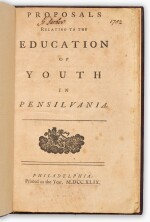
Benjamin Franklin | “probably the most fundamental thing ever done in the field of electricity”
Live auction begins on:
June 24, 06:00 PM GMT
Estimate
75,000 - 125,000 USD
Bid
45,000 USD
Lot Details
Description
Benjamin Franklin
Experiments and Observations on Electricity, made at Philadelphia in America, … and Commuinicated in several Letters to Mr. P. Collinson, of London, F.R.S. London: Printed and sold by E. Cave, at St. John’s Gate, 1751 [bound with:] Supplemental Experiments and Observations on Electricity, made at Philadelphia in America, Part II. London: Printed and sold by E. Cave, at St. John’s Gate, 1753 [and with:] New Experiments and Observations on Electricity. Made at Philadelphia in America. … To which are added A Paper on the same Subject by J. Canton … and another in defence of Mr. Franklin against the Abbe Nollet, by Mr. D. Colden, of New York. Part III. London: Printed and sold by D. Henry, and R. Cave, at St. John’s-Gate, 1754
3 parts in one volume, 4to (228 x 170 mm). First work with folding engraved plate by T. Jefferys and final leaf of advertisements for Cave’s publications, part II with errata to first part on P4v, part III with woodcut text illustration; some scattered minor foxing and soiling, P4 with repaired tear at lower margin, a couple of very tiny and virtually undetectable wormholes in the top margins of the first two parts, occasionally just touching a letter of a headline, part III evidently added to the first two parts at a somewhat later date and its final page quite soiled. Handsome retrospective calf-backed marbled boards using period materials, red edges to first two parts; rebacked. Half brown morocco folding-case gilt.
First editions. “The most important scientific book of eighteenth-century America” (Printing and the Mind of Man). Franklin's published reports of his experiments in electricity, written as a series of letters addressed to Peter Collinson, made him the first American scientist to secure an international reputation and led to his election as the first colonial American member of the Royal Society. In addition to the famous kite and key experiment, Franklin's work with Leyden jars, lightning rods, and charged clouds is summarized. The three publications of Experiments and Observations were issued with continuous pagination and signatures despite their irregular publication.
“The letters that Franklin had been sending to Collinson in London contained such novel and provocative experimental results and such a clear explanation of complex electrical phenomena, especially in using the recently discovered Leyden jar, that his letters were read at meetings of the Royal Society, and correspondence flourished with European savants engaged in electrical experimenting. Edward Cave, London publisher, perceived in Franklin's letters readership potential. With the sponsorship of Collinson, and Dr. John Fothergill as editor and writer of the unsigned preface, Franklin's Experiments and Observations on Electricity Made at Philadelphia, was published in London in 1751. The contents span a period reaching from a letter from Franklin to Collinson dated 28 July 1747; they discuss the properties of the Leyden jar and suggest eleven experiments in support of his conclusions. The book ends with ‘Opinions and Conjectures Concerning the Properties and Effects of the electrical Matter made in Philadelphia, 1749.’ In the 37 paragraphs of this lengthy letter Franklin emphasized the ‘operation of points’ in drawing off the electrical fire. He conjectured, ‘Now if the fire of electricity and that of lightning be the same, as I have endeavour'd to show at large in a former paper …’” (Dibner, 1976, pp. 13–14).
Franklin’s experimental proof of his theory “that the Electrical Fire was not created by Friction, but collected, being an Element diffused among, and attracted by other Matter, particularly by Water and Metals,” was termed by Robert Andrews Millikan, the 1923 Nobel Prize winner in physics, “probably the most fundamental thing ever done in the field of electricity” (quoted in Lemay, Life 3:69).
REFERENCES
Dibner 57; Grolier/American 10; Grolier/Horblit 31a; Norman 830; Printing and the Mind of Man 199; Sabin 25505; Streeter sale 7:4151; cf. Dibner, Benjamin Franklin Electrician (1976)
PROVENANCE
Wakefield Mechanics Institute (ink stamp to title-page of Part III)
You May Also Like