

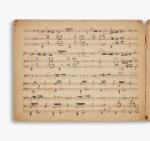
Christoph Willibald Gluck | Autograph manuscript of part of the celebrated air 'J’ai perdu mon Eurydice' from "Orphée et Eurydice", 1774
Estimate
60,000 - 80,000 GBP
We may charge or debit your saved payment method subject to the terms set out in our Conditions of Business for Buyers.
Read more.Lot Details
Description
Christoph Willibald Gluck
Autograph manuscript of part of the celebrated air “J’ai perdu mon Eurydice” from Orphée et Eurydice
A WORKING DRAFT DIVERGING FROM THE FIRST EDITION, including changes to the music and text, beginning with the accompanied recitative for Eurydice and Orphée (“[Reçois] donc mes derniers adieux”), including Orphée’s fatal backward glance and Eurydice’s death, and concluding with the opening twenty-five bars of Orphée’s air (up to the Adagio “C’est ton amant”), in score, for voices and instruments, notated in dark brown ink on three five-stave systems per page, some annotations in pencil and red crayon, with deletions, smudging, and alterations, the manuscript extensively reworked by the composer, including a revision of the passage leading up to Eurydice’s death, notated on a single stave at the foot of the first page, with some earlier passages, diverging from the final published versions, still legible (including “objet de mes amours”)
4 pages, folio (c. 300 x 230 mm), 16-stave paper, [1774], a few minor tears, a little paper loss caused by oxidation of the ink, some spotting and staining, strengthened at spine
THIS IS THE AUTOGRAPH MANUSCRIPT OF ONE OF THE MOST FAMOUS ARIAS IN ALL OPERA; IT IS WITHOUT DOUBT THE MOST IMPORTANT MANUSCRIPT BY GLUCK TO HAVE BEEN OFFERED AT AUCTION.
This is a working manuscript, containing Gluck’s draft of the crucial scene preceding Orphée’s famous air, where, having been forbidden to look back at Eurydice as he leads her out of the underworld, the hero finds he is unable to resist her plaintive cries, glances at her, and causes her death. Gluck has deleted early versions of several passages in Orphée’s part and extensively remodelled them, the earlier drafts still visible under his heavy deletions; some of these reveal different words as well as different music from the final versions known today.
The moment of Eurydice’s death is underscored by the momentary singing together of the two voices (not found in the Italian version), and this too is subject to deletions and revisions. Gluck deletes the first version of the words and writes the revision at the foot of the page (“Eu Orfée o Ciel je Meurs”). Even the words of Orphée’s “J’ai perdu mon Eurydice” are different, the second line “…rien n’égale mon Malheur” here given as “j’ai perdu tout mon bonheur”; similarly the words “c’est ton Epoux” of the Adagio are given here as “c’est ton amant”.
Gluck originally wrote Orfeo ed Euridice as an opera in Italian (Vienna, 1762), with the hero sung by a castrato. No autograph manuscript survives: the first edition is the primary source for the Vienna version. The composer greatly amplified the opera for Paris in 1774, rewriting the hero’s part for haut-contre (a high tenor). There is no complete autograph manuscript of the Paris version, though sections survive in Paris, Berlin and Stanford, amounting to roughly two-thirds of the score. In the present manuscript, Orphée’s part is notated in the alto clef, although the composer mistakenly began writing part of the opening of the air in the tenor clef.
This air has been celebrated as a star vehicle for mezzo sopranos and contraltos from Pauline Viardot in the nineteenth century to the present. It was especially beloved in this country as “What is life to me without thee?”, as sung by the great contralto Kathleen Ferrier.
PROVENANCE:
Sale in these rooms, 3 December 2008, lot 35
You May Also Like
![Ludwig van Beethoven | Autograph sketches for the overture "Die Weihe des Hauses", op.124, [1822], UNPUBLISHED](https://sothebys-md.brightspotcdn.com/dims4/default/c565f6d/2147483647/strip/true/crop/5422x4429+0+0/resize/150x123!/quality/90/?url=http%3A%2F%2Fsothebys-brightspot.s3.amazonaws.com%2Fmedia-desk%2Fe6%2F74%2Feb15ba294c6a972baac55d9ba11c%2Fl26402-dldkj-t1-13.jpg)


![[Pernambuco] | First printed work in favor of Brazilian Independence](https://sothebys-md.brightspotcdn.com/dims4/default/b0a5319/2147483647/strip/true/crop/1393x2000+0+0/resize/150x215!/quality/90/?url=http%3A%2F%2Fsothebys-brightspot.s3.amazonaws.com%2Fmedia-desk%2Fwebnative%2Fimages%2Ff0%2F8e%2Fa8df300d4deabce1402f19d0f73b%2Fn12191-dlyqm-t1-01-cropped.jpg)


