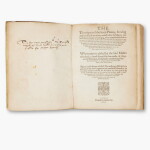
Blundeville, Thomas | The Theoriques of the Seven Planets …, London, 1602, first edition, contemporary limp vellum
Live auction begins on:
October 20, 02:00 PM GMT
Estimate
10,000 - 15,000 USD
Bid
9,000 USD
Lot Details
Description
Blundeville, Thomas
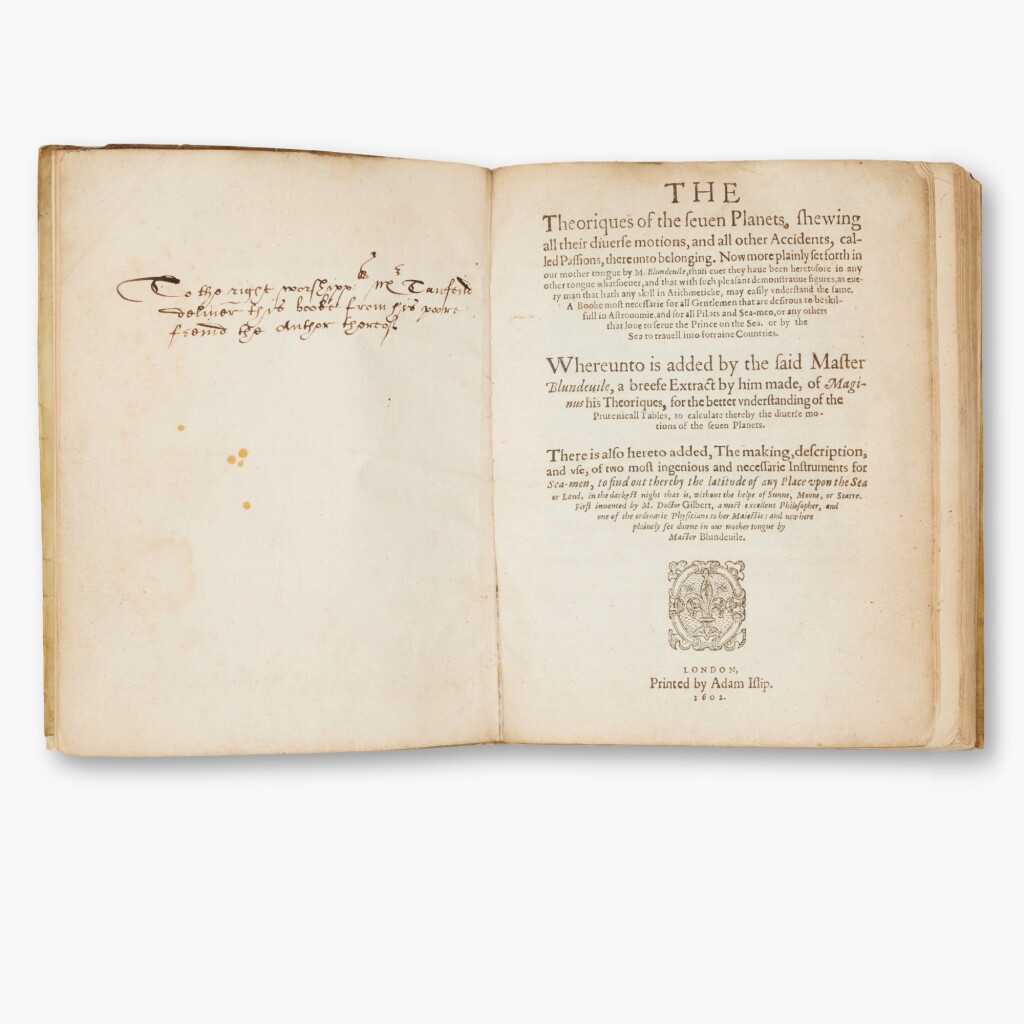
The Theoriques of the Seven Planets. … A Booke most necessary for all Gentlemen that are desirous to be Skilful in Astronomie, and for all Pilots and Sea-men. … There is also hereto added, The Making, Description, and Use, of Two most ingenious and necessary Instruments for Sea-men, to find out thereby the Latitude of any Place upon the Sea or Land, in the darkest night that is, without the help of Sunne, Moone, or Starre. First invented by M. Doctor Gilbert. London: Adam Islip, 1602
First edition. Evidently a presentation copy, with an inscription on the initial blank leaf: "To the right worshipp: Mr. Tanfeild deliver this booke from his poore friend the author thereof." In a typed letter to Robert Dunham, 30 July 1981, that accompanies this volume, Owen Gingerich wrote, "It seem that the book is inscribed to Mr. Tanfeild [sic] rather than Tannsforrd as Dawson's read it for you. Sir Lawrence Tanfield was admitted to the Inner Temple in 1569 and knighted after Blundeville had died; the Inner Temple connection is quite nice, I think. There is at least some indication that Blundeville's book was published posthumously, in which case the inscription would be made by a friend carrying out Blundeville's wishes, rather than in his own handwriting. For the time being, I will have to be somewhat guarded about accepting this as Blundeville's own hand."
While the date of Blundeville’s death remains uncertain, it is most commonly given as “ca. 1606.” Whether the inscription is Blundeville’s autograph or not, it seems accurate to consider this a presentation copy.
“Blundeville's work on the planets, an illustrated book of some bulk, showing their motions, was undoubtedly erudite, but its practical value must really have been small. The most important part was the appendix, and of that the most valuable was the final sheet of paper. This embodied the results of [Henry] Briggs's laborious calculations, doing away with the need for a dip- dial” to determine latitude (D. W. Waters, The Art of Navigation in England in Elizabethan and Early Stuart Times, p. 248).
Two parts in one volume, 4to (184 x 146 mm). Each part with separate title-page, numerous woodcut diagrams, with the initial blank but wanting the folding diagram and terminal blank, volvelle at F3 disassembled but laid in; a few minor paper defects. Contemporary limp vellum, horizontal spine title, modern morocco lettering piece; a few edges expertly renewed, ties lost.
REFERENCES
Adams & Waters 218; ESTC S117447; Honeyman Sale I:357; Mottelay, p.94; STC 3160; Wheeler gift 74
PROVENANCE
Sir Laurence Tanfield (presentation inscription; see above) — Robert S. Dunham (acquired from Dawsons on 16 November 1970; Sotheby's New York, 11 December 1993, lot 642)
![Kepler, Johannes | Harmonices Mundi Libri V, Linz, 1619, first edition, [bound with:] Prodomus dissertationum cosmographicum …, Frankfurt, 1621–1622](https://sothebys-md.brightspotcdn.com/dims4/default/d54d010/2147483647/strip/true/crop/2000x2000+0+0/resize/150x150!/quality/90/?url=http%3A%2F%2Fsothebys-brightspot.s3.amazonaws.com%2Fmedia-desk%2Fwebnative%2Fimages%2F63%2F0b%2Fa27794664ee78085e15afe3c5535%2Fn12451-58tmv-t1-05.jpg)



![Euclid | Geometricorum elementorum libri xv, Paris, [1517], first edition of Euclid to be printed outside of Italy, extensive early modern marginalia](https://sothebys-md.brightspotcdn.com/dims4/default/8662503/2147483647/strip/true/crop/2000x2000+0+0/resize/150x150!/quality/90/?url=http%3A%2F%2Fsothebys-brightspot.s3.amazonaws.com%2Fmedia-desk%2Fwebnative%2Fimages%2F62%2F7c%2F8b628e9a4ce981cee9cab085d772%2Fn12451-bkf9m-t2-03.jpg)
