
THE PROPERTY OF THE BEAVERBROOK FOUNDATION
Thomas Faed
When the Day is Done
Lot closes
April 15, 12:57 PM GMT
Estimate
30,000 - 50,000 GBP
Starting Bid
26,000 GBP
We may charge or debit your saved payment method subject to the terms set out in our Conditions of Business for Buyers.
Read more.Lot Details
Description
The Property of the Beaverbrook Foundation
Thomas Faed
1826-1900
When the Day is Done
signed and dated Thomas Faed. 1870 lower left
oil on canvas
unframed: 128 x 152.5 cm.; 50⅜ x 60 in.
framed: 136 x 171 cm.; 53½ x 67⅜ in.
Ernest Gambart, London, sold to James Houldsworth, Coltness House, Wishaw, North Lanarkshire by 1874 and until 1901;
Edward F. White, London;
Navy, Army and Air Force Institute, Glasgow;
Ian MacNichol, Glasgow;
Bought by Max Aitken, 1st Lord Beaverbrook (1879-1964) and thence to the present ownership.
London, Royal Academy, 1870, no.192;
Edinburgh, Royal Scottish Academy, 1874, no.261;
Glasgow International Exhibition, 1888, no.275;
Glasgow International Exhibition, 1901, no.299;
Glasgow Museum and Art Gallery, Scottish Exhibition of Natural History, Art and Industry, 1911, no.524;
Beaverbrook Art Gallery, Victorian Painting in the Beaverbrook Art Gallery, 1989, no.21;
Beaverbrook Art Gallery, Britanica: British Paintings from the Permanent Collection, 2004-2005.
The London Scotsman, 'Scotland in the Royal Academy', 7 May 1870;
Art Journal, 1870, p.165;
James L. Caw, Scottish Painting: Past and Present, 1908, p.165, illus. opposite p.164 as The End of the Day;
Stanley Cursiter, Scottish Art, 1949, p.101;
Christopher Wood, The Dictionary of Victorian Painters, 1978, p.148;
Mary McKerrow, The Faeds: A Biography, 1982, pp.96, 118, 152.
'It has been said that Thomas Faed has done for Scottish art what Robert Burns did for Scottish song. He has made it attract universal interest and command universal respect.' ENCYCLOPAEDIA AMERICANA, 1886
Born in Gatehouse of Fleet, Scotland, Thomas Faed was the son of James Faed, a skilled millwright. He was one of six children, two of whom, his brothers James and John, were also accomplished artists. After the death of his father in 1843, Thomas moved to Edinburgh to assist his brother John in the production of miniatures, but soon began to achieve artistic acclaim in his own right. He attended the Trustees Academy, and was soon widely praised for the work he exhibited at the Scottish Royal Academy beginning in 1849. Following his move to London in 1851, he established his popularity with the London viewing public with Mitherless Bairn, which was exhibited at the Royal Academy in 1855. Faed exhibited at the Academy up until 1893, showing more than a hundred works. In terms of artistic legacy, Thomas Faed is most well known for his rustic scenes of seemingly everyday Scottish life, which proved immensely popular with the Victorian viewing public. The strong narrative, the carefully observed and depicted elements of character, and the representation of the quaint rural lower classes all proved appealing to a new group of emerging buyers, particularly to northern industrialists. The type of genre scenes which he painted catered to both the critical and the viewing public. He was a worthy successor to David Wilkie who had painted similar scenes earlier in the century.
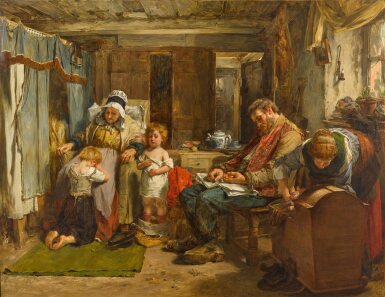
The present work, which relates to a smaller version of the same composition and date entitled Saying Prayers (Christie's Scotland, 26 October 2006, lot 113), shows a rural Scottish family preparing for their evening rest after a hard days labour. As the twilight streams in through the window, the ruddy-faced father succumbs to his fatigue, his head lolled and legs buckled; the mother gazes fondly down at the infant she places in the cradle; and the little boy in tattered garb says his evening prayers as his grandmother looks on. Here the viewer is presented with a rural family who are clearly needy, as demonstrated by their outfits, furnishings and cramped quarters, but who are also industrious, morally sound, content, and loving. It was this demonstration of a set of virtues encompassed by the rural poor, which Victorian viewers found so appealing, and it was in this mode that Faed excelled. Viewers were not only impressed by Faed's subject but by the level of visual and narrative detail seen in works such as this. When the Day is Done is an excellent example of the type of narrative paintings Victorians revelled in engaging with, slowly 'reading' and interpreting not only the psychological relationships between the characters but each of the various domestic objects. One sees the dirt and mud on the father's worn boots, a testament to his labour, as well as the lively blue and white tea set, a picture hidden behind the curtain, the postered bed tucked away to one side, each element adding richness to the underlying story as well as to the composition.
When the Day is Done was immensely popular with the public when it was exhibited at the Royal Academy in 1870. It attracted a vast crowd and drew various heated responses from the critics. The 'London Scotsman [commented] that it was a wonder the crowd was not even larger, so exquisite did the writer consider the picture in its homeliness and truthfulness. He criticised The Times for considering the composition crowded and remarked, "When somebody asked Stephenson what would be the effect of his locomotive running up against a cow, his reply was, 'It would be bad for the coo.' So the overcrowding to which the Times refers might be bad for the labourer's family in a sanitary point of view, although to be sure they all look healthy enough; but the picture is a true one in the minutest detail, and whoever wishes to study a piece of careful painting let him inspect the gudeman's plush waistcoat and the bit of faded drugget on which the laddie is kneeling at his prayers."' (Mary McKerrow, The Faeds: A Biography, 1982, p. 118)
You May Also Like


