
THE PROPERTY OF THE BEAVERBROOK FOUNDATION
Sir William Quiller Orchardson, R.A.
The Duke’s Antechamber
Lot closes
April 15, 12:58 PM GMT
Estimate
10,000 - 15,000 GBP
Starting Bid
9,000 GBP
We may charge or debit your saved payment method subject to the terms set out in our Conditions of Business for Buyers.
Read more.Lot Details
Description
The Property of the Beaverbrook Foundation
Sir William Quiller Orchardson, R.A.
1832-1910
The Duke’s Antechamber
oil on canvas
unframed: 105 x 191 cm.;
framed: 126 x 213 cm.;
Mr Octavius Edward Coope, M.P., Rochetts, near Brentwood, Essex by 1878, his sale Christie's, London, 16 February 1910, lot 26;
James Kitson, 1st Lord Airedale (1835-1911), by descent to his son Albert Kitson, 2nd Lord Airedale (1863-1944) and in his collection as late as 1942;
Morris Mandl, New York;
London, Christie's, 2 December 1960, lot 88;
M. Newman Ltd, London;
Bought by Max Aitken, 1st Lord Beaverbrook (1879-1964) and thence to the present ownership.
London, Royal Academy, 1869, no. 103;
Paris Universal, 1878, no.194 as L'Antichambre;
London, Royal Academy, Winter Exhibition of Works by Recently Deceased Members, 1911, no.39;
Plymouth City Art Gallery, Old Masters from London Galleries, 1961, no.24;
Edinburgh, Royal Scottish Academy, Aberdeen Art Gallery, Dundee City Art Gallery, Manchester City Art Gallery, Laing Art Gallery, Newcastle, Fine Art Society, London and Glasgow City Art Gallery, Sir William Quiller Orchardson R.A., 1972, no.17;
Beaverbrook Art Gallery and tour to other Canadian museums, Victorian Painting in the Beaverbrook Art Gallery, 1989-1990.
Athenaeum, 1869, vol. I, p.675;
Art Journal, 1869, p.163;
Times, 1 May 1869, p.12;
London Weekly Dispatch, 1 May 1869, p.18
Illustrated Times, 8 May 1869, p.10
The London Scotsman, 8 May 1869, p.10
Watford Observer, 8 May 1869, p.4
The Scotsman, 10 May 1869, p.6
James Dafforne, 'British Artists: Their Style and Character, William Quiller Orchardson, A.R.A.', in Art Journal, 1870, p.244;
Hilda Orchardson Gray, The Life of Sir William Quiller Orchardson, 1930, p.12;
Mark Girouard, Sweetness and Light: The Queen Anne Movement 1840-1900, 1977, p.138.
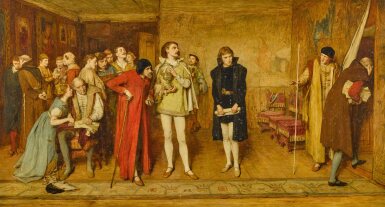
The Duke's Antechamber is a relatively early work by Orchardson painted at a time when he was seeking critical acclaim with a series of depictions of Shakespearian romance painted in his London studio, although in this case the subject appears to be an allegory of wealth and poverty. The influence of John Everett Millais is clear in Orchardson's paintings of the 1860s and it was the narrative force and technical dexterity that earned him Associateship of the Royal Academy in 1869, a year before he exhibited The Duke's Antechamber.
When the picture was exhibited at the Royal Academy it was highly acclaimed, one critic writing; 'The Duke's Antechamber is very cleverly treated by Mr. Orchardson' (Athenaeum, 1869, p.675) whilst another wrote that; 'Unquestionably the work has done much to advance the reputation of the painter in public opinion' (James Dafforne, 'British Artists: Their Style and Character, William Quiller Orchardson, A.R.A.', in Art Journal, 1870, p.244) and another felt that it was 'The greatest work the artist has yet produced.' (Art Journal, 1869, p.163)
‘…perhaps the most striking picture in this room is Mr. Orchardson’s “Duke’s Antechamber”, a realistic work that requires, and will well bear, study for its due appreciation, so full is it in character and expression.’ (Illustrated Times, 8 May 1869, p.10)
‘”The Duke’s Ante-chamber”, by Mr. Orchardson, must be admitted to be one of the pictures of the year. It is the only work he exhibits. The scene is the ante-room of an art-patron in the middle ages, with a group of a dozen or more needy supplicants, among whom are a young pale-faced, half-starved-looking poet, with manuscript in hand, a sculptor with a silver cup, an alchemist, a musician, a monk, and an old soldier, careworn and dejected, tended by his daughter – each waiting his turn for an audience with my lord. The work offers a perfect study of character, and is marvelously picturesque in colour and texture – astonishingly clever. The artist has, we understand, sold this picture for the liberal sum of a thousand guineas.’ (The London Scotsman, 8 May 1869, p.10)
‘Mr. Orchardson’s “Duke’s Ante-chamber” holds distinguished rank. It is one of the most popular pictures of the year, and also obtains deserved critical commendation… A gentlemen usher is showing one of the Duke’s clients into the inner room, and there is a clutter of mingled expectation and impatience amongst the rest. A somewhat rusty poet, with a dedication to offer, is evidently conning over an elaborate compliment he has prepared to conciliate the great man. The Cellini of the day holds his fine cup, all “rich and rough with stories of the gods,” proudly in his arms, confident that it will speak for him. A little girl whispers her grandfather, who has a “sifilication” of some kind to make, that his turn will not be long now. The miscellaneous throng of loungers, some prim and dapper, others rough and swaggering, but all equally ready to bow to the knee to His Highness, fill up the canvas.’ (The Scotsman, 10 May 1869, p.6)
‘Of Mr. Orchardson’s “Duke’s Ante-chamber” it would be difficult to over-express the merits, and our space does not allow us at present to attempt to estimate them. No one can study that picture without acknowledging that Mr. Orchardson has the ability to do much for the future of English art.’ (London Weekly Dispatch, 1 May 1869, p.18)
‘The “Duke’s Antechamber,” by Mr. Orchardson, is capital, and is excellent in every way; it is, however, somewhat a reminder of Hogarth’s scene in the “Rake’s Progress.” The anxious look of the beggared but respectful retainer, whose heart and spirits his daughter is trying to re-assure; the sly and uninviting look of the cure; the careless and half-worn-out habit of the poet; the triumphant deportment of the lucky man who has gained the first audience of his Highness; the contemptuous glance of the fool at the pet dog, valuable doubtless for its exceeding ugliness; and the scowl on the features of the bravo, - all tend to perfect the picture and to please.’ (Watford Observer, 8 May 1869, p.4)
You May Also Like


