Boris Izrailevich Anisfeld
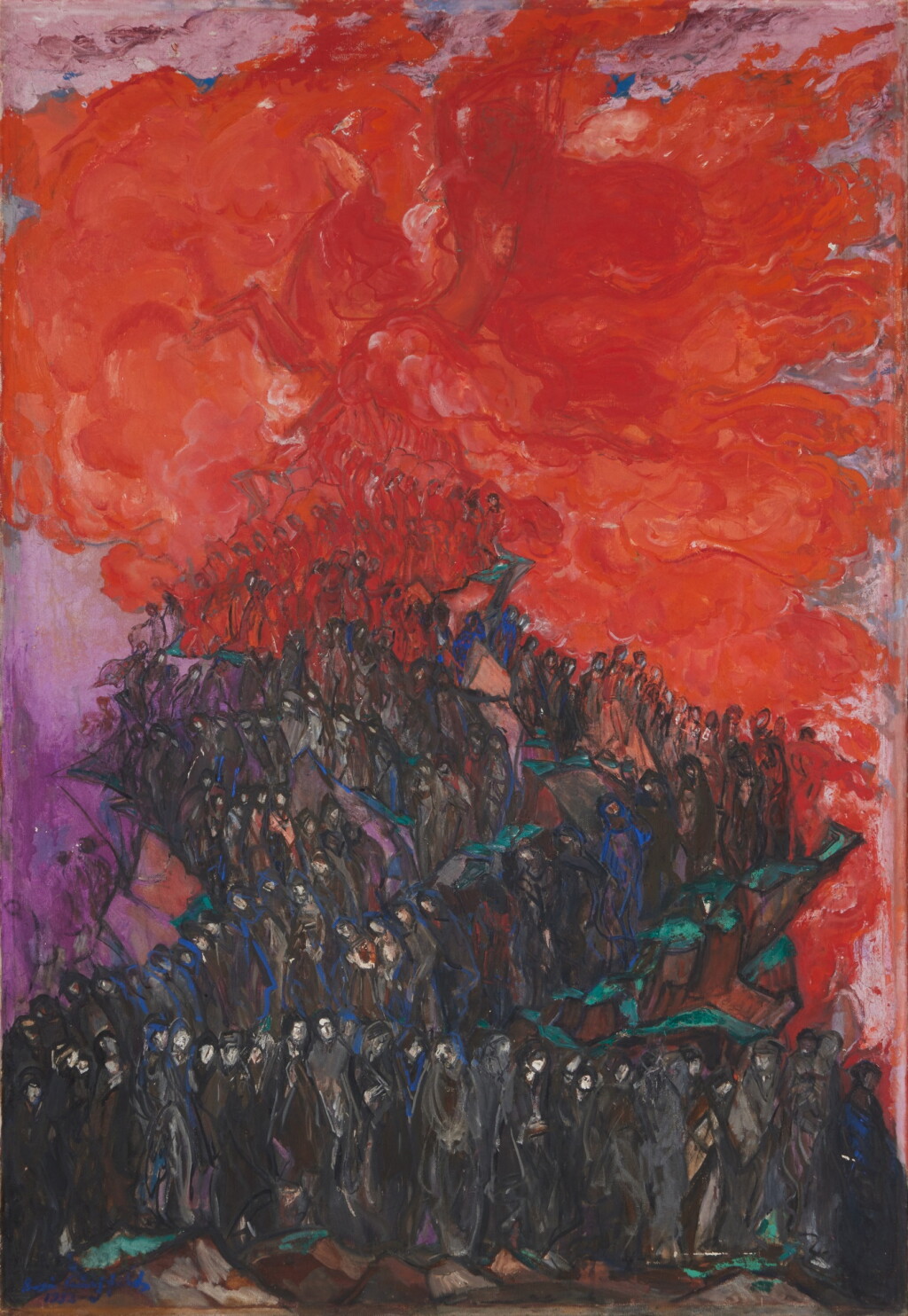
Rhapsody II
Lot closes
October 9, 04:39 PM GMT
Estimate
25,000 - 35,000 USD
Starting Bid
25,000 USD
We may charge or debit your saved payment method subject to the terms set out in our Conditions of Business for Buyers.
Read more.Lot Details
Description
Boris Izrailevich Anisfeld
1878 - 1973
Rhapsody II
signed Boris Anisfeld and dated 1953-4 (lower left); titled and inscribed 133 (on the reverse)
oil on canvas
55 by 37 ½ in.
137.5 by 92 cm.
Executed in 1953-54.
Dr. John Ignatius Perl, Chicago (acquired directly from the artist)
Private Collection, United States (acquired by descent from the above)
Acquired from the above by the present owner
Eckart Lingenauber and Olga Sugrobova-Roth, Boris Anisfeld Catalogue Raisonné, Dusseldorf, 2011, no. P 044, p. 104, illustrated
The Art Institute of Chicago, Boris Anisfeld. Retrospective Exhibition, 1958, no. 52, illustrated
Rhapsody II (1953) is one of a trio of paintings by Boris Anisfeld, which also includes Rhapsody (1942) and Rhapsody III (1956). These late paintings testify to his abiding Symbolist vision and exhilarating use of colour, which had, back in 1918 (a year after Anisfeld’s arrival in the United States) been styled by critic L. Mechlin as ‘…a decadence which was dangerous to the mental health of young American Americans.’
Anisfeld’s Symbolist influences were numerous. He was closely associated with the Moscow-based Symbolist group The Blue Rose, although he was not represented at their 1907 eponymous exhibition. Despite his academic training under the overarchingly realist Ilya Repin, Anisfeld, even early on, inclined more towards the symbolism of Mikhail Vrubel. While his mystic proclivities and catholic use of religious and mythological symbol were nothing unusual for his time and environment, descriptions of Anisfeld’s personality – mercurial, spiritual, reclusive – confirm him as an inveterate Symbolist right up until his death in Connecticut in 1973, long after the movements in both Europe and Russia had waned.
In 1906, eleven years before Anisfeld moved to America, he was invited by Sergei Diaghilev to design the sets for the opera Boris Gudenov, alongside artists Konstantin Yuon and Stepan Yaremich. He would go on to have brilliant career in theatre design, both for and outside the Ballets russes, and later in New York and Chicago. In his own words 'no less a musician than an artist', his Symbolism was fundamentally musical in nature, concerned with principles of rhythm, harmony, movement, and repetition. He had close ties with the composers Rachmaninov and Prokofiev, collaborating with the later on his opera The Love for Three Oranges in Chicago.
The word ‘Rhapsody’ is pleasingly representative of Anisfeld’s artistic vision in its musical, literary, and biblical associations. In it connotes contrast, a freedom of form, a sense of spontaneity. In literature: the epic poem, or any dramatic expression of feeling. Finally, in the Bible, ‘rhapsody’ refers to an ecstatic declaration of faith and human emotion, and its eschatological undertones feel particularly relevant to the present work. Here, Anisfeld allows his crimson, present but not dominant in the other two paintings, to flare into an apocalyptic blaze.
You May Also Like