
Property of a Private Collector
Bernard Perlin
Colosseum
Lot closes
October 9, 04:38 PM GMT
Estimate
15,000 - 25,000 USD
Starting Bid
14,000 USD
We may charge or debit your saved payment method subject to the terms set out in our Conditions of Business for Buyers.
Read more.Lot Details
Description
Property of a Private Collector
Bernard Perlin
1918 - 2014
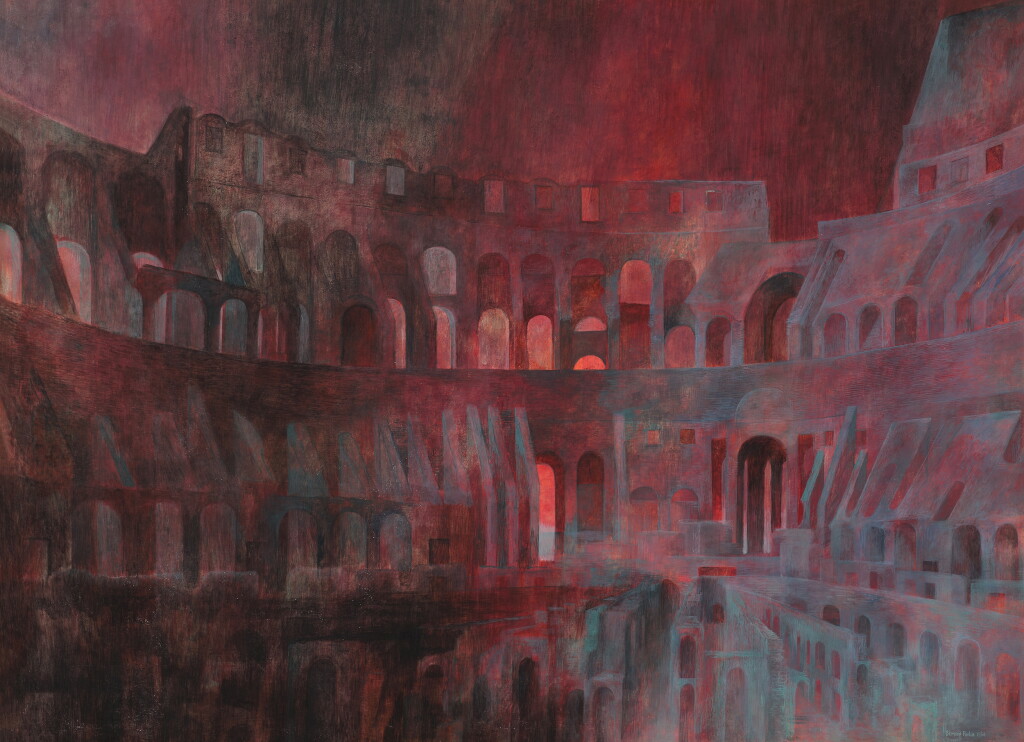
Colosseum
signed Bernard Perlin and dated 1954 (lower right)
tempera on Masonite
34 by 47 ¼ in.
86.4 by 120 cm.
Executed in Rome in 1954.
Catherine Viviano Gallery, New York (acquired directly from the artist)
Hugh Chisholm, Jr., Big Sur, California (acquired by 1955)
Mr. and Mrs. Joseph M. Field, New York (acquired in 1960)
Mr. and Mrs. Frederick H. Von Stade, New York (acquired by descent from the above)
Private Collection
Private Collection (acquired from the above in 2019)
Sotheby’s, New York, 17 May 2023, lot 485 (consigned by the above)
Acquired at the above sale by the present owner
New York, Catherine Viviano, Bernard Perlin, 1955, no. 7
University of Illinois, Urbana, Contemporary American Painting and Sculpture, 1955, no. 102, pl. 108, illustrated
New York, Whitney Museum of American Art; San Francisco Museum of Art; University of California, Los Angeles, Art Galleries; Colorado Springs Fine Arts Center; City Art Museum of St. Louis, The New Decade: 35 American Painters and Sculptors, 1955-56, p. 64, illustrated
Brussels, Universal and International Exhibition, Seventeen Contemporary American Painters, 1958, no. 148, p. 76
Emily Genauer, “Art and Artists: Will Pictures Talk to Us Again?,” New York Herald Tribune, 9 January 1955, p. E9
“Americans at Brussels: Soft Sell, Range & Controversy,” Time, June 1958, vol. 71, p. 72, illustrated in color (titled Coliseum and dated 1953)
William L. Vance, America’s Rome, vol. 2, New Haven and London, 1989, p. 432
Michael Schreiber, One-Man Show: The Life and Art of Bernard Perlin, Berlin, 2016, pp. 167 and 191
Bernard Perlin, a Richmond-born painter who first gained recognition as a wartime artist-correspondent for Life and was later associated with the Magic Realists, had a long attachment to Italy, where he had lived as a Fulbright fellow in the late 1940s. Perlin returned to Rome in 1954, a stay he described as “fruitful” (Michael Schreiber, One-Man Show: The Life and Art of Bernard Perlin, Berlin, 2016, p. 167). There, he painted the present work, Colosseum, along with further views of Italian landmarks such as The Spanish Steps and Piazza Navona. All three were included in his first one-man-show back in New York, held at the Catherine Viviano Gallery in 1955. Reviewing the exhibition for the New York Herald Tribune, a critic singled out Perlin’s willingness to take on the most universal of subjects, the Colosseum among them, and to approach them with wonder, fresh perspectives, and refreshing imagination. Perlin’s own explanation was disarmingly simple: as he grew older, he said he had come to realize “that all the cliches we grew up rebelling against are true. The Colosseum at night is beautiful” (quoted in Emily Genauer, “Art and Artists: Will Pictures Talk to Us Again?,” New York Herald Tribune, 9 January 1955, p. 9).
The painting went on to become one of Perlin’s most visible works: shown in the 1958 World’s Fair in Brussels, it caught the eye of Eleanor Roosevelt herself, along with another work by Perlin. Rendered in smoldering reds and muted greys and blues, Colosseum looks into the ancient amphitheater's hollowed interior, where tiers of arches glow against a fiery sky and the exposed passageways of the arena floor dissolve into shadow. For a painting built on one of the most familiar and reproduced subjects in the world, it has proven a fitting vindication of Perlin’s belief that the old, classic postcard images still had something to say.
You May Also Like


