
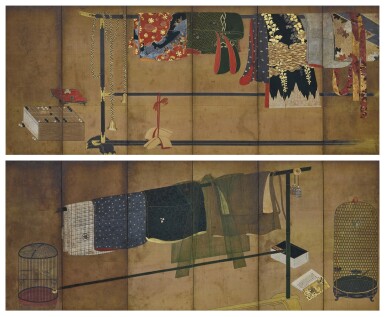
Anonymous, Whose Sleeves? (Tagasode), Edo period, early 17th century | 誰ヶ袖図屏風 江戸時代初期 17世紀
Session begins in
September 4, 02:00 AM GMT
Estimate
300,000 - 500,000 HKD
Lot Details
Description
pair of six-panel folding screens: ink, colour, gold and gofun on paper, silk brocade borders, lacquered wood mounts
each screen approx. 116 x 276 cm. (when unfolded)
each screen approx. 116 x 46 cm. (when folded)
Hasunuma Family
Rimpa meihinten [Rimpa: The Debut of Essential Rimpa Masterpieces in the Okada Museum of Art Collection], Mitsukoshi (Nihonbashi), Tokyo, 2015, cat. no. 2.
Bi no suta-tachi Korin Jakuchu Hokusai joyo nado meihin zoroi [5th Anniversary Exhibition. All-Stars of the Okada Collection: Masterworks of Korin, Jakuchu, Hokusai and the Ru Ware Kilns], Okada Museum of Art, Hakone, 2018-19, exh. no. 422 (unillustrated).
Kobayashi Tadashi ed., Masterpieces of the Okada Museum of Art, vol. 1, Tokyo, 2019, no. 89.
More than its colour,
the fragrance moves me –
whose sleeves, brushing past
left this scent of plum blossoms
at my door?1
Iro yori mo
ka koso aware to
omohoyure
tagasode fureshi
yado no ume zo mo
In the genre painting subject known as Tagasode [lit. ‘another's sleeves’], the viewer is immediately confronted with the question: who is the wearer of these garments? The owner of these sumptuous belongings is expressed in absentia, conveyed through the fashionable patterning and personal accessories arranged on the garment stands. Following a general trajectory toward abbreviation in Edo period (1615-1868) genre painting, such screens evoke an absent presence – an unseen figure of taste and fashion, conjured through dress alone, without face or figure.
Many genre paintings of Japan's early modern period feature men and women dressed in kosode [lit. ‘short sleeves’], which by the Momoyama period (1568-1615) denoted a kimono with narrow hand openings that had become the common outer garment across all classes. The townscape of the period would have appeared a rich tapestry of embroidered silk in motion: the regular, symmetrical designs of the earlier seventeenth century gave way in its latter half to bolder and more asymmetrical forms. Under the strict social order of the Pax Tokugawa, sumptuary edicts enforced status distinctions through dress; it was most often the fashions of the unofficial world (oku) – free to experiment without such constraint – and the demands of the merchant classes and denizens of the floating world, that drove the period's many stylistic shifts.
The theme of Tagasode has roots in classical love poetry, where the phrase evoked a beautiful woman whose presence was longed for. Such screens draw their name from precisely this conceit: the garments draped over a kimono rack hint at the beauty of an unseen wearer. The theme can be traced to the Heian period (794-1185), when the language of robes carried particular significance. Court women customarily veiled themselves behind curtains or screens; a young, inquisitive suitor might glimpse her sumptuous robes and judge her aesthetic sophistication and amorous potential from them alone. Lovers of the period also exchanged waka, the thirty-one syllable court poetry rich in insinuation and veiled meaning, in which incense-scented robes could stand in for an otherwise inaccessible woman. Sleeves were so bound up with the person of the wearer that emotional distress itself was conventionally expressed through them, as in nururu sode [sleeves sodden with tears] or sode no tsuyukeki [sleeves still drenched with dew].
Here, what hangs on the kimono rack is military-class dress, both male and female. A sugoroku board, books, incense burner, and unusually for Tagasode screens, two birdcages housing skylarks or bush warblers are arranged around the stand. On the right screen, women’s and children's kosode are painted with embroidery details and gold and silver surihaku, forming lively, bold designs of golden wisteria fronds and autumn foliage. One robe bears a design of stylised snowflake motifs and karako throwing snowballs. On the left screen, a man's formal kamishimo and a woman's kosode, are emblazoned with family crests and are more subtly patterned. The gauziness of the kamishimo kataginu indicates summer wear. The pairing of adult and children's garments suggests an entire household evoked through dress.
1. Kokin wakashu [Collection of Japanese Poetry Ancient and Modern], Book 1 (Spring I), no. 33.
來源
蓮沼家舊藏
展覽
《琳派名品展》,三越(日本橋),東京,2015年,編號2
《美のスターたち-光琳・若冲・北斎・汝窯など名品ぞろい-》,岡田美術館,箱根,2018–19年,展覽編號422(沒載圖)
出版
小林忠編,《岡田美術館名品撰》,卷1,東京,2013年,編號89
在被稱為「誰之袖」(Tagasode)的風俗畫主題中,觀者立刻會面臨一個問題:這些衣物的主人是誰?這些華麗物品的主人並未現身,而是透過衣架上排列的時尚圖案與個人飾品來表達。隨著江戶時代(1615–1868年)風俗畫走向簡約的總體趨勢,這類屏風喚起了一種「缺席的存在」,一種僅透過服飾,在沒有面容或身姿的情況下,勾勒出一位品味高雅、引領潮流的未露面人物。
日本近世早期的許多風俗畫都描繪了身穿「小袖」(kosode)的男女。到了桃山時代(1568–1615年),小袖已成為袖口狹窄的和服代名詞,並成為各階層普遍穿著的外衣。當時的街景宛如一幅流動的華麗絲綢刺繡織錦:十七世紀早期規整、對稱的設計,在後半葉讓位於更大膽、不對稱的圖案。在德川幕府治世的嚴格社會秩序下,禁奢令強制規定了透過服飾來區分階級地位;因此,往往是內室(oku)的時尚可以不受此限制自由嘗試,以及商人階層和浮世百姓的需求,推動了該時期許多風格的轉變。
「誰之袖」的主題源於古典愛情詩,詩中這個詞喚起了對一位令人渴望的佳人的聯想。這類屏風正是得名於這種巧妙的構思:披在衣架上的衣物暗示著未露面主人的美麗。這一主題可追溯至平安時代(794–1185年),當時服飾的語言具有特殊的意義。宮廷女性習慣將自己隱藏在帷幔或屏風之後;年輕好奇的追求者或許只能瞥見她華麗的衣裳,並僅憑此來判斷她的審美品味。當時的戀人們還會交換「和歌」(waka,一種三十一音節的宮廷詩,富含暗示與隱喻),其中薰香的衣袍可以代表那位難以接近的女子。衣袖與穿著者的身份緊密相連,以至於情感上的痛苦通常也透過衣袖來表達,例如「濡袖」(nururu sode,被淚水浸濕的衣袖)或「袖之露」(sode no tsuyukeki,沾滿露水的衣袖)。
在此屏風中,衣架上懸掛的是武士階層的男女服飾。衣架周圍擺放著雙陸棋盤、書籍、香爐,以及在「誰之袖」屏風中較為罕見的兩個裝著雲雀或樹鶯的鳥籠。在右側屏風上,婦女與兒童的小袖繪有刺繡細節及金銀「摺箔」(surihaku),形成了由金色藤蔓與秋葉組成的生動大膽圖案。其中一件衣袍上飾有圖案化的雪花紋樣,以及「唐子」打雪仗的場景。在左側屏風上,男子的正式「裃」(kamishimo)與女子的小袖飾有家族紋章,圖案更為含蓄。裃的「肩衣」(kataginu)呈現輕薄的紗質,表明是夏季服飾。成人與兒童衣物的組合,透過服飾勾勒出了一個完整的家庭景象。
- 《古今和歌集》,卷一(春歌上),第33首。
You May Also Like

![Sakai Hoitsu (1761-1828), The Jewel River at Chofu (Chofu no Tamagawa), Edo period, dated Kinoto mi shoto (10th month in the Year of the Wood Snake [1785]) | 酒井抱一 調布の玉河図 江戸時代 天明五年 十月](https://sothebys-md.brightspotcdn.com/dims4/default/302bc21/2147483647/strip/true/crop/788x2000+0+0/resize/150x381!/quality/90/?url=http%3A%2F%2Fsothebys-brightspot.s3.amazonaws.com%2Fmedia-desk%2Fwebnative%2Fimages%2Fe4%2Fb7%2F136ca4124188b61cce19b9da469f%2Fhk1785-dlsgl-t3-02.jpg)


