
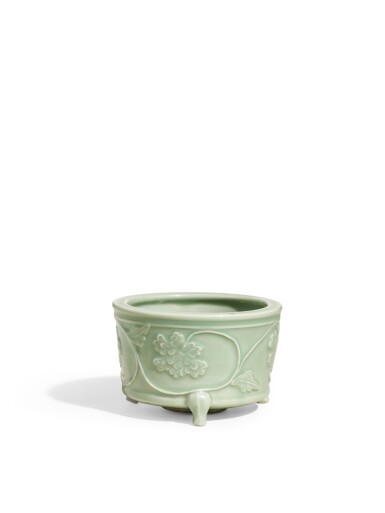
An heirloom Longquan celadon 'peony' tripod incense burner, Southern Song – Yuan dynasty | 南宋至元 龍泉青釉貼纏枝牡丹紋奩式爐
Session begins in
September 4, 06:00 AM GMT
Estimate
300,000 - 600,000 HKD
Lot Details
Description
Japanese metal cover made by Tsukada Shukyo (塚田秀鏡, 1848–1918), and double wood box with inscription by Koyama Fujio (小山富士夫, 1900–1975)
w. 13.8 cm
Robed in an unctuous sea-blue celadon glaze with a luminous surface, the present incense burner is a fine example of a much-loved Longquan design. Made at the height of celadon production in the 13th century, it possesses all the features most desirable for a piece of this type: sturdily potted yet gracefully poised atop three small bulbous feet, enlivened by crisp moulded ornament under a generously applied glaze. The body is decorated with raised ribs and a peony scroll design, with four sprig-moulded blossoms joined by stems of trailed slip.
Incense burners of this type were made in both the Song and Yuan dynasties. Similar examples have been excavated from Song layers at Quanzhou, Fujian, the main overseas trade port of the time; see Quanzhou Waixiao Ci Chenlieguan, Museum of Overseas Communication History, Quanzhou, p. 8, bottom left; and from a Yuan tomb at Quanzhou, illustrated in Longquan Qingci, Beijing, 1966, pl. 23, bottom. An heirloom example from the collection of Mr Hirota Matsushige is preserved at the Tokyo National Museum (acc. no. TG‑2481).
Longquan wares were especially prized in Japan. Their glazes were admired for a jade-like, blue-green colour that Japanese connoisseurs described with terms such as kinuta (“mallet”) for the most admired Song blue-green tones. These wares arrived through trade and were incorporated into elite tea culture, where they were treasured as prestigious tea-ceremony vessels and displayed in collections.
You May Also Like


