
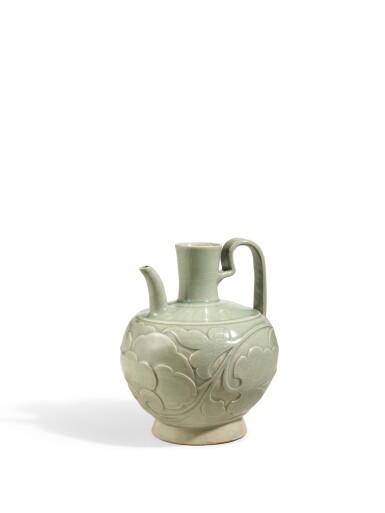
A finely carved Yaozhou celadon 'peony' ewer, Five Dynasties – Northern Song dynasty | 五代至北宋 耀州青釉刻纏枝牡丹紋執壺
Session begins in
September 4, 02:00 AM GMT
Estimate
300,000 - 600,000 HKD
Lot Details
Description
Japanese wood box
h. 19.5 cm
Uragami Sokyu-do Co., Ltd, Tokyo.
The International Asian Art Fair, New York, 2002.
The 30th Anniversary of Uragami Sokyu-do, Uragami Sokyu-do Co., Ltd, Tokyo, 2009, p. 113.
Uragami Mitsuru, Kobijutsusho ni manabu Chugoku Chosentoji no Mikata Erabikata [A Dealer's Eyes: Appreciating and Collecting Chinese and Korean Ceramics], Kyoto, 2011, p. 91.
來源
浦上蒼穹堂,東京
展覽
《The International Asian Art Fair》,紐約,2002年
出版
《浦上蒼穹堂30周年記念》,浦上蒼穹堂,東京,2009年,頁113
浦上満,《古美術商にまなぶ中国.朝鮮古陶磁の見かた、選びかた》,京都,2011年,頁91
Likely made during the early development of the Yaozhou celadon production, this exceptional ewer, remarkably potted and carved, belongs to a rare group of northern celadons inspired by Tang dynasty metalwork.
The Yaozhou kilns at Huangpu, southwest of Tongchuan city in Shaanxi province, which had gained renown through their pale green vessels with deep, large-scale carving in the Five Dynasties period (907-960), became China’s major suppliers of high-quality celadon wares in the Northern Song dynasty (960-1127). While production of bowls and dishes with incised or moulded designs was executed on a vast scale, a small number of vessels in other shapes, such as the current ewer, received particular attention.
A closely related covered ewer, excavated in 1972 from the Huangbaozhen kiln site in Tongchuan County, Shaanxi province, and now preserved in the Yaozhou Ware Museum, was included in The Masterpieces of Yaozhou Ware, Osaka, 1997, cat. no. 142. Two further comparable ewers, both lacking their original covers, are illustrated in Kanzo Meihin Sen / Selected Masterpieces from the Idemitsu Collection, vol. 3, Tokyo, 1996, pl. 102, and Regina Krahl, Chinese Ceramics from the Meiyintang Collection, vol. III (II), London, 2006, no. 1472.
For other related Yaozhou celadon ewers, compare a double-spouted example from the Charles Bain Hoyt Collection, now preserved in the Museum of Fine Arts, Boston, accession no. 50.2009, another with a double spout in the form of two phoenix from the Ernest Grandidier Collection and now housed in the Musée Guimet, Paris, accession no. G 5119, and another with a singular lion-shaped spout in the Cleveland Museum of Art, accession no. 1948.220.
此件執壺造工精湛,刻花生動,應製於耀州青瓷發展初期,屬於一類受唐代金銀器啟發而製的珍罕北方青瓷。耀州窰位於陝西省銅川市西南的黃堡鎮,在五代時期(907-960年)以其淡青釉及深剔大膽的刻花器物而聲名鵲起,至北宋時期(960-1127年)更成為中國高品質青瓷的主要產地。雖然當時大量生產帶有刻劃或印花紋飾的盌盤,但如本品這類其他器型的少數器皿,則顯然經過更為精心的製作與關注。
一件極為相近的帶蓋執壺,1972年出土於陝西省銅川市黃堡鎮窰址,現藏於耀州窰博物館,曾收錄於《耀州窯の名品》,大阪,1997年,圖錄編號142。另有兩件缺蓋的相近執壺可資比較,分別著錄於《館藏名品選 / 出光美術館藏品圖錄》第3卷,東京,1996年,圖版102,以及康蕊君著,《玫茵堂中國陶瓷》第3(2)卷,倫敦,2006年,編號1472。
其他相關的耀州窰青釉執壺,可參考 Charles Bain Hoyt 舊藏一件雙流執壺,現藏於波士頓美術館(館藏編號50.2009);Ernest Grandidier 舊藏一件雙鳳流執壺,現藏於巴黎吉美博物館(館藏編號G 5119);以及克利夫蘭藝術博物館藏一件單獅流執壺(館藏編號1948.220)。
You May Also Like


