
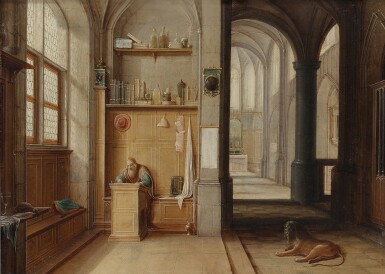
Bibliotheca Brookeriana: Property From the Collection of T. Kimball Brooker
Hendrik van Steenwijck the Younger
Saint Jerome in his Study
Live auction begins on:
February 6, 03:00 PM GMT
Estimate
40,000 - 60,000 USD
Bid
40,000 USD
Lot Details
Description
Bibliotheca Brookeriana: Property From the Collection of T. Kimball Brooker
Hendrik van Steenwijck the Younger
Antwerp 1580 - circa 1640 Leiden
Saint Jerome in his Study
signed and dated lower left on bench: H.V.S. / 1625
oil on copper
copper: 8 by 11 ¾ in.; 20.3 by 29.8 cm
framed: 11 ½ by 14 ¾ in.; 29.2 by 37.5 cm
Possibly Schönborn-Buchheim collection, Vienna;
Arthur Morrison (1863-1945);
By whose estate anonymously sold, London, Sotheby's, 6 March 1946, lot 152;
Where acquired by "K. Mosley," for £232;
Private collection;
By whom anonymously sold ("Various Properties"), London, Sotheby's, 15 June 1983, lot 145;
Where acquired by Galerie Nissl, Eschen, Liechtenstein;
With Galerie Sanct Lucas, Vienna;
From whom acquired by Ian Woodner (1903-1990), Cambridge, Massachusetts, 1984;
Thence by descent within the family until sold ("The Property of the Woodner Family Collection"), New York, Christie's, 16 January 16, 1992, lot 10;
Where acquired by Otto Naumann, New York;
From whom acquired by the present collector.
London, Tate Gallery, 1930, no. 78.
Gemälde alter meister, exhibition catalogue, Vienna 1983, n.p., cat. no. 6, reproduced;
J. Howarth, The Steenwyck Family as Masters of Perspective, Turnhout 2009, p. 236, cat. no. II.D7, reproduced p. 511.
Signed and dated 1625, this intimate painting on copper depicts Saint Jerome seated at his desk within a carefully articulated architectural setting. The work belongs to a group of small cabinet pictures produced by Hendrik van Steenwijck the Younger during his years in London, where he worked for the court of Charles I and collaborated with Anthony van Dyck, supplying architectural settings for the latter’s compositions. The painting exemplifies the perspectival precision and atmospheric clarity that made Steenwijck’s diminutive coppers especially prized by wealthy connoisseurs in the early seventeenth century.
Jerome appears absorbed in his work, situated within a paneled niche whose shelves contain books and scholarly objects that allude to his intellectual pursuits, most notably his translation of the Bible into the Latin Vulgate. At right, a lion, the saint’s traditional attribute, rests on the floor at right before a sequence of receding Gothic chapels. Steenwijck’s refined orchestration of space and light reflects his deep affinity for architectural interiors, likely inherited from his father, the architectural painter Hendrick Steenwijck the Elder, and may draw inspiration from monumental ecclesiastical spaces such as Antwerp Cathedral.
You May Also Like


